
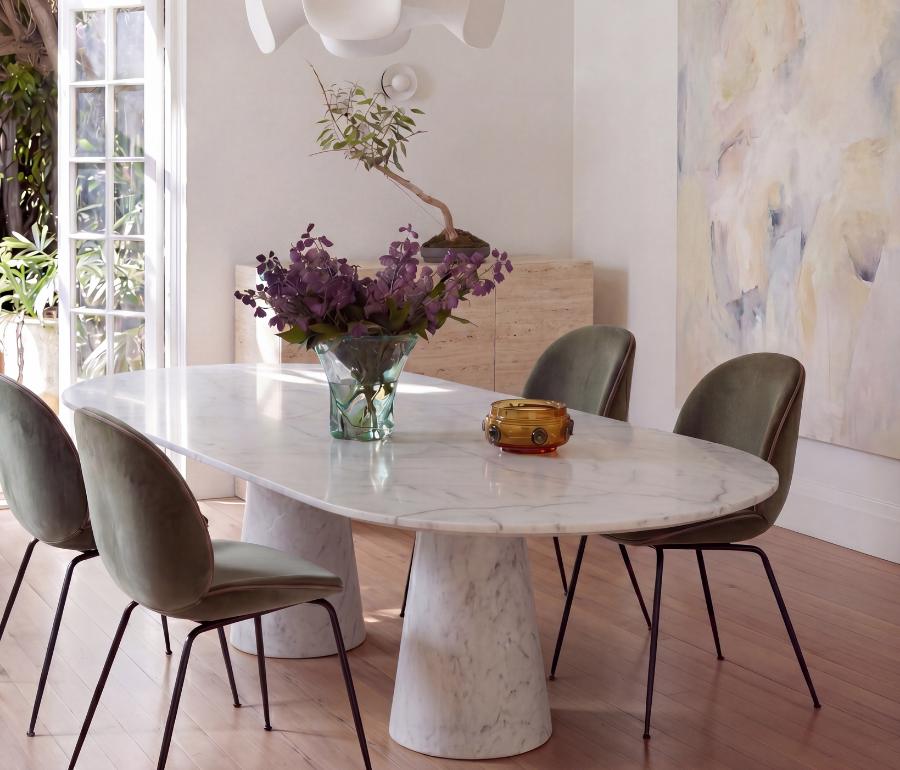
A marble dining table is more than a functional surface placed at the center of a dining area. Its color, natural veining, surface finish, proportions, and base design can define the atmosphere of the entire room. For this reason, choosing a marble dining table requires more than selecting an attractive model from a catalog.
Calacatta marble, Rosso Levanto marble, Muğla Calacatta marble, and Italian Carrara marble can create completely different results even when used in the same table shape. A light Calacatta marble table may make a dining area feel brighter and more open, while a Rosso Levanto table can introduce a rich burgundy focal point with a stronger architectural presence.
The dimensions of the table, the form of the top, the position of the base, and the surface finish are just as important as the type of marble. A table may look impressive in photographs but feel uncomfortable in daily use when its scale does not match the room or when the base restricts chair placement.
A successful marble dining table should respond to the size of the interior, the number of users, the surrounding materials, and everyday dining habits. The following eight considerations provide a practical framework for selecting a table that works both visually and functionally.
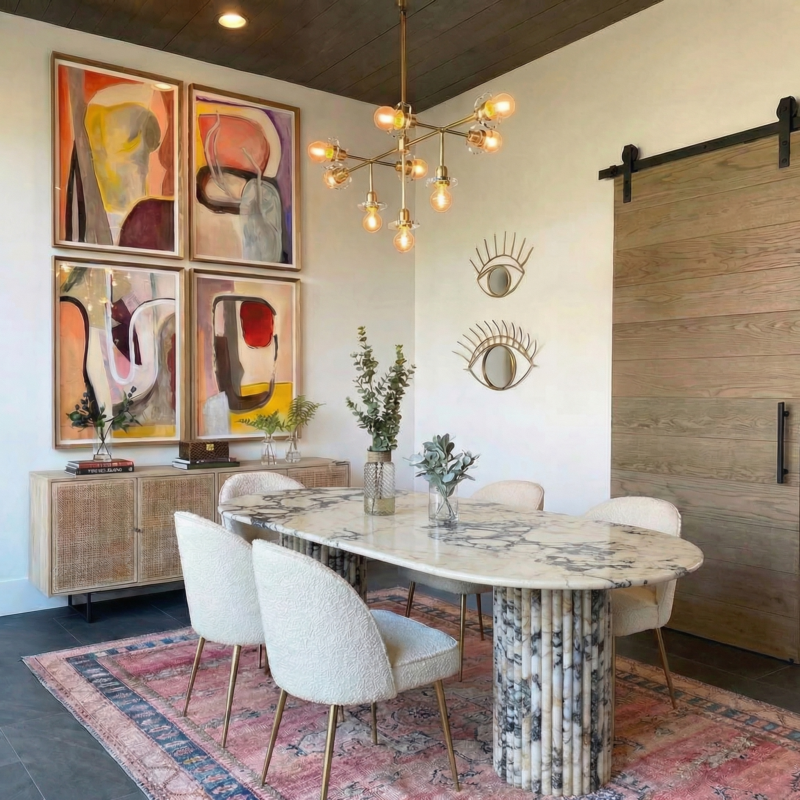
Calacatta Marble Dining Table with Fluted Natural Stone Bases
1. Study the Visual Character of the Marble
The first step in choosing a marble dining table is selecting the natural stone itself. Every marble variety has a distinctive base color, vein pattern, contrast level, and visual movement. These qualities determine whether the table will appear calm, dramatic, understated, or highly decorative within the room.
Calacatta marble is recognized for its light background and pronounced gray veining. On large dining surfaces, these veins become an important part of the furniture design. An oval or wide rectangular tabletop provides enough space for the natural pattern to remain visible and expressive.
Rosso Levanto marble has a deeper and more dramatic appearance. Its burgundy and dark red background is crossed by white and pale mineral lines, giving the stone a powerful visual identity. It works particularly well in dining spaces with neutral upholstery, warm woods, brass details, or restrained wall finishes.
Muğla Calacatta marble offers a light and balanced appearance with white and pale gray movement. Its surface can feel bright without appearing flat, making it suitable for both minimalist and more decorative interiors.
Italian Carrara marble generally features softer gray veining distributed across a white or light gray background. Its quieter pattern makes it easy to combine with timber, metal, glass, and neutral fabrics.
The Actual Slab Matters as Much as the Stone Name
Natural stone is never completely uniform. Two slabs from the same marble selection may vary in vein direction, color tone, contrast, and mineral distribution. For that reason, a decision should not be based only on the commercial stone name or a sample photograph.
Whenever possible, the actual slab intended for production should be reviewed before cutting. This allows the design team to study how the veins will appear across the tabletop and which section of the slab best suits the selected table shape.
On a long dining table, veins running lengthwise can create a more continuous and flowing composition. Concentrated veining near the center can produce a stronger focal point. A quieter area of the slab may be more suitable when the surrounding interior already includes patterned rugs, artwork, or decorative wall treatments.
Expert Insight: For large marble dining tables, slab selection should not be based on color alone. Vein direction, table shape, cut placement, and base position should be considered together so that the most characteristic areas of the stone appear in a balanced way.
Match the Stone to the Visual Intensity of the Room
A dining area with patterned textiles, expressive lighting, decorative wall panels, or colorful artwork may benefit from a more restrained marble selection. Highly active veining can compete with these elements and make the room feel visually crowded.
In a simpler interior, a strongly veined Calacatta or richly colored Rosso Levanto marble can perform as the primary decorative feature. The natural stone then becomes the focal point without requiring additional ornament.
2. Determine the Table Size According to the Room
One of the most common mistakes when selecting a marble dining table is focusing only on the number of seats. The actual comfort of the table depends not only on its dimensions, but also on chair movement, circulation space, and the position of nearby furniture.
A table that is too large can restrict movement and make a dining area feel smaller than it is. A table that is too small may look visually weak in a spacious room and may not provide enough seating or serving space.
The following factors should be reviewed together:
- The number of regular users
- How often guests are entertained
- Chair width and armrest design
- Clearance between the table and walls
- Main circulation paths
- The position of sideboards, cabinets, and other furniture
- The center point of the pendant light
How Much Clearance Should Be Left Around the Table?
There should be enough space for chairs to be pulled back comfortably. In busy circulation areas, it is also important to allow another person to pass behind a seated guest.
Oval and rounded tables can be especially useful in compact interiors because they remove sharp corners from circulation routes. In open-plan homes, the table can also act as a visual divider between the kitchen and living area, so its direction should align with the overall floor plan.
Approximate Dining Table Dimensions
The following measurements can be used as general starting points. Final dimensions should always be adjusted according to chair width, base placement, and room layout.
| Seating Capacity | Approximate Rectangular or Oval Table Size |
|---|---|
| 4 People | 120–140 × 80–90 cm |
| 6 People | 160–180 × 90–100 cm |
| 8 People | 200–240 × 95–110 cm |
| 10 People | 260–300 × 100–120 cm |
For round tables, the required diameter increases with seating capacity. While a compact round table may work well for four people, very large round tables can make the center difficult to reach.
Why Custom Dimensions Are Valuable
Standard furniture sizes do not suit every interior. Long, narrow, compact, or asymmetrical dining areas often benefit from project-specific production.
A custom marble dining table can be designed around the actual room dimensions, chair type, desired seating capacity, edge profile, and base position. The table then becomes part of the architectural layout rather than an object that has simply been placed into the room.
Efesus Home evaluates the marble selection, tabletop dimensions, shape, and base design together in custom furniture projects. This approach helps create a more balanced relationship between the table and its surroundings.
3. Choose the Table Shape According to the Floor Plan
The shape of a marble dining table affects circulation, seating arrangement, and the perceived scale of the room. Rectangular, oval, round, and square tables each respond differently to interior layouts.
Rectangular dining tables work particularly well in long rooms and open-plan living spaces. They provide an orderly seating arrangement and can be extended in size for six, eight, or ten users.
Oval dining tables combine the surface area of a rectangular table with softer edges. Their curved form can improve circulation and reduce the impact of corners in narrow spaces.
Round tables create a more conversational arrangement because guests can see one another more easily. They are often suitable for square or compact dining zones. However, increasing the diameter for larger groups can make the middle of the table difficult to reach.
Square tables create a strong geometric composition in four-person dining areas. Larger square tables require substantial floor space and may not be practical in narrow rooms.
When Is a Rectangular Marble Table Appropriate?
Rectangular tables establish a clear direction within long interiors. They can also help define a dining zone in an open-plan kitchen and living space.
Vein direction becomes especially important on this shape. Longitudinal veining can emphasize the length of the table, while crosswise movement creates a more rhythmic and graphic appearance.
Why Do Oval Marble Tables Feel Softer?
Oval tables balance the straight architectural lines of walls, cabinetry, rugs, and flooring. Their curved edges introduce a more organic transition within interiors dominated by rectangular elements.
Strongly veined Calacatta marble often appears especially fluid on an oval top because the natural pattern is framed by continuous curves rather than interrupted by corners.
Rosso Levanto marble also benefits from an oval format. The rounded silhouette can soften the intensity of its burgundy color while maintaining a sculptural presence.
Coordinate the Table Shape with the Lighting
The pendant or chandelier above the dining table should relate to the size and form of the tabletop. Linear fixtures work well over long rectangular tables, while a central pendant may suit a round table.
Oval tables can support either linear or softly rounded lighting, depending on their proportions. When ordering a custom table, the existing ceiling point should be included in the measurements so that the table and light remain properly aligned.
4. Coordinate the Marble Color and Veining with the Interior
Because a dining tabletop occupies a large visual area, its color plays an important role in the room’s overall palette. The marble should be considered alongside flooring, walls, chairs, rugs, lighting, and nearby furniture.
Light-colored marble can reflect natural light and make a dining area appear more open. Calacatta, Muğla Calacatta, and Italian Carrara marble coordinate easily with white, cream, beige, pale gray, and natural wood tones.
Darker marble creates a stronger visual weight. Rosso Levanto, with its burgundy background, can become the defining element of the room. Its surrounding colors should support the stone rather than compete with it.
The amount of natural light also matters. A dark table may feel visually heavy in a small, dim room, while the same stone can create a balanced focal point in a spacious interior with large windows.
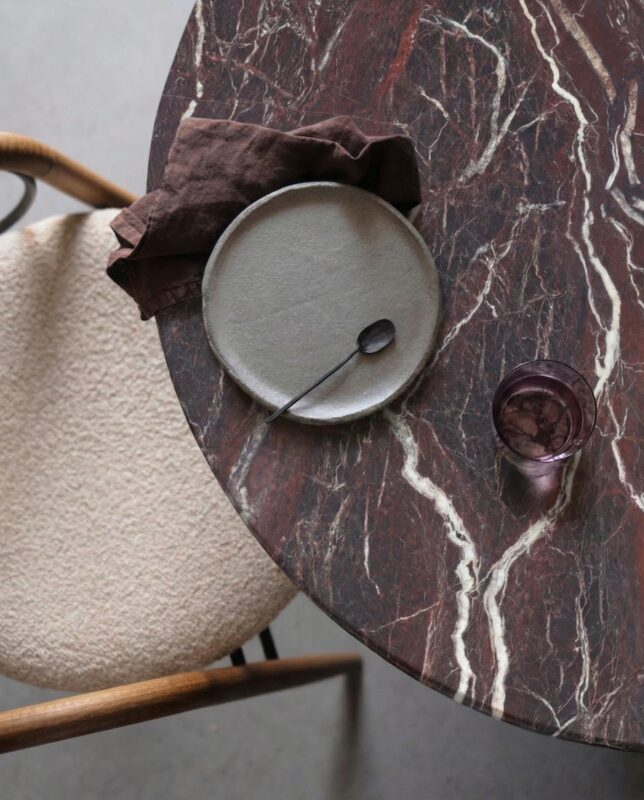
Rosso Levanto Marble Oval Dining Table and Natural Veining
Colors That Work with Calacatta Marble
Calacatta marble pairs naturally with neutral upholstery, pale timber, dark wood, black metal, smoked glass, brass, and bronze.
When the slab has bold veining, restrained textiles and simple wall finishes allow the marble to remain the principal feature.
How to Balance Rosso Levanto Marble
Rosso Levanto works well with off-white, cream, warm gray, beige, and natural timber. Brass or bronze accents can complement its rich color without overwhelming the composition.
There is no need to repeat burgundy throughout the entire room. Small references in artwork, textiles, or decorative objects are usually enough to connect the table with the broader palette.
The Interior Effect of Muğla Calacatta Marble
Muğla Calacatta marble offers the brightness of white stone with enough natural movement to avoid appearing plain. It pairs well with oak, linen upholstery, textured plaster, and matte metal finishes.
When used with fluted stone bases, the table gains additional depth and a more architectural character.
Why Italian Carrara Marble Is Easy to Coordinate
Italian Carrara marble usually has finer and more evenly distributed gray veining. This makes it flexible across minimalist, Scandinavian, contemporary, transitional, and classic interiors.
Its quieter surface also allows stronger patterns to be introduced through rugs, curtains, artwork, or upholstered seating.
How Should Vein Intensity Be Selected?
Wide, high-contrast veins produce a dramatic appearance, while finer veins create a quieter and more consistent surface.
If the dining area already includes statement lighting, a patterned wall, or expressive artwork, a calmer slab may provide better balance. In a neutral room, a strongly veined marble can become the main visual feature.
The dimensions of the tabletop also affect how the veins are perceived. Large veins may appear fragmented on a small surface but can read clearly across a broad eight- or ten-person table.
Expert Insight: A small sample shows the stone’s color but not the true scale of its veining. For a large dining table, reviewing the full slab and marking the intended cut area provides a far more accurate understanding of the finished result.
Marble Types and Interior Styles
| Marble Type | Visual Character | Suitable Interior Styles |
|---|---|---|
| Calacatta Marble | White background with bold gray veining | Modern, contemporary, classic, Art Deco |
| Rosso Levanto Marble | Burgundy background with pale veining | Art Deco, eclectic, classic, maximalist |
| Muğla Calacatta Marble | Light background with balanced gray movement | Modern, minimalist, transitional, organic modern |
| Italian Carrara Marble | Soft gray-white background with fine veining | Minimalist, Scandinavian, classic, contemporary |
These combinations are not strict rules. The same stone can be adapted to different interiors through the table shape, edge detail, finish, and choice of surrounding materials.
5. Select the Surface Finish According to Daily Use
The finish of a marble dining table affects both its appearance and how it feels in everyday use. The same stone can look noticeably different when polished or honed.
A polished finish reflects more light and strengthens the appearance of color and veining. It can give Calacatta marble a crisp, decorative look and deepen the burgundy tones of Rosso Levanto.
A honed finish is more matte and subdued. It reduces reflections and gives the stone a softer, more natural presence. Honed finishes often work well in organic modern and minimalist interiors.
The decision should also account for how frequently the table will be used and how much maintenance the household is prepared to manage.
Who May Prefer a Polished Marble Table?
A polished surface is suitable for users who want the stone’s color and veins to appear highly defined. It can look especially effective in bright dining spaces.
However, fingerprints, water marks, and surface residue may be more visible on a glossy finish, so regular cleaning is important.
Where Does Honed Marble Work Best?
Honed marble suits interiors that favor matte textures, natural timber, linen, plaster, and restrained metal finishes.
Italian Carrara and Muğla Calacatta can appear particularly calm and balanced with a honed surface.
Does Sealing Make Maintenance Easier?
A suitable penetrating sealer can slow the absorption of liquids into the stone. It does not make marble completely stain-proof or maintenance-free.
Spills should still be cleaned promptly, especially when they contain lemon, vinegar, wine, oil, or other acidic or strongly colored substances.
Coasters, placemats, trivets, and cleaning products intended for natural stone can help preserve the surface.
6. Consider Top Thickness and Edge Profile Together
The perceived thickness of the tabletop has a major influence on the overall design. A thin top appears lighter and more minimal, while a thick edge creates a more substantial and sculptural presence.
The visual thickness does not always need to equal the full thickness of the stone. A mitered edge can create the appearance of a thicker slab while allowing the technical structure to be designed more efficiently.
Straight Edge
A straight edge creates a clean and precise appearance. It is often used on modern rectangular and square dining tables.
The corners should still be finished carefully so that they are not uncomfortably sharp during daily use.
Lightly Beveled Edge
A subtle bevel softens the edge while maintaining a contemporary line. The width of the bevel should be proportionate to the tabletop thickness and overall design.
Rounded or Eased Edge
Rounded edges complement oval and round dining tables. They create a softer tactile quality and may be preferable in homes with young children.
Bullnose Edge
A bullnose profile creates a more visible curve and decorative shadow line. It can suit classic, transitional, and more detailed furniture designs.
Mitered Thick-Looking Edge
Mitered edges make the tabletop appear thicker and more monolithic. On strongly veined marble, the pattern should be carefully aligned around the edge so that the joint remains visually controlled.
Expert Insight: Edge profiles should not be selected in isolation. The tabletop shape, marble veining, base design, and architectural language of the room should all inform the final detail.
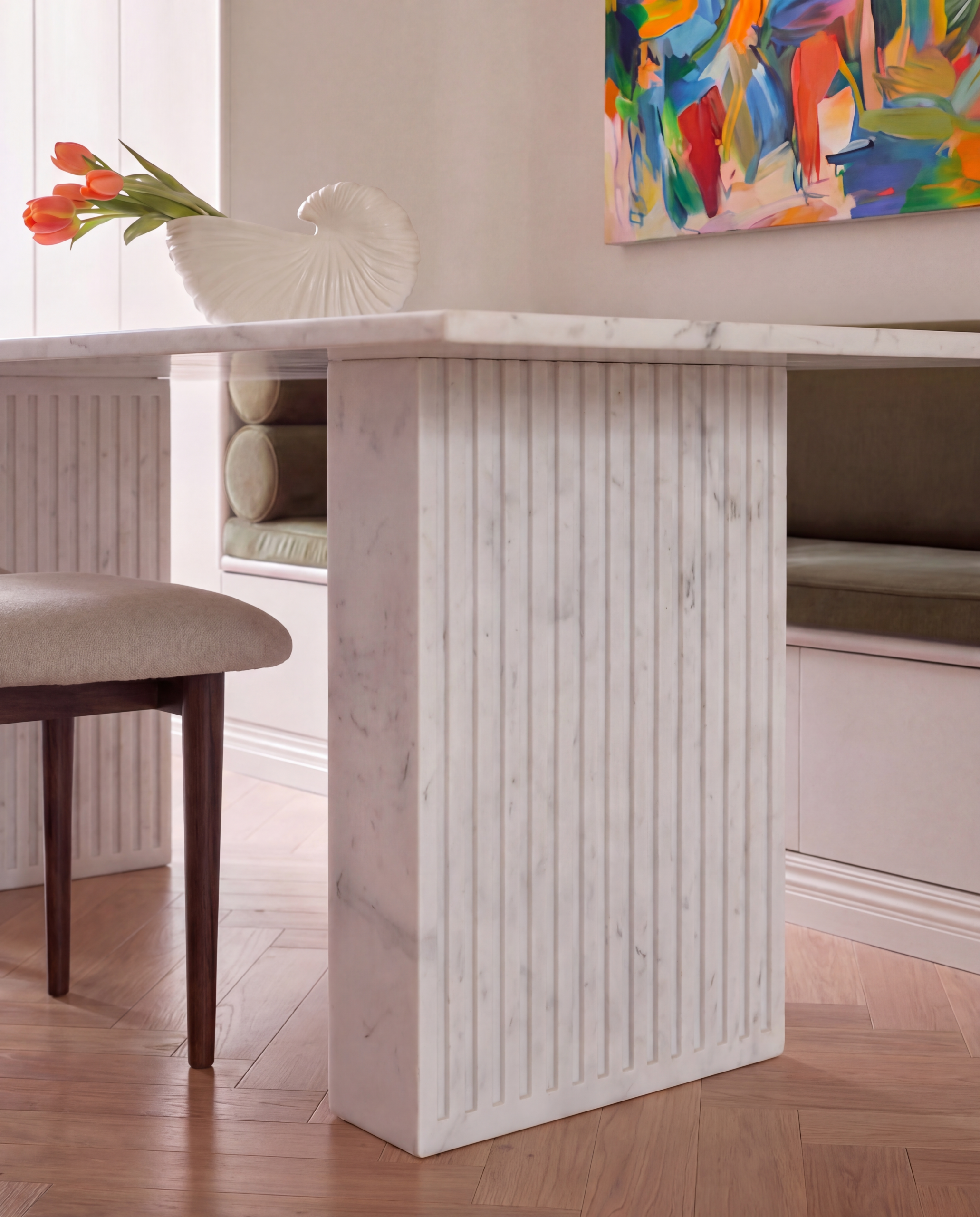
Muğla Calacatta Marble Dining Table with Fluted Stone Base Detail
Marble Dining Table Size Guide
The amount of space allocated to each user depends on chair width, armrests, base placement, and serving requirements. As a general guide, approximately 55–65 cm of table edge may be planned per person.
Four-Person Marble Dining Table
A rectangular or oval four-person table may begin at approximately 120–140 cm long and 80–90 cm wide.
For round designs, a diameter of approximately 100–120 cm may suit four users, depending on chair dimensions.
Six-Person Marble Dining Table
A six-person table is often designed at approximately 160–180 cm long and 90–100 cm wide.
The base should be positioned so that the chairs at both ends can be used comfortably.
Eight-Person Marble Dining Table
An eight-person table may measure approximately 200–240 cm long and 95–110 cm wide.
At this scale, the weight of the marble top and the balance of the support structure become especially important.
Ten-Person Marble Dining Table
A ten-person table may require approximately 260–300 cm in length and 100–120 cm in width.
Large-format tops also require careful slab selection, vein planning, transportation, and installation.
| Seating Capacity | Approximate Length | Approximate Width |
|---|---|---|
| 4 People | 120–140 cm | 80–90 cm |
| 6 People | 160–180 cm | 90–100 cm |
| 8 People | 200–240 cm | 95–110 cm |
| 10 People | 260–300 cm | 100–120 cm |
These measurements are general guidelines. The final dimensions should respond to the interior, chairs, table base, and daily use requirements.
Five Common Mistakes When Choosing a Marble Dining Table
1. Choosing from a Product Photograph Alone
Every natural stone slab is different. A catalog image may not match the exact color and vein distribution of the slab selected for production.
2. Ordering Without Measuring the Room
Choosing a table only according to seating capacity can create circulation problems. Chair movement and nearby furniture should also be measured.
3. Ignoring the Relationship Between the Base and Chairs
An attractive base can still reduce comfort when it conflicts with seating positions or knee space.
4. Overlooking Vein Direction and Cut Planning
The veins should be deliberately positioned according to the tabletop shape and size rather than treated as a random feature.
5. Purchasing Without Understanding Maintenance
Marble requires appropriate care. Acidic products, abrasive cleaners, and liquids left on the surface can affect its appearance.
7. Review the Base Design, Position, and Structural Support
The base is both a design feature and the structural support for the marble top. It should carry the weight safely, maintain stability, and allow comfortable chair placement.
Natural stone bases can include cylinders, fluted columns, geometric blocks, or sculptural pedestal forms. Their scale should remain proportionate to the top.
A base that is too large may reduce legroom, while a base that appears too light may not visually or technically support a large marble surface.
Central Pedestal Bases
Central bases provide flexible chair placement, particularly on round and oval tables. The width of the upper section should not prevent users from moving their chairs close to the tabletop.
Large oval or extended tabletops may require two pedestals or additional internal reinforcement.
Double-Pedestal Designs
Double-pedestal bases are often suitable for long rectangular or oval tables. They distribute the weight across two support points.
The exact position should allow seating at the ends while preserving the balance of the tabletop.
The Effect of Fluted Marble Bases
Fluting introduces rhythm, shadow, and depth to the stone. Vertical grooves can make the base appear taller and more refined.
On light Calacatta or Muğla Calacatta marble, the fluting creates subtle shadows. On Rosso Levanto, the same detail appears stronger and more dramatic.
Concealed Metal Support Systems
Some marble tables use hidden metal reinforcement inside the stone base or beneath the top. This can provide additional stability without interrupting the visual continuity of the design.
Expert Insight: A marble table base should never be developed through appearance alone. Top weight, overall length, seating positions, connection details, and floor conditions should be reviewed as part of the same technical design.
8. Understand Maintenance and Everyday Use
Marble is a durable natural material, but its porous structure makes it sensitive to certain liquids, acids, and abrasive cleaning products.
With suitable maintenance, a marble dining table can remain in use for many years. However, users should understand that natural stone may develop subtle signs of use over time.
Contact with Acidic Products
Lemon, vinegar, some fruit juices, and acidic cleaning products may etch the surface and create dull areas.
Spills should be blotted and cleaned promptly rather than spread across the tabletop.
Oils and Colored Beverages
Olive oil, sauces, coffee, tea, and wine may penetrate the surface when left for long periods. A suitable sealer can slow absorption, but rapid cleaning remains essential.
Hot Serving Items
Although marble is naturally heat-resistant, very hot cookware should not be placed directly on the surface. Trivets and protective mats are recommended.
Suitable Cleaning Products
A soft cloth, warm water, and a pH-neutral cleaner intended for natural stone are generally appropriate for everyday cleaning.
Abrasive powders, harsh chemicals, and rough sponges should be avoided.
Renewing the Protective Treatment
The frequency of resealing depends on the marble, finish, level of use, and type of protective product. There is no single schedule suitable for every table.
When the surface begins absorbing liquid more quickly, the protective treatment may need to be reviewed by a natural stone specialist.
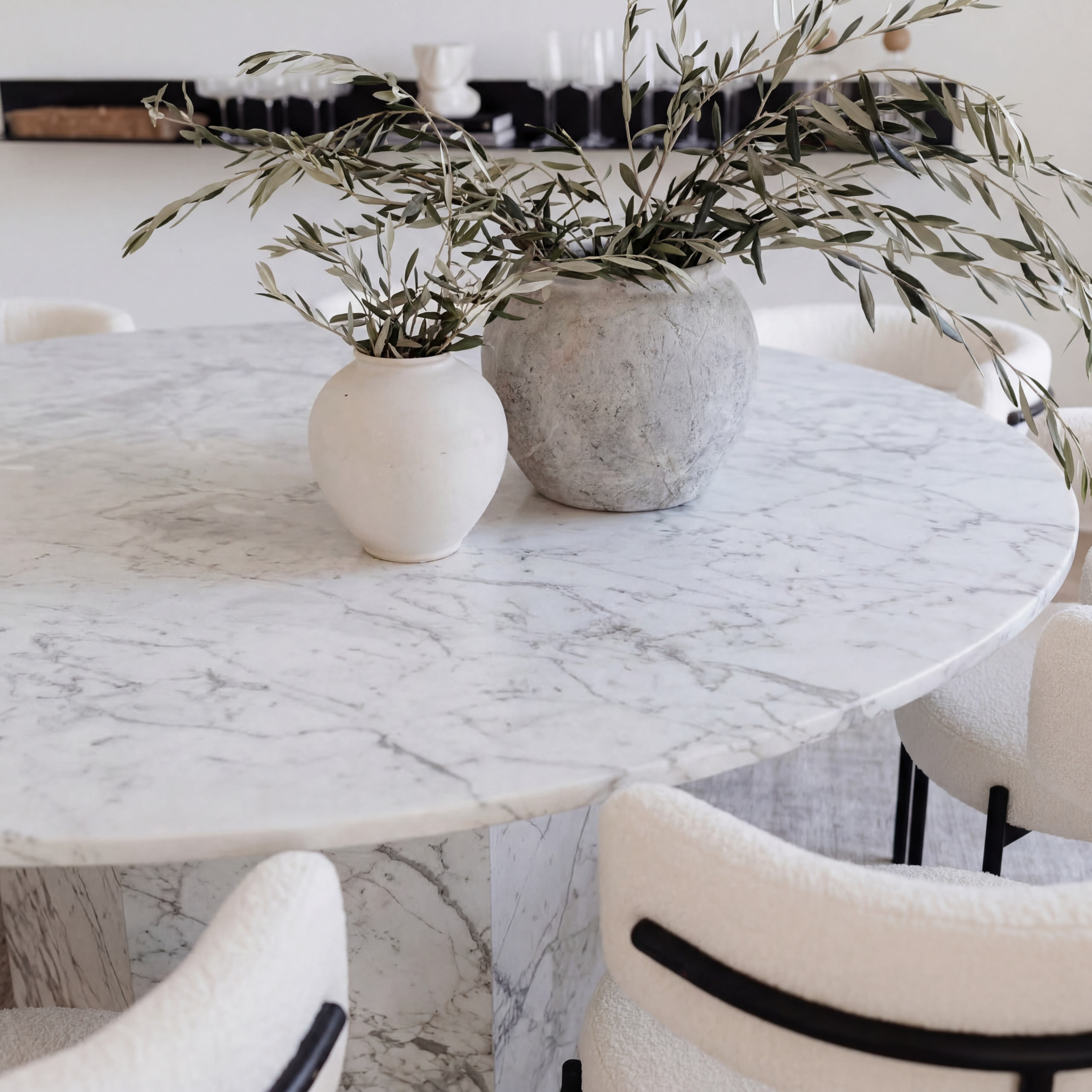
Italian Carrara Marble Oval Dining Table with Natural Veining
Marble or Travertine: A Brief Dining Table Comparison
Marble and travertine are both natural stones used in dining table design, but they create different visual and tactile effects.
| Feature | Marble Dining Table | Travertine Dining Table |
|---|---|---|
| Visual Character | Distinct veining and varied colors | Layered, porous, and organic texture |
| Overall Atmosphere | Refined, decorative, sculptural | Warm, calm, and natural |
| Common Finishes | Polished, honed, and specialty finishes | Honed, filled, brushed, and textured |
| Suitable Styles | Modern, classic, Art Deco, contemporary | Organic modern, Mediterranean, minimalist, rustic |
| Color Range | White, gray, burgundy, black, green, brown | Beige, cream, walnut, gray, earth tones |
| Natural Pattern | Fine or dramatic veining | Linear, cloudy, or open-pore structure |
Marble can create a stronger focal point through expressive veining and color. Travertine offers a softer, warmer, and more textural presence.
The choice should respond to the overall interior rather than current popularity alone.
Marble Dining Table Design Directions for 2026
Sculptural Bases
Cylindrical, fluted, monolithic, and geometric natural stone bases are replacing simple support structures in many custom furniture projects.
Oval and Organic Shapes
Oval, capsule-shaped, and softly irregular tops bring smoother circulation and present natural veining in a more fluid way.
Thick-Looking Edges
Mitered edges continue to create a substantial block-like appearance, especially on large dining tables.
Colored Marble
White marble remains important, while burgundy, green, brown, and black stones are increasingly used as statement materials.
Single-Material Designs
Using the same marble for both the tabletop and base creates a monolithic and cohesive appearance.
Marble and Natural Timber
Wooden chairs, wall panels, and sideboards can warm the cooler visual character of marble and create a more balanced dining environment.
Which Marble Works with Which Interior Style?
Modern Interiors
Muğla Calacatta and Italian Carrara marble coordinate well with clean edges, black metal, pale timber, and neutral upholstery.
Minimalist Interiors
Fine-veined Carrara or calmer Muğla Calacatta slabs introduce natural variation without creating excessive visual movement.
Organic Modern Interiors
Oval tabletops, fluted stone bases, natural fabrics, and pale wood produce a softer architectural composition.
Art Deco Interiors
Rosso Levanto marble can be paired with brass, dark timber, velvet seating, and geometric forms.
Classic Interiors
Calacatta and Carrara marble work with decorative lighting, dark timber, and softer edge profiles.
Scandinavian Interiors
Carrara marble combines naturally with pale wood, light upholstery, and uncomplicated furniture forms.
Internal Linking Opportunities
This article can naturally connect to relevant Efesus Home product and content pages, including:
- Marble dining tables
- Travertine dining tables
- Marble coffee tables
- Natural stone console tables
- Marble side tables
- Custom natural stone furniture
- Marble kitchen islands
- Marble fireplace surrounds
In open-plan interiors, a marble dining table can be coordinated with a coffee table, side table, or console made from a related stone family. Similar colors and veining can create continuity between connected living areas.
Frequently Asked Questions
Is a marble dining table suitable for everyday use?
Yes. With an appropriate finish, suitable protection, and regular care, marble dining tables can be used daily.
Should I choose Calacatta or Carrara marble?
Calacatta generally has broader, more dramatic veins. Carrara usually has finer and more evenly distributed gray movement. The choice depends on the desired visual intensity.
Can Rosso Levanto marble be used in a small dining room?
Yes, but its dark burgundy color should be balanced with light seating, simple walls, and sufficient lighting.
Can a marble dining table stain?
Marble is porous, so some liquids can stain or etch the surface when left untreated. Sealing and prompt cleaning help reduce the risk.
Is polished or honed marble better?
Neither finish is universally better. Polished marble appears brighter and more reflective, while honed marble has a softer matte appearance.
Can marble dining tables be made to custom dimensions?
Yes. Length, width, height, shape, edge profile, and base design can all be adapted to the room and seating requirements.
What is the most practical marble table shape?
The best shape depends on the floor plan. Rectangular tables work well in long spaces, oval tables support smoother circulation, and round tables encourage conversation.
Are natural stone table bases safe?
Yes, when the dimensions, internal support, and connection details are engineered according to the weight and size of the top.
Is it important to view the actual marble slab?
Yes. A small sample shows color but not the full scale of the veins. Viewing the slab allows the cut layout to be planned more accurately.
Are marble tables suitable for homes with children?
They can be, especially when designed with rounded corners or softened edge profiles and used with appropriate care.
Choosing a marble dining table requires more than selecting a preferred stone or furniture shape. The marble color, vein intensity, dimensions, surface finish, edge profile, base placement, and maintenance requirements should be considered together.
The expressive veining of Calacatta marble, the burgundy depth of Rosso Levanto, the bright character of Muğla Calacatta, and the softer pattern of Italian Carrara each create a different dining environment.
Careful slab selection, custom sizing, and technically planned support systems increase both the visual quality and practical value of the finished furniture. Through Efesus Home’s custom production approach, marble dining tables can be developed as long-lasting design pieces that bring the individuality of natural stone into the center of everyday living.