
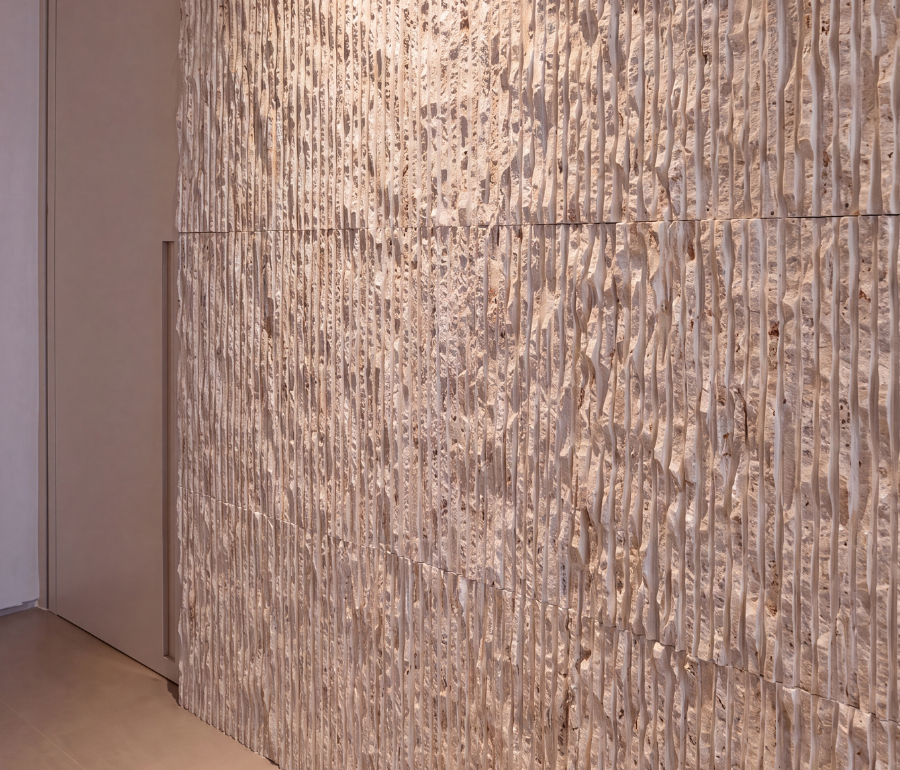
Natural stone wall décor is moving beyond smooth slabs and conventional cladding. In contemporary interiors, stone is incrasingly shaped into tactile architectural surfaces that interact with light, create visual rhythm, and give otherwise simple rooms a stronger identity.
Textured marble, travertine, and limestone walls introduce depth without depending on vivid paint colors, wallpaper patterns, or temporary decorative treatments. Their impact comes from the natural material itself: mineral variation, open pores, subtle tonal movement, carved lines, and changing shadows.
The result can feel quiet from a distance yet highly detailed when viewed closely.
A textured natural stone wall may define an entrance, frame a console, complete a dining room, enrich a hotel reception area, or transform a narrow corridor into a carefully designed architectural experience. Because the surface changes throughout the day, the wall never appears completely static. Direct daylight emphasizes deeper cuts and irregularities, while warm artificial lighting creates softer shadows and a more atmospheric appearance.
This guide explores three distinctive wall applications:
- Crema Bella Marble with a Dentelle surface
- Silver Travertine with a combed finish
- Bianco Crema Limestone with a Dentelle surface
Although all three examples use linear texture, each material creates a different visual result. Crema Bella Marble appears refined and sculptural. Silver Travertine develops a stronger horizontal architectural rhythm. Bianco Crema Limestone offers a softer, warmer surface that works especially well with timber and relaxed residential interiors.
Understanding these differences helps architects, interior designers, and homeowners choose a wall finish that supports the character of the space rather than treating natural stone as a purely decorative layer.
Why Natural Stone Wall Décor Has Such a Strong Architectural Effect
A wall occupies a large portion of the visual field. When that wall is treated with natural stone, it becomes more than a background for furniture. It begins to influence proportion, light, movement, and atmosphere throughout the room.
Smooth stone panels create elegance through color and veining. Textured stone adds another dimension: shadow.
Every groove, carved line, raised area, and natural pore responds differently to illumination. As the angle of light changes, some areas appear brighter while others become more pronounced. This allows a monochromatic wall to create considerable depth without introducing several unrelated materials.
Textured natural stone is particularly effective because it combines:
- Authentic mineral variation
- Handcrafted or mechanically produced surface relief
- Natural shadow lines
- Long-term architectural value
- Compatibility with warm and cool materials
- Custom panel dimensions
- Vertical or horizontal directional effects
- Unique variations from piece to piece
Unlike printed decorative panels, genuine stone does not repeat in a perfectly identical pattern. Even when panels share the same finish, their mineral structure and natural markings vary. This prevents large surfaces from appearing overly manufactured.
However, successful stone wall décor requires planning. Panel size, joint placement, texture direction, lighting position, stone selection, installation system, and surrounding furniture should be considered together.
Crema Bella Marble Dentelle Wall: A Sculptural Surface with Soft Warmth
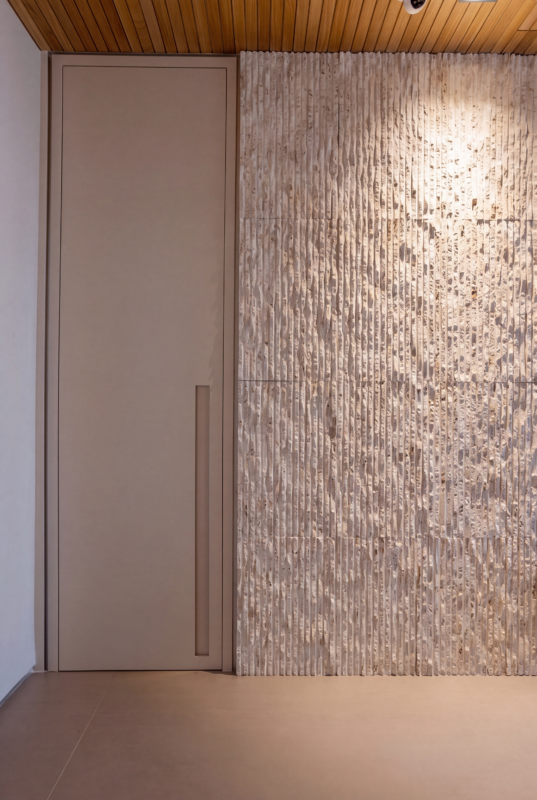
Crema Bella Marble Dentelle Wall with Vertical Textural Movement
Floor-to-ceiling Crema Bella Marble wall with a Dentelle finish and warm architectural lighting
Crema Bella Marble offers a warm neutral color palette that can include cream, beige, pale taupe, and subtle mineral variation. In a Dentelle wall application, these restrained tones allow the texture to become the main design feature.
The first image shows a tall wall covered with vertically textured Crema Bella Marble panels. Rather than relying on strong veining, the design creates impact through irregular relief and repeated vertical movement.
The wall feels architectural because the texture continues across a large surface. It is not treated as a small decorative insert. Extending the material from floor level toward the timber ceiling gives the stone sufficient scale to influence the entire space.
The vertical orientation also affects how the room is perceived. Long upward lines draw the eye toward the ceiling and can make the wall appear taller. This is especially useful in entrance halls, double-height spaces, stair zones, hotel corridors, and narrow transitional interiors.
How the Dentelle Surface Changes Crema Bella Marble
A smooth Crema Bella Marble panel would highlight its color and natural mineral movement. The Dentelle treatment adds a stronger tactile quality.
The surface includes variations in depth rather than a completely uniform repeated groove. This produces a more handcrafted and organic effect. Some areas capture direct light, while deeper sections remain in shadow.
The result is neither highly rustic nor perfectly geometric. It sits between the two, which makes it suitable for interiors that combine contemporary architecture with natural materials.
Materials That Complement Crema Bella Marble
The pictured installation is paired with a warm timber ceiling. This is a highly effective combination because both materials share soft beige and brown undertones.
Crema Bella Marble can also work well with:
- Oak
- Walnut
- Bronze
- Aged brass
- Warm white plaster
- Beige microcement
- Taupe upholstery
- Linen curtains
- Smoked glass
- Dark brown metal
- Soft indirect lighting
Using a limited palette allows the texture to remain prominent. If the surrounding room contains several strong patterns, the detail of the stone may become visually lost.
Suitable Applications
A Crema Bella Marble Dentelle wall may be considered for:
- Residential entrance halls
- Hotel reception areas
- Staircase walls
- Living room feature walls
- Dining areas
- Gallery-style corridors
- Private offices
- Boutique retail interiors
- Wellness and spa spaces
- Architectural niches
Because marble has greater visual richness than many uniform wall materials, the wall often requires only minimal furniture or artwork.
What Is a Dentelle Natural Stone Finish?
Dentelle is used here as a decorative surface model that creates irregular linear relief across natural stone panels. Its visual identity comes from repeated carved movement, changing depth, and the contrast between raised and recessed areas.
The finish is particularly effective on light-colored stones because shadows remain visible without making the wall appear excessively dark.
A Dentelle wall can look different depending on:
- The stone variety
- Panel dimensions
- Direction of the texture
- Depth and density of the carving
- Distance between the light source and wall
- Warm or cool lighting temperature
- Joint width
- Viewing distance
- Natural porosity of the stone
On marble, the result may appear more refined and sculptural. On limestone, the same model can feel softer, more artisanal, and closely connected to earthy interior palettes.
Dentelle should not be evaluated only through a small sample. A single piece shows the texture, but it does not fully communicate how repetition, panel joints, and lighting will affect an entire wall.
For larger projects, a mock-up or representative panel arrangement can help confirm:
- Texture direction
- Panel alignment
- Lighting response
- Joint visibility
- Overall color range
- Desired degree of variation
Silver Travertine Combed Wall: Horizontal Rhythm in a Contemporary Interior
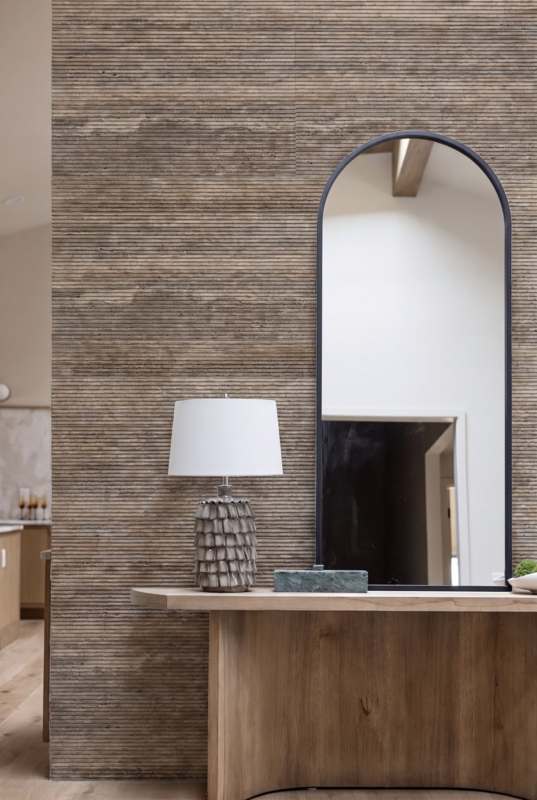
Combed Silver Travertine Wall Creating Horizontal Architectural Lines
Combed Silver Travertine feature wall with horizontal grooves behind a console and arched mirror
Silver Travertine has a naturally layered structure that includes gray, taupe, silver, beige, and occasionally brown mineral tones. When a combed finish is applied horizontally, the surface reinforces the stone’s geological direction and creates a strong architectural rhythm.
The second and third images show Silver Travertine used behind a timber console and tall arched mirror. The texture consists of narrow horizontal lines that continue across the wall panels.
This orientation creates a very different effect from the vertical Dentelle application. Instead of making the wall feel taller, the horizontal movement visually widens the composition and directs the eye across the room.
The result is structured but not rigid. The grooves create regularity, while the natural pores and tonal variations of travertine prevent the surface from feeling machine-perfect.
Why Silver Travertine Works Well with a Combed Finish
Travertine is defined by natural layers and pores. A combed surface does not hide these characteristics. Instead, it adds another controlled layer of texture.
Silver Travertine is particularly suitable for contemporary interiors because its palette connects easily with both warm and cool materials.
In the photographed space, the stone is combined with:
- Light natural timber
- A black-framed mirror
- Gray decorative objects
- White lighting
- Soft neutral walls
- Minimal accessories
The dark outline of the mirror creates a clean contrast with the textured wall, while the timber console prevents the composition from becoming too cold.
Using the Wall Behind a Console or Mirror
A textured wall behind a console is practical from a design perspective because the furniture creates a horizontal base while the mirror adds vertical height.
The stone becomes the connecting surface between the two.
To maintain balance:
- The console should not cover too much of the wall.
- The mirror frame should remain simple.
- Accessories should be limited in number.
- Decorative objects should vary in height.
- The wall texture should remain visible around the furniture.
- Lighting should emphasize the surface without producing harsh glare.
A wall like this does not require additional artwork. The natural stone already provides enough pattern and movement.
Suitable Applications for Combed Silver Travertine
Combed Silver Travertine may be used in:
- Entrance halls
- Console walls
- Living rooms
- Fireplace walls
- Hotel lobbies
- Reception areas
- Executive offices
- Restaurant interiors
- Elevator halls
- Feature columns
- Retail spaces
- Headboard walls
Horizontal combing works especially well on broad surfaces. On very narrow walls, the lines may need to be planned carefully so the panel layout does not appear overly fragmented.
Combed Finish or Fluted Finish: What Is the Difference?
The term combed finish is more appropriate for the Silver Travertine wall shown in these images.
Combing creates repeated shallow linear grooves across the face of the stone. The lines may be horizontal or vertical depending on the design.
A fluted stone surface generally uses deeper, more pronounced channels or rounded grooves and often creates a stronger three-dimensional profile.
Although the terms are sometimes used loosely in decorative design, they should not automatically be treated as identical.
A combed finish typically offers:
- Finer linear texture
- A more continuous surface
- Subtle shadow movement
- Strong directional rhythm
- Less projection from the wall
A deeply fluted finish often creates:
- Larger grooves
- More dramatic light and shadow
- A stronger sculptural profile
- Greater surface depth
- More pronounced repetition
For this blog and the pictured Silver Travertine application, combed Silver Travertine wall cladding is the most accurate description.
Bianco Crema Limestone Dentelle Wall: A Warm Background for Everyday Interiors
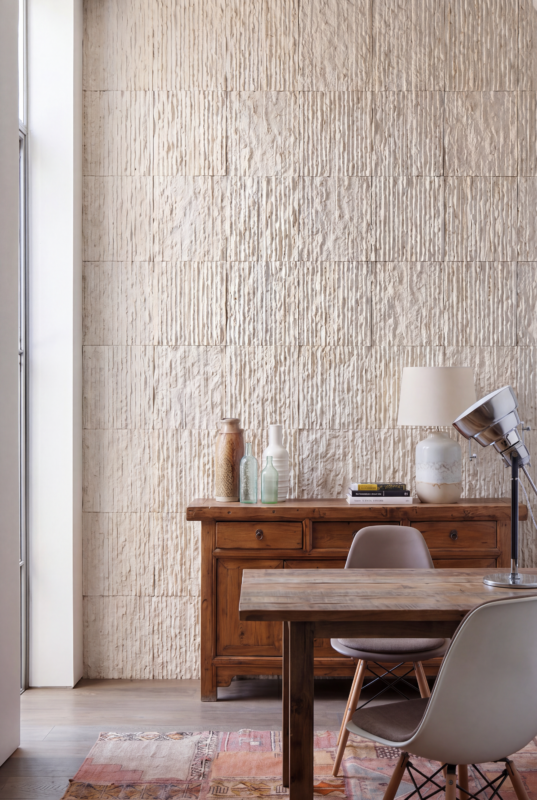
Bianco Crema Limestone Dentelle Wall in a Warm Residential Interior
Bianco Crema Limestone feature wall with a Dentelle texture behind timber furniture in a bright dining and work area
Bianco Crema Limestone has a pale cream character that creates a calmer and softer effect than strongly veined marble or dark-toned travertine.
The fourth and fifth images show the stone used as a full-height feature wall behind timber furniture in a bright residential setting. The Dentelle model introduces vertical relief, while the warm neutral color allows the wall to coordinate naturally with the rest of the room.
This example demonstrates that a textured stone wall does not have to feel formal or monumental. It can also support relaxed, lived-in interiors.
The wall is combined with:
- A timber dining or work table
- A traditional timber sideboard
- Mixed contemporary chairs
- A patterned rug
- White ceramic accessories
- A metal floor lamp
- Soft natural daylight
Despite the number of surrounding objects, the pale limestone wall holds the composition together. Its color remains quiet, while the carved texture adds architectural interest.
Why Limestone Creates a Softer Effect
Limestone generally has a quieter mineral structure than highly veined marble. This allows the surface treatment to be read more clearly.
On Bianco Crema Limestone, the Dentelle texture produces a tactile, almost hand-worked appearance. Small natural variations and pale tonal shifts prevent the wall from looking flat.
The material is particularly suited to interiors influenced by:
- Organic Modern design
- Mediterranean interiors
- Contemporary rustic style
- Warm minimalism
- Natural material palettes
- Relaxed residential architecture
- Modern farmhouse elements
- Japandi-inspired spaces
Vertical Texture and Room Proportion
The vertical movement of the Dentelle model helps visually lift the wall. In the pictured room, the feature surface draws attention upward and creates contrast with the horizontal table, sideboard, and rug.
This directional balance is important. If every element in a room runs horizontally, the space may feel visually compressed. Vertical stone texture introduces height without adding a separate decorative material.
Suitable Applications for Bianco Crema Limestone
This limestone treatment may be considered for:
- Dining room walls
- Home offices
- Living rooms
- Breakfast areas
- Hallways
- Bedroom feature walls
- Hotel lounges
- Restaurant interiors
- Wellness areas
- Boutique retail environments
Because the stone has a soft color, it can cover a larger wall without creating the visual heaviness sometimes associated with darker materials.
Marble, Travertine, and Limestone: How Do Their Textured Walls Differ?
Although all three materials are natural stones, they create different visual and tactile results.
| Material | Main Visual Character | Best Design Effect | Suitable Pairings |
|---|---|---|---|
| Crema Bella Marble | Warm, refined, subtly mineral | Sculptural and elevated | Timber, bronze, warm plaster |
| Silver Travertine | Layered gray and taupe movement | Structured and architectural | Black metal, wood, glass |
| Bianco Crema Limestone | Pale, calm, softly varied | Relaxed and tactile | Oak, linen, ceramics, soft textiles |
Crema Bella Marble
Crema Bella Marble offers a more refined appearance. Even when heavily textured, it retains the visual quality associated with marble.
It suits interiors that need:
- Warm sophistication
- Strong vertical emphasis
- Sculptural stone detail
- Controlled luxury
- A refined natural surface
Silver Travertine
Silver Travertine has a more visibly geological structure. Its pores, natural layers, and gray-taupe movement work particularly well with linear combing.
It suits interiors that need:
- Directional rhythm
- Contemporary character
- Strong material contrast
- Connection between warm and cool finishes
- Architectural depth
Bianco Crema Limestone
Bianco Crema Limestone has a softer and more relaxed appearance. It can support everyday residential interiors without making the room feel overly formal.
It suits interiors that need:
- Warm neutrality
- Subtle natural texture
- Large feature walls
- Compatibility with timber furniture
- A handcrafted visual character
No material is universally better. The correct choice depends on the interior style, wall dimensions, lighting, desired texture, and surrounding palette.
Where Can Textured Natural Stone Walls Be Used?
Decorative natural stone walls can be adapted to both residential and commercial interiors.
Entrance Halls
A textured wall creates an immediate sense of material quality when entering the building. It may be combined with a console, mirror, bench, or minimal artwork.
Living Rooms
Stone can define a television wall, fireplace zone, seating background, or full-height architectural panel.
Dining Areas
A carved wall creates depth behind a dining table or sideboard without requiring wallpaper or several decorative objects.
Home Offices
Limestone and travertine add natural texture to workspaces while maintaining a calm color palette.
Hotels
Reception areas, corridors, lounges, restaurants, and spa spaces can use textured stone to establish a consistent architectural identity.
Restaurants and Cafés
Indirect lighting across carved stone can create a warm atmosphere while making the wall part of the brand experience.
Retail Interiors
Textured walls can act as a premium background for products, display platforms, mirrors, or reception counters.
Wellness Areas
Natural stone, warm lighting, timber, and quiet colors support a calmer and more tactile environment.
How Should Lighting Be Planned for Textured Stone Walls?
Lighting is one of the most important parts of a textured wall design. Without suitable light, the carved surface may lose much of its depth.
Grazing Light
Lighting placed close to the wall and directed across the surface creates stronger shadows. This technique can make grooves and irregularities much more visible.
It works particularly well for:
- Dentelle surfaces
- Combed walls
- Split-face stone
- Fluted stone panels
- Deep carved patterns
Indirect Lighting
Indirect lighting creates softer shadow transitions and a calmer atmosphere. It is suitable for bedrooms, lounges, spa areas, and residential living spaces.
Warm or Cool Light
Warm light generally strengthens cream, beige, brown, and warm gray tones. Cool light may emphasize silver, gray, and blue undertones.
For Crema Bella Marble and Bianco Crema Limestone, warm white lighting often supports the natural palette.
Silver Travertine can work with either warm or neutral lighting depending on the surrounding materials.
Avoiding Excessive Glare
Because these surfaces are textured rather than highly polished, glare is usually less intense. However, very strong spotlights can create uneven bright areas and make panel joints more visible.
A sample should be tested under the intended lighting angle before the entire wall is installed.
Panel Layout, Joints, and Texture Direction
The success of a textured natural stone wall depends not only on the stone but also on how the pieces are arranged.
Important planning points include:
- Panel width and height
- Texture orientation
- Horizontal and vertical joint alignment
- Corner details
- Electrical sockets
- Door openings
- Mirror or furniture locations
- Wall substrate
- Installation system
- Access for future maintenance
Consistent Texture Direction
Panels should be marked and installed according to the intended orientation. Accidentally rotating a piece can interrupt the visual flow.
Joint Placement
Joints should relate to the architecture. Aligning them with door frames, furniture widths, wall edges, or ceiling lines can make the composition appear more deliberate.
Corners
External and internal corners require careful detailing. The texture may wrap around the corner, stop at a clean trim, or meet another material.
Electrical Elements
Sockets, switches, wall lights, and screens should be coordinated before fabrication. Cutting through textured panels after installation may weaken the visual quality of the wall.
Pairing Textured Stone with Wood, Metal, and Fabric
Textured natural stone becomes more effective when contrasted with smoother materials.
Wood
Wood introduces warmth and a finer natural grain. Crema Bella Marble and Bianco Crema Limestone work especially well with oak, walnut, and warm-toned timber.
Black Metal
Black metal adds definition and creates a contemporary outline against pale stone. Mirror frames, lighting, furniture legs, and shelving can use this contrast.
Brass and Bronze
Warm metals complement beige and cream stones. They also create refined highlights without competing with the carved wall.
Linen and Bouclé
Soft fabrics balance the hardness of stone. Their tactile surfaces support Organic Modern and warm minimalist interiors.
Glass
Glass maintains visual openness and allows the stone wall to remain visible. It works well in consoles, tables, screens, and lighting.
The room does not need several additional textured finishes. When the wall already contains considerable depth, the surrounding materials should provide visual rest.
Common Mistakes in Natural Stone Wall Décor
Selecting the Stone from a Small Sample Only
A small piece cannot show how the color and texture will repeat across a full wall. Larger samples or mock-ups provide more reliable information.
Ignoring the Lighting Plan
Textured stone without suitable lighting may appear flatter than expected. Lighting should be planned before installation.
Using Too Many Competing Materials
Strong stone texture, patterned wallpaper, heavily grained wood, colorful rugs, and several decorative objects can make the room visually crowded.
Failing to Plan Panel Joints
Random joint positions can interrupt the rhythm of the wall. Panel sizes should relate to the room and furniture.
Rotating Panels During Installation
Directional models require clear labeling. Incorrect orientation may break the continuity of the texture.
Covering Too Much of the Wall
Large furniture, oversized artwork, or several shelves may hide the most important parts of the stone surface.
Expecting Perfect Uniformity
Natural pores, mineral markings, color transitions, and small variations are part of genuine natural stone. The approved selection range should be confirmed before production.
Using Inappropriate Cleaning Products
Acidic and abrasive products can damage calcium-based stones such as marble, limestone, and travertine.
Cleaning and Maintaining Textured Natural Stone Walls
Textured walls require a slightly different cleaning approach from completely smooth stone surfaces because dust can settle within the grooves.
For routine maintenance:
- Use a soft brush attachment or low-suction vacuum.
- Remove dust with a clean microfiber cloth.
- Use a pH-neutral cleaner suitable for natural stone when necessary.
- Avoid soaking the wall.
- Do not use acidic cleaners.
- Avoid harsh abrasive brushes.
- Clean stains promptly.
- Follow professional recommendations for any protective treatment.
High-touch areas near switches, consoles, and corridors may require more frequent attention than upper wall sections.
The maintenance schedule should reflect the material, texture depth, location, and level of use.
Frequently Asked Questions About Natural Stone Wall Décor
Is textured natural stone suitable for residential interiors?
Yes. It can be used in entrance halls, living rooms, dining areas, home offices, bedrooms, and corridors when the material and installation are suitable.
What is the difference between Dentelle and combed stone?
Dentelle creates a more irregular decorative relief, while a combed finish produces finer repeated linear grooves. The exact appearance depends on the selected model and stone.
Can textured stone be used on an entire wall?
Yes. Full-height applications often create a stronger architectural result than small decorative inserts. Panel layout and installation should be planned carefully.
Which stone is best for a warm interior?
Crema Bella Marble and Bianco Crema Limestone both support warm palettes. Silver Travertine can also work well when combined with timber, beige textiles, and warm lighting.
Is Silver Travertine suitable for modern interiors?
Yes. Its gray, taupe, and silver layers coordinate well with black metal, glass, timber, and contemporary furniture.
Does textured stone make a room look smaller?
Not necessarily. Light-colored stone and vertical textures can add depth and height. Darker surfaces or very deep relief should be balanced with the room dimensions and lighting.
Can a television or mirror be mounted on a textured stone wall?
Yes, but mounting points, cabling, brackets, and panel fabrication should be coordinated before installation.
Are natural pores considered defects?
No. Natural pores are characteristic of travertine and may also appear in other stones. Their appearance depends on the stone and finish.
Is it difficult to clean a textured wall?
It requires regular dust removal, particularly in deeper grooves. A soft brush or suitable vacuum attachment can make routine maintenance easier.
Can textured natural stone panels be custom-made?
Yes. Panel dimensions, stone selection, texture orientation, and project details can be adapted according to architectural drawings and production limits.
Should the texture be vertical or horizontal?
Vertical texture can emphasize height, while horizontal texture can visually widen a wall. The correct direction depends on the room proportions and design concept.
Does the wall need special lighting?
Textured stone can be used without decorative lighting, but carefully positioned grazing or indirect light significantly strengthens its depth and shadow pattern.
Turning Natural Stone into an Architectural Wall Surface
Natural stone wall décor demonstrates how marble, travertine, and limestone can move beyond smooth cladding and become fully dimensional architectural materials.
Crema Bella Marble with a Dentelle model creates a warm sculptural wall defined by vertical movement. Combed Silver Travertine introduces fine horizontal rhythm and works naturally with timber, black metal, and contemporary furniture. Bianco Crema Limestone offers a softer interpretation, combining tactile relief with a calm cream palette suited to relaxed residential interiors.
The strongest results come from treating the wall as a complete design element rather than choosing the stone in isolation. Texture direction, panel scale, joints, lighting, furniture placement, surrounding materials, and maintenance should all be coordinated before production.
When these details are carefully planned, a textured natural stone wall does not need excessive artwork or decoration. Light and shadow become part of the design, and the geological character of the stone gives the room an identity that manufactured surfaces cannot reproduce.
Efesus Home develops custom natural stone wall panels and decorative surfaces in selected marble, travertine, and limestone varieties. Dentelle models, combed finishes, project-specific dimensions, surface treatments, and panel layouts can be prepared for residential, hospitality, retail, office, and interior design projects according to the required architectural concept.