
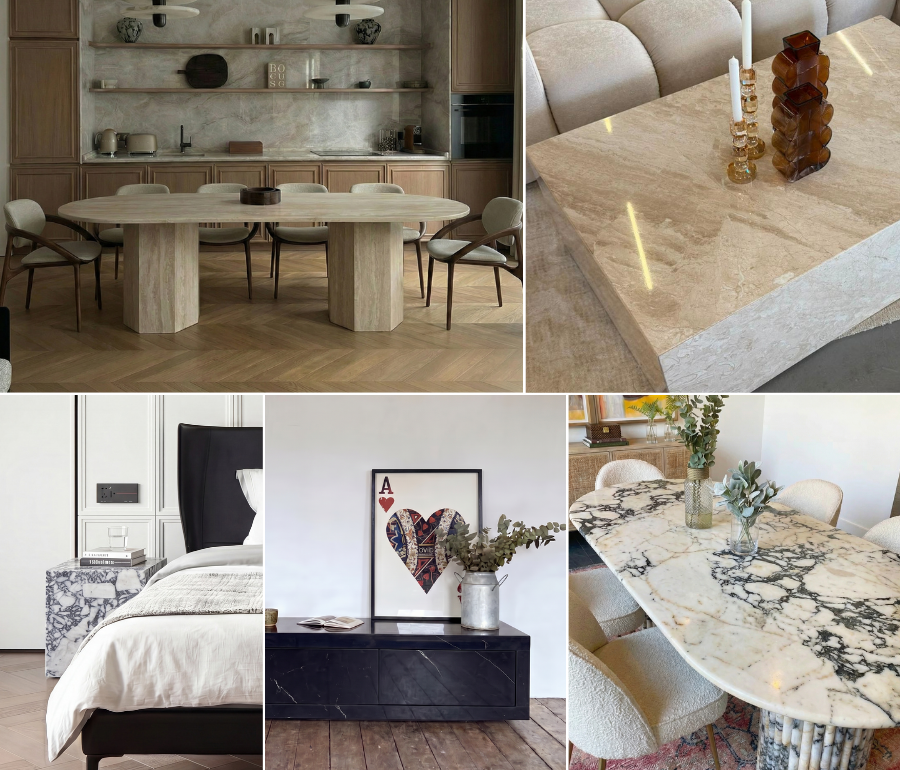
Natural stone furniture has evolved far beyond being a functional object within a living space. Today, marble dining tables, travertine coffee tables, sculptural side tables, and onyx statement pieces are designed as architectural elements that influence the entire character of an interior. Rather than simply filling a room, these pieces establish hierarchy, improve visual balance, and create lasting impressions through their carefully considered proportions.
When people first encounter a beautifully designed interior, they rarely analyze dimensions consciously. Instead, they instinctively recognize harmony. That feeling is not created by expensive materials alone. It is the result of proportion, scale, geometry, and the relationship between furniture and architecture. Even the most exclusive marble can appear overwhelming if the proportions are poorly calculated, while a modest piece can become extraordinary when every dimension is perfectly balanced.
Unlike mass-produced furniture, natural stone pieces possess inherent visual weight. Marble, travertine, limestone, and onyx each carry unique textures, veining, density, and color movement. Because of these characteristics, designers cannot approach stone furniture in the same way they design wood or metal furniture. Every adjustment in thickness, edge detail, tabletop shape, or pedestal size directly changes how heavy, elegant, sculptural, or minimalist the final product appears.
This is precisely why leading architects and interior designers spend significant time refining proportions before production begins. A dining table is never just a tabletop supported by legs. It is a composition where the thickness of the slab, the spacing of the base, the room dimensions, circulation paths, seating capacity, ceiling height, lighting fixtures, and flooring patterns all contribute to a unified design language.
Throughout this guide, we explore how professional designers use form, proportion, and scale to create timeless natural stone furniture. Using real examples of Calacatta Marble, Light Travertine, Diana Royal Marble, White Onyx, and Nero Marquina Marble, you’ll discover why balanced proportions remain one of the most important principles in luxury interior design.
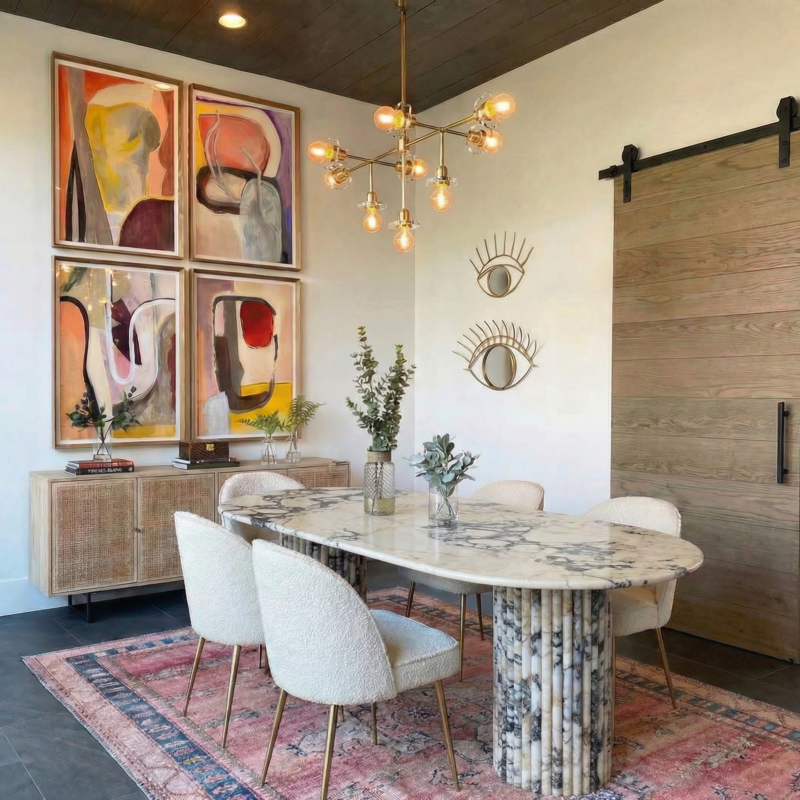
Calacatta Marble Oval Dining Table with Sculptural Double Pedestal Base
Form Is the First Design Language of Every Piece
Before noticing the color of a marble slab or admiring intricate veining, the human eye first understands shape. Form communicates intention instantly. It determines whether a piece feels soft or bold, welcoming or monumental, contemporary or classical. This subconscious reaction happens within seconds, making form one of the most powerful design tools available.
Natural stone enhances this effect because of its permanence. Unlike lightweight materials that visually disappear into an interior, stone immediately commands attention. Every curve, edge, radius, and geometric transition becomes more pronounced due to the material’s density and natural movement. Designers therefore begin every project by selecting an overall form before deciding on finishes or decorative details.
Oval dining tables have become increasingly popular in luxury residential projects because they encourage movement and interaction. Without sharp corners, circulation around the furniture becomes smoother, making the dining area feel more open and inviting. This subtle improvement in spatial flow is particularly valuable in open-plan homes where dining, kitchen, and living spaces are visually connected.
The Calacatta Marble dining table shown above demonstrates how an elongated oval surface softens the architectural geometry surrounding it. The rounded ends reduce visual rigidity while allowing the natural veining to flow uninterrupted across the tabletop. Instead of competing with the room, the furniture complements it through gentle transitions and carefully balanced proportions.
Its double pedestal base also illustrates another important principle: stability should be expressed visually without appearing excessively heavy. Rather than relying on four conventional legs, the sculptural bases create a strong architectural presence while preserving generous legroom and comfortable seating arrangements. This combination of elegance and functionality is one of the defining characteristics of premium natural stone furniture.
Professional furniture designers often describe successful form as “quiet confidence.” Exceptional pieces rarely depend on excessive ornamentation. Instead, they allow geometry, material quality, and craftsmanship to speak naturally. This philosophy explains why minimalist marble furniture continues to remain relevant despite constantly changing interior trends.
Perhaps the greatest advantage of natural stone is its ability to make simple forms feel luxurious. A perfectly proportioned oval table crafted from Calacatta Marble requires no unnecessary embellishment. Its silhouette alone becomes the focal point of the room because every curve has been intentionally designed to support both aesthetics and daily living.
Why Proportion Matters More Than Size
One of the most common misconceptions in furniture design is that larger pieces automatically create a greater sense of luxury. While impressive dimensions may initially attract attention, true luxury is defined by proportion rather than sheer size. A perfectly proportioned natural stone table can appear sophisticated and timeless in almost any setting, whereas an oversized piece with poor proportions can quickly dominate a room and disrupt the overall balance.
Proportion refers to the relationship between every element of a piece of furniture. The thickness of the tabletop, the dimensions of the base, the overall height, the overhang, and even the spacing between structural elements all influence how the eye perceives the object. These relationships are often subtle, yet they determine whether a piece feels refined or awkward.
Designers frequently compare furniture proportions to architectural proportions. Just as a well-designed building relies on balanced windows, doors, ceilings, and structural elements, natural stone furniture depends on carefully calculated relationships between its individual components. Every measurement contributes to a visual rhythm that should feel effortless rather than forced.
Marble and travertine make these relationships even more noticeable because of their visual weight. Stone naturally appears heavier than wood or metal, meaning that even small proportional changes dramatically alter the perception of the furniture. Increasing the slab thickness by only a few centimeters, for example, can transform a table from elegant and floating to heavy and monumental.
This explains why premium furniture manufacturers invest considerable time in refining prototypes before production begins. Every adjustment is evaluated from multiple viewing angles, ensuring the furniture maintains harmony whether viewed from a distance or experienced up close.
Luxury interiors are rarely filled with oversized furniture. Instead, they are composed of carefully proportioned pieces that complement one another. The room itself should never feel smaller because of the furniture. Rather, the furniture should strengthen the architecture while allowing natural circulation and visual openness to remain intact.
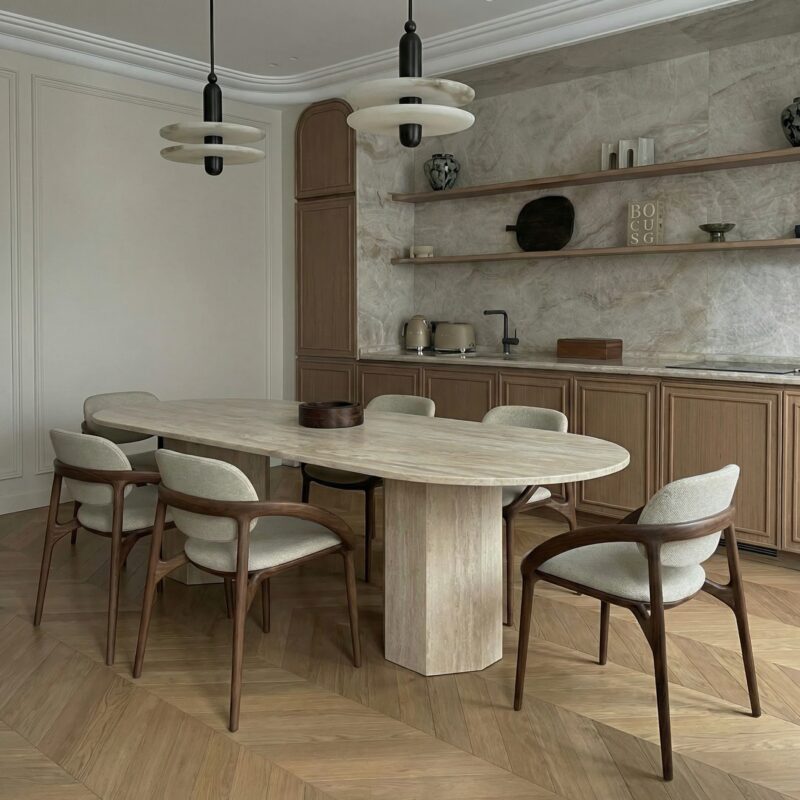
Light Travertine Dining Table Demonstrating Balanced Scale and Seating Layout
Scale Creates Comfort Before Beauty
Scale is often confused with proportion, yet the two concepts serve different purposes. While proportion describes the relationship between parts of a single object, scale explains how that object relates to the surrounding environment. A perfectly proportioned dining table may still feel inappropriate if its overall scale does not correspond to the size of the room.
Professional interior designers always begin by evaluating the architecture before selecting furniture. Ceiling height, wall length, circulation paths, window placement, and natural light all influence the appropriate scale of a stone dining table. Furniture should enhance these architectural characteristics rather than compete with them.
The Light Travertine dining table above illustrates this principle exceptionally well. Although generous in length, the soft beige tones and rounded geometry prevent the piece from feeling visually overwhelming. The slender yet substantial cylindrical bases provide excellent structural support while preserving an airy appearance beneath the tabletop.
Another important consideration is seating capacity. A dining table should provide generous personal space without forcing guests too far apart. Designers typically calculate chair spacing, leg clearance, and circulation simultaneously rather than treating them as separate decisions. When these dimensions work together, the dining experience becomes significantly more comfortable.
Lighting also plays a crucial role in perceived scale. Pendant fixtures should complement the table rather than overshadow it. In many luxury interiors, designers intentionally select lighting that echoes the geometry of the tabletop, reinforcing visual consistency throughout the room.
The surrounding materials further influence perception. Warm timber flooring, soft upholstery, neutral cabinetry, and natural fabrics all help balance the visual weight of travertine. This layered material palette creates interiors that feel calm, welcoming, and timeless rather than cold or overly formal.
Ultimately, successful scale is almost invisible. Occupants rarely notice it consciously, yet they immediately feel comfortable within the space. This effortless sense of harmony is one of the defining characteristics of exceptional interior design.
Natural Stone Furniture Should Complement Architecture, Not Compete With It
One of the greatest strengths of natural stone furniture is its architectural quality. Unlike decorative furniture that simply occupies empty space, stone pieces establish structure within a room. They define gathering areas, guide circulation, and reinforce the visual rhythm created by walls, ceilings, and flooring.
For this reason, experienced designers avoid selecting furniture solely because of an attractive marble pattern or a trending social media aesthetic. Instead, they consider how the piece interacts with the architecture as a whole. The dining table becomes part of the building rather than an isolated object placed inside it.
This architectural approach explains why premium stone furniture often features clean silhouettes and restrained detailing. The beauty comes from proportion, craftsmanship, and material authenticity instead of excessive decoration.
Travertine, in particular, has become increasingly popular for contemporary interiors because of its understated elegance. Its soft textures and warm neutral palette allow large furniture pieces to integrate naturally into residential environments without overwhelming adjacent materials. Even substantial dining tables appear inviting when their proportions respect the surrounding architecture.
As a result, well-designed stone furniture rarely feels temporary. Instead of following seasonal trends, it establishes a permanent visual language that continues to feel relevant for decades. That longevity is one of the greatest advantages of investing in thoughtfully proportioned natural stone furniture.
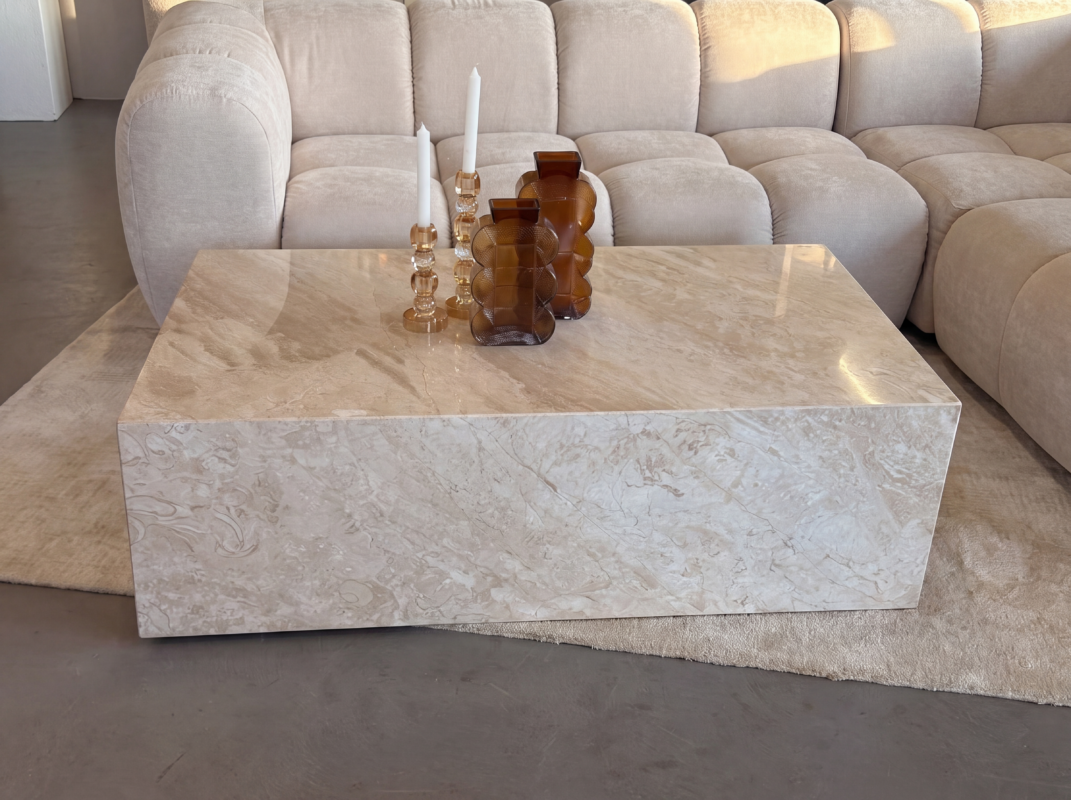
Diana Royal Marble Coffee Table with a Monolithic Block Form
Monolithic Forms Create Architectural Presence
Monolithic furniture is defined by visual unity. Rather than appearing as a separate tabletop, frame, and set of legs, the piece is perceived as one complete volume. This approach gives natural stone furniture a stronger architectural identity and allows the material itself to become the principal design feature.
The Diana Royal Marble coffee table shown here demonstrates how a simple rectangular block can create a powerful focal point without relying on decorative profiles or complex details. Its low, wide proportions reinforce the horizontal lines of the living room, while the warm beige background and gentle natural movement prevent the table from feeling overly severe.
Diana Royal Marble is especially suitable for monolithic forms because its neutral color palette softens the physical weight of the stone. A darker marble with the same dimensions could create a more dramatic and visually dominant effect. Diana Royal, by contrast, maintains a calm relationship with cream upholstery, natural timber, textured rugs, and soft wall colors.
This balance is essential. Monolithic furniture naturally attracts attention because of its volume. If the stone selection is highly dramatic, the form, surrounding colors, and accessories should be carefully controlled. When the marble has a quieter pattern, the furniture can occupy more visual space without overwhelming the room.
Width, Height, and Visual Weight
The success of a block coffee table depends heavily on its height-to-width ratio. A table that is too tall may appear like a pedestal or solid architectural plinth rather than a practical coffee table. If it is excessively low and broad, it may visually flatten the seating arrangement or make access uncomfortable.
The correct height should relate to the sofa seat. In many interiors, a coffee table is positioned at approximately the same height as the seating surface or slightly lower. The exact dimension should still be determined according to the sofa design, user habits, and intended function.
Width also affects how the table is perceived. A long rectangular block can visually connect a large modular sofa, while a more compact square table may suit a smaller seating group. Sufficient space must remain around the piece for movement and comfortable access.
Designers generally consider:
- Sofa width and seat height
- Distance between the table and seating
- Main circulation routes
- Rug dimensions
- Nearby armchairs
- Decorative object placement
- The visual strength of the marble pattern
A monolithic table should feel connected to the seating arrangement rather than placed as an isolated stone volume in the center of the room.
The Importance of Edge Precision
Simple forms reveal craftsmanship more clearly than ornate designs. Because there are fewer decorative elements to distract the eye, every edge, corner, joint, and surface transition becomes more visible.
A premium monolithic marble table should have:
- Consistent geometry
- Clean and carefully finished edges
- Controlled corner details
- Balanced vein placement
- Smooth surface transitions
- A stable internal or structural system
- Professionally coordinated fabrication
Where panels are joined to create a block appearance, the alignment of the marble pattern becomes especially important. Veins that continue naturally around corners help the piece appear more unified. Abrupt changes in pattern may make the construction lines more visible.
The aim is not always to make the table look as though it was carved from one enormous block. Instead, the objective is to create a visually coherent object in which every surface belongs to the same design.
Styling a Monolithic Marble Coffee Table
Because the table already has strong architectural presence, it usually benefits from restrained styling. Covering a large part of the surface with books, trays, candles, and decorative objects can reduce the impact of the natural stone.
A more balanced arrangement may include:
- One large-format design book
- A low ceramic bowl
- A sculptural vase
- A small natural branch arrangement
- A simple decorative tray
- One glass or stone object
Open surface area should remain visible so the marble contributes to the room’s composition.
The table should also be balanced by softer materials. Bouclé, linen, wool, velvet, and textured upholstery help reduce the visual hardness of stone. This contrast between solid mineral surfaces and tactile fabrics is one of the foundations of successful contemporary natural stone interiors.
Block Forms Versus Sculptural Forms
Natural stone furniture does not need to be either completely minimal or highly decorative. Most designs fall somewhere between strict geometry and sculptural expression.
Block furniture relies on:
- Straight lines
- Clear volumes
- Low profiles
- Strong horizontal or vertical proportions
- Minimal visible construction
- The natural stone pattern as decoration
Sculptural furniture may use:
- Curved silhouettes
- Tapered bases
- Asymmetrical outlines
- Fluted details
- Layered components
- Varying heights
- Organic transitions
Neither approach is automatically more refined. The correct choice depends on the architecture and the role the furniture will play.
A block coffee table may be ideal for a room with curved sofas, soft fabrics, and organic accessories because its geometry creates contrast. A highly sculptural table may work better in a more restrained interior where the furniture itself is expected to provide movement.
The stone also influences this decision. Strongly veined marble often looks balanced in simple forms because the material already provides visual complexity. Quieter travertine and limestone selections can support more textured, curved, or detailed silhouettes without making the piece appear too busy.
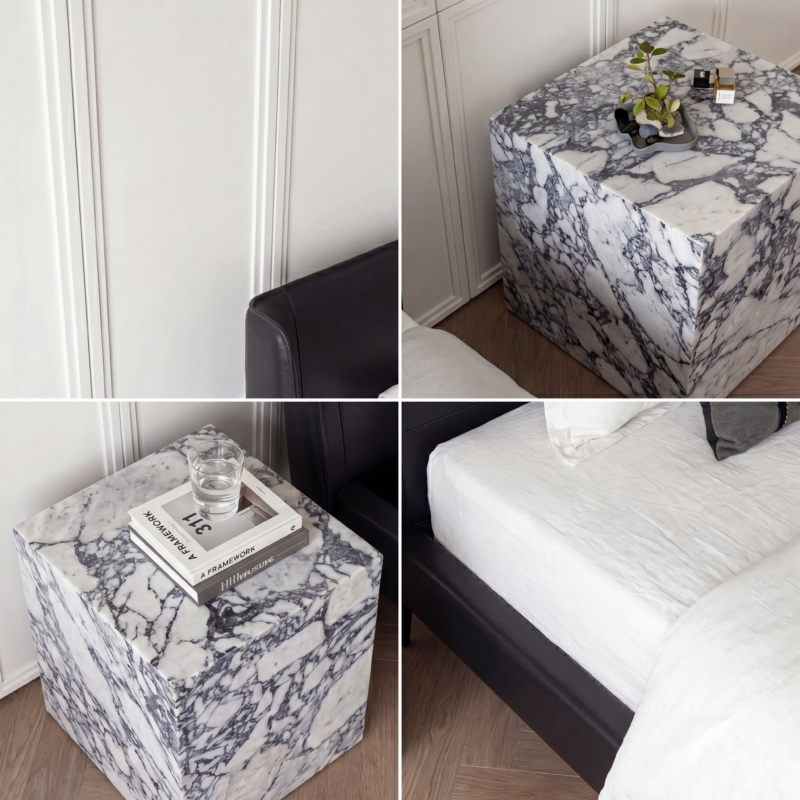
Calacatta Marble Cube Bedside Table with Compact Minimalist Geometry
Compact Furniture Requires Precise Proportion
Small furniture may appear easier to design, but compact dimensions often leave less room for error. A few centimeters can change whether a bedside table feels elegant, bulky, too low, or visually disconnected from the bed.
The Calacatta Marble cube shown here uses one of the simplest possible forms. Its strength comes from the relationship between its width, height, depth, and the movement of the natural veins across multiple visible faces.
A cube shape creates stability and clarity. There are no separate legs, handles, or decorative frames to interrupt the stone. As a result, the marble becomes both the material and the visual structure of the piece.
Calacatta Marble works particularly well in compact geometric furniture because its bold gray veining prevents the cube from looking flat or overly plain. Each side reveals a different part of the natural pattern, allowing the piece to change depending on the viewing angle.
Matching the Bedside Table to the Bed
A bedside table should not be selected independently from the bed. Its dimensions should relate to:
- Mattress height
- Bed frame thickness
- Headboard scale
- Available wall width
- Distance from the bed
- Lamp dimensions
- Storage expectations
- User reach
A bedside surface that is significantly lower than the mattress may be inconvenient for placing a phone, glass, or book. A table that is too high can feel visually heavy and may interfere with the proportions of the headboard.
The cube should also leave sufficient space around the bed. In a compact bedroom, an oversized block may reduce circulation and make the room feel crowded. In a larger bedroom with a tall upholstered headboard, a very small cube may appear visually weak.
The best result usually comes from selecting a table height close to the upper mattress level, while still considering the exact design of the bed and lamp.
Visual Weight in Small Spaces
Natural stone furniture has more visual and physical weight than many timber or metal alternatives. This does not mean it cannot be used in smaller rooms. It simply requires a more controlled design approach.
A light-colored marble cube can work well in a compact bedroom because:
- The pale surface reflects light.
- The simple form avoids visual clutter.
- The stone can replace the need for additional decoration.
- The natural veining adds interest without using multiple colors.
- The solid geometry creates a clear focal point.
The surrounding palette should provide balance. Soft bedding, fabric upholstery, warm wall colors, and indirect lighting can make the stone feel integrated rather than severe.
Vein Placement Across a Cube Form
Cube furniture provides several visible planes: the top, front, and side surfaces. The marble pattern should therefore be considered three-dimensionally.
Before fabrication, designers may review:
- Which vein appears on the top
- How the pattern moves toward the front
- Whether side panels should align
- Where stronger mineral areas will be positioned
- Whether the piece should look continuous or deliberately varied
A carefully planned layout can make the cube feel like one unified natural stone object. Pattern placement is especially important when the bedside table will be viewed from several angles.
Practical Use and Surface Styling
Although the cube is visually minimal, it still needs to function as bedside furniture. Its top should provide enough space for essential objects without becoming crowded.
An appropriate arrangement may include:
- One table lamp
- A small book
- A glass or carafe
- A compact decorative object
- A small tray
The proportions of the lamp are particularly important. A very large lamp may make the cube appear undersized, while a very small lamp may fail to balance the visual weight of the stone.
Natural stone bedside tables should also be protected from liquids, cosmetics, perfumes, and acidic products. Coasters or small trays can support daily use while preserving the surface.
Repetition and Symmetry in Bedroom Furniture
When two identical stone bedside tables are used on either side of a bed, they create symmetry and reinforce the central position of the headboard. This can make the bedroom feel calm, structured, and balanced.
However, symmetry does not require every decorative object to be identical. The furniture may remain consistent while lamps, books, or accessories vary slightly to create a more natural interior.
In smaller rooms, a single stone cube can be paired with a lighter alternative on the other side, especially where access or wall width is limited. The key is to maintain a relationship in height, color, or form so the arrangement does not appear accidental.
Compact natural stone furniture is most successful when it is treated as part of the architecture. Its position, lighting, and relationship to the bed should be planned rather than added at the final stage of decoration.
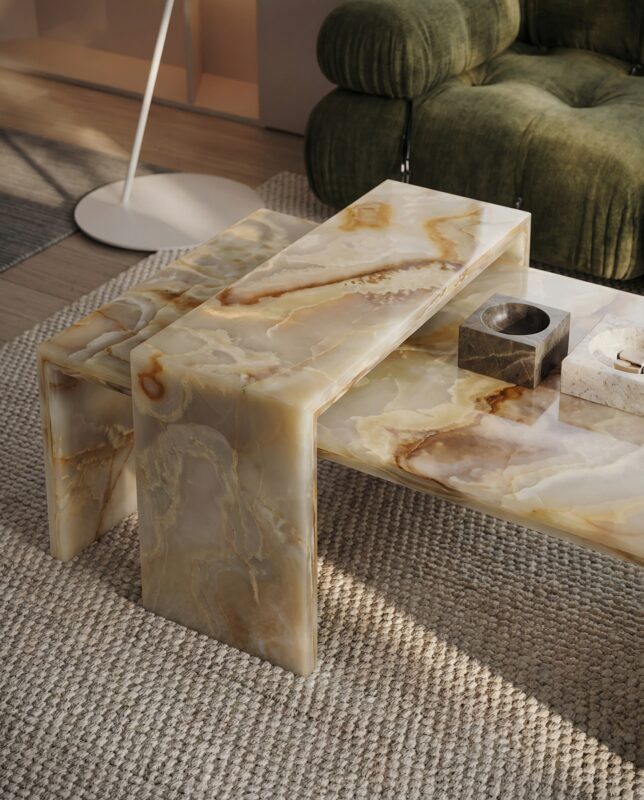
Layered White Onyx Coffee Tables with Sculptural Overlapping Forms
Layering Introduces Movement Without Visual Clutter
Layered furniture creates depth by placing two or more surfaces at different heights, angles, or positions. Instead of relying on complex carving or excessive decorative detail, the composition gains movement through overlap.
The White Onyx coffee tables shown here demonstrate how layering can make natural stone appear lighter and more dynamic. Although onyx is physically substantial, the staggered surfaces create open areas, changing shadows, and a stronger relationship with the surrounding seating arrangement.
This type of composition is particularly effective in living rooms where one large central table would feel too rigid. Multiple levels allow the furniture to adapt more naturally to curved sofas, lounge chairs, and irregular circulation paths.
The tables can be read as one sculptural composition while still offering separate functional surfaces. One level may hold books and decorative objects, while another remains available for drinks or everyday use.
Why White Onyx Works Well in Layered Furniture
White Onyx differs from marble and travertine because it can transmit a degree of light, depending on its thickness, structure, and lighting conditions. Its cloudy mineral movement, translucent sections, and pale tonal transitions create a softer visual effect than many strongly veined stones.
In layered forms, these characteristics become more noticeable. The edges, overlapping surfaces, and changing heights allow light to interact with the stone from several directions.
Under natural daylight, White Onyx may appear creamy, pale beige, ivory, or softly gray. Under warm artificial light, the stone can reveal more golden or honey-toned areas.
This visual variability makes onyx especially suitable for statement furniture, but it also requires restraint. The material already contains considerable depth, so the form should remain controlled and the surrounding décor should not compete with it.
Creating Balance Through Different Heights
Layered tables should not look like unrelated pieces placed together accidentally. Their heights, diameters, and positions need to create a clear relationship.
Designers may vary:
- Surface height
- Table diameter or width
- Degree of overlap
- Base position
- Edge thickness
- Distance between levels
- Orientation toward the seating
The difference in height should be noticeable enough to create depth but not so extreme that one table appears disconnected from the other.
A lower surface can visually extend beneath the higher table, making the composition feel wider without increasing the apparent mass. This approach can be useful in generous living rooms where the seating arrangement requires a broad central element.
Layered Tables and Seating Layout
The furniture should respond to the shape of the seating group.
For example:
- A curved sofa may work well with rounded or organic tables.
- A long sectional sofa may require an elongated layered arrangement.
- Two opposing sofas may benefit from a more centered and symmetrical composition.
- A sofa and lounge-chair arrangement may suit offset surfaces that serve different seating positions.
The tables should remain reachable from the main seats without obstructing circulation. Their placement should also leave enough open floor around the composition so the layered effect can be clearly understood.
Transparency, Light, and Interior Atmosphere
White Onyx can create a softer and more luminous atmosphere than opaque dark marble. This makes it suitable for interiors that need a statement piece without a heavy visual center.
It works especially well with:
- Cream upholstery
- Pale oak
- Warm walnut
- Brushed brass
- Soft beige rugs
- Glass accessories
- Linen curtains
- Warm indirect lighting
- Neutral plaster walls
Backlighting may be considered for certain onyx applications, but it is not automatically appropriate for every furniture design. The stone thickness, internal support, wiring, heat management, access, and maintenance should all be professionally planned.
Even without integrated lighting, onyx interacts beautifully with daylight and nearby lamps. The goal is not always to make the material glow dramatically. Subtle illumination can be more refined and easier to integrate into residential interiors.
Styling Layered Onyx Tables
Because the composition already includes multiple levels, excessive styling can make it feel crowded.
A balanced arrangement may use:
- One large book on the lower surface
- A small glass object
- A low ceramic bowl
- A single floral arrangement
- A sculptural accessory
- A simple tray
Not every surface needs to be decorated. Leaving one level mostly empty emphasizes the overlap and allows the onyx pattern to remain visible.
Asymmetry Can Still Feel Balanced
Symmetry creates immediate order, but asymmetry can make an interior feel more relaxed and contemporary. The key is to balance visual weight rather than mirror every element exactly.
Layered tables often use asymmetry through:
- Different heights
- Unequal surface sizes
- Offset bases
- Partial overlaps
- Varied decorative objects
The composition can still feel stable when the larger or visually heavier surface is balanced by the placement of the sofa, rug, lighting, or nearby furniture.
This type of balance is sometimes described as dynamic equilibrium. The arrangement is not identical on both sides, yet no single element appears to pull the room out of alignment.
Natural stone is especially effective in asymmetrical furniture because the material itself provides continuity. Even when the forms differ, using the same White Onyx connects the individual pieces into one family.
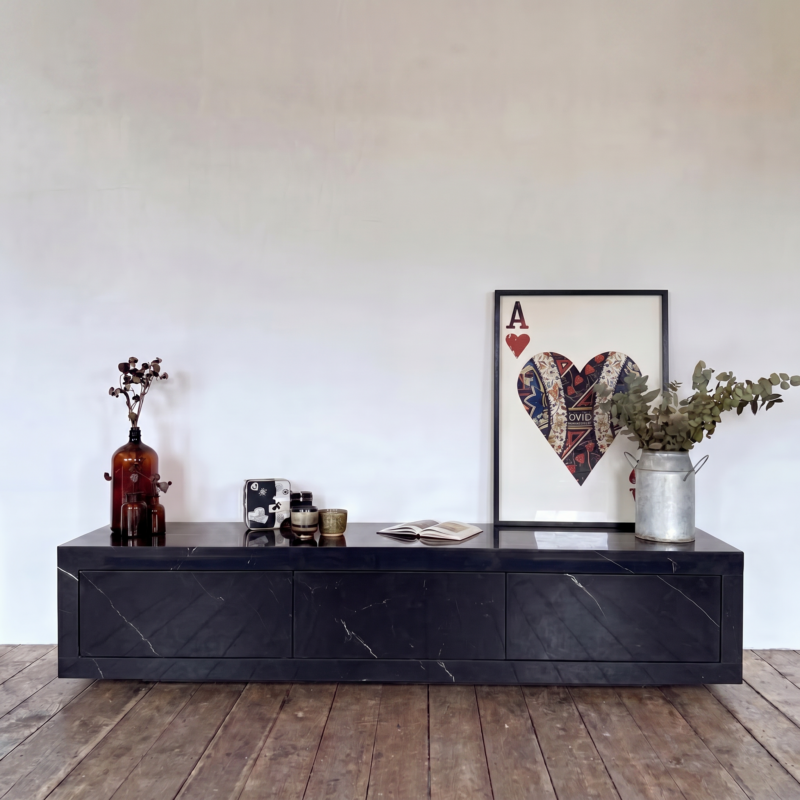
Nero Marquina Marble Console with a Long, Low Architectural Profile
Horizontal Proportion Can Visually Extend a Wall
Console tables often occupy transitional areas: entrance halls, corridors, dining-room walls, living-room boundaries, and spaces behind sofas. In these locations, the furniture must relate closely to the architecture.
The Nero Marquina Marble console shown here uses a long and low proportion that reinforces the horizontal line of the wall. Rather than standing as a tall, decorative object, it creates a calm architectural base for artwork and accessories.
The deep black background of Nero Marquina gives the console strong visual presence, while the white veining prevents the surface from appearing flat. Because the material is dark and expressive, the simple geometry helps maintain balance.
A more complicated form combined with intense veining could make the piece feel overly decorative. The restrained silhouette allows the stone to provide the main visual interest.
Choosing the Correct Console Length
The console should be proportioned according to the wall, nearby furniture, and objects displayed above it.
A console that is too short may look disconnected from a wide wall. One that is excessively long can restrict circulation, interfere with doors, or visually compress the surrounding architecture.
Designers often review:
- Total wall width
- Door and window positions
- Distance from corners
- Width of artwork or mirror
- Nearby seating
- Corridor clearance
- Ceiling height
- Baseboard and wall details
The console does not need to fill the entire wall. Leaving controlled negative space at both ends usually creates a more refined composition.
Low Profiles and Perceived Spaciousness
A low console preserves more open wall area above the furniture. This can help a room or corridor feel less crowded, especially when the stone itself is dark.
The horizontal form can also make the wall appear wider. This effect is strengthened when:
- The console has clean straight lines.
- The artwork above follows a similar width.
- Lighting is distributed along the wall.
- Accessories remain low and controlled.
- The floor continues visually beneath the furniture.
In compact interiors, a dark console can still work successfully when the surrounding wall is light and the furniture height remains restrained.
The Relationship Between Console and Artwork
Artwork, mirrors, or sculptural objects placed above a console should relate to its width and visual weight.
A very small artwork over a long stone console may feel weak. An oversized piece can dominate the furniture and reduce the sense of balance.
The composition may use:
- One large horizontal artwork
- Two coordinated framed pieces
- A wide mirror
- A sculptural wall object
- An asymmetrical group with clear visual order
The space between the console and artwork is also important. Too little distance can make the objects feel compressed, while too much may disconnect them.
The correct spacing depends on the ceiling height, artwork dimensions, and overall wall composition.
Styling a Nero Marquina Console
Dark marble provides a strong base for lighter or warmer accessories.
Suitable combinations include:
- Pale ceramic vessels
- Brushed brass lamps
- Clear glass
- Off-white artwork
- Bronze objects
- Warm timber frames
- Neutral books
- Natural branches
Accessories should not cover the entire top. Open areas allow the black marble and white veins to remain visible.
A single table lamp can create warm contrast against the dark stone. However, the scale of the lamp should match the console. A small lamp may appear lost, while an oversized one can disturb the horizontal balance.
Console Height and Function
Console height depends on its use and location.
An entrance console may need a practical surface for keys, trays, or lighting. A dining-room console may serve as a display or service surface. A low living-room console may function more like an architectural plinth.
The design should clarify the intended role before production begins.
Important considerations include:
- Comfortable reach
- Relationship to adjacent furniture
- Electrical access for lamps
- Storage needs
- Wall-mounted elements
- Floor clearance
- Cleaning access
- Stability and support
A visually elegant console should still function comfortably within daily life.
Choosing the Right Natural Stone for Each Furniture Form
Stone selection should respond to the geometry of the furniture. Some materials support strict forms, while others become more expressive in curved or layered designs.
| Furniture Form | Suitable Stone Character | Design Effect |
|---|---|---|
| Oval dining table | Flowing or directional veining | Soft movement and continuity |
| Long travertine table | Calm linear layers | Warm architectural balance |
| Monolithic coffee table | Moderate veining and neutral tones | Strong but controlled presence |
| Cube bedside table | Bold pattern with light background | Compact sculptural identity |
| Layered coffee table | Translucent or softly varied stone | Depth and visual lightness |
| Long low console | Dark contrasting marble | Strong horizontal definition |
Calacatta Marble
Calacatta Marble is particularly effective in oval tables, cube forms, and sculptural furniture because its bold veins remain visible across simple geometry.
The stone should be carefully laid out so the strongest veins support the form rather than becoming randomly cut across important surfaces.
Light Travertine
Light Travertine suits broad dining tables and softer organic furniture. Its warm neutral color reduces the apparent weight of large pieces.
The linear or cloud-like pattern depends on the cut direction and should be selected according to the table form.
Diana Royal Marble
Diana Royal’s beige and warm neutral movement works well in monolithic coffee tables because it creates presence without excessive contrast.
White Onyx
White Onyx is well suited to layered or illuminated statement furniture. Its translucent character introduces visual depth, but its design and structural requirements should be handled carefully.
Nero Marquina Marble
Nero Marquina creates strong graphic contrast. It works particularly well in consoles, side tables, and simple architectural forms where the white veining can remain the main decorative element.
Common Proportion Mistakes in Natural Stone Furniture
Choosing a Table Only by Seating Capacity
A table may technically accommodate the required number of chairs but still be too large for the room. Circulation, chair movement, and visual scale must also be considered.
Making the Base Too Heavy
An oversized pedestal can reduce legroom and make the furniture feel visually dense. Structural stability and comfort should be balanced.
Using a Tabletop That Looks Too Thin
A very thin-looking top may feel visually weak when paired with a large stone base. The edge profile should relate to the overall dimensions.
Making Compact Furniture Too Bulky
Cube tables and bedside pieces can quickly overwhelm small rooms if width and height are not carefully controlled.
Ignoring Sofa and Coffee Table Height
A coffee table that is too high or low may be uncomfortable and visually disconnected from the seating.
Overlapping Layered Tables Without a Clear Relationship
Different heights and sizes should create one composition. Random overlap can make the furniture look improvised rather than designed.
Selecting a Console Without Measuring the Wall
The console, artwork, doors, lighting, and negative space should be planned together.
Focusing Only on Front Views
Natural stone furniture is often visible from multiple angles. Side, rear, top, and corner views should also be evaluated before production.
How Designers Evaluate Form Before Production
Professional furniture development often begins with drawings, scaled plans, elevations, or three-dimensional models. These tools help identify proportion problems before the stone is cut.
Designers may evaluate:
- Overall dimensions
- Human scale
- Seating positions
- Base locations
- Overhang
- Edge thickness
- Visual weight
- Vein orientation
- Transport dimensions
- Assembly requirements
- Room circulation
- Relationship to lighting and rugs
For custom pieces, templates or full-scale markings on the floor can help clients and designers understand the real size of the furniture.
A table that looks balanced on a small screen may feel completely different at full scale. Testing the footprint within the room can prevent expensive mistakes.
Stone layout should also be reviewed together with the design drawing. The geometry and natural pattern should support one another from the beginning.
Caring for Sculptural Natural Stone Furniture
Complex or monolithic furniture forms may require different cleaning habits from conventional tables.
For routine care:
- Use a soft microfiber cloth.
- Choose pH-neutral products intended for natural stone.
- Clean spills promptly.
- Avoid acidic and abrasive cleaners.
- Use coasters, placemats, and protective pads.
- Do not drag heavy objects across the surface.
- Clean around bases and lower surfaces carefully.
- Follow professional guidance regarding sealers.
Layered tables and deeply positioned bases may collect dust in less accessible areas. The design should allow reasonable cleaning access.
Stone furniture is also heavy. It should not be moved frequently without proper planning and suitable equipment. Floors should be protected, and lifting should be carried out by people experienced with natural stone furniture.
Frequently Asked Questions About Form and Proportion in Natural Stone Furniture
What is the difference between form, proportion, and scale?
Form refers to the overall shape of the furniture. Proportion describes the relationship between its individual parts. Scale explains how the furniture relates to the room and the human body.
Are oval dining tables suitable for small rooms?
They can be. Rounded ends improve circulation, but the total dimensions must still leave sufficient space for chairs and movement.
How high should a coffee table be?
Coffee tables are often close to the sofa seat height or slightly lower. The ideal dimension depends on the sofa and intended use.
Are monolithic stone tables made from one solid block?
Not always. Some may be produced from solid material, while others use precisely fabricated panels or engineered internal support to create a monolithic appearance.
Is a stone cube suitable as a bedside table?
Yes, provided its height, width, weight, and distance from the bed are appropriate for the room.
Can White Onyx furniture be illuminated?
Certain designs can incorporate lighting, but stone thickness, support, wiring, heat management, and maintenance access must be professionally planned.
Does dark marble make furniture look larger?
Dark stone often has stronger visual weight. Simple forms, controlled dimensions, and light surroundings can keep the piece balanced.
How much space should remain around a dining table?
The required clearance depends on chair depth and circulation. The table should allow chairs to be pulled out and people to pass comfortably.
Why is base placement important?
Base position affects stability, legroom, seating capacity, and the way the tabletop appears to float or feel supported.
Can natural stone furniture be made to custom dimensions?
Yes. Dimensions, forms, bases, edge profiles, finishes, and stone layouts can be developed according to the room and project requirements.
Balanced Design Gives Natural Stone Furniture Lasting Value
Natural stone furniture becomes timeless not because the material is expensive, but because form, proportion, scale, and craftsmanship work together.
The oval Calacatta Marble dining table uses soft geometry and balanced double pedestals to create movement and comfort. The Light Travertine dining table shows how a generous scale can remain warm and visually controlled. The Diana Royal Marble coffee table demonstrates the architectural strength of a low monolithic form. A compact Calacatta cube proves that small furniture requires the same level of proportional precision as a large table.
Layered White Onyx tables introduce movement, light, and asymmetrical balance, while the long Nero Marquina console shows how horizontal proportion can shape the perception of an entire wall.
Each example follows the same principle: the stone should support the form, and the form should respond to the room.
When these relationships are planned carefully, natural stone furniture does more than occupy space. It creates structure, guides movement, establishes visual hierarchy, and gives the interior a lasting architectural identity.
Efesus Home develops custom natural stone dining tables, coffee tables, bedside tables, consoles, pedestals, and sculptural furniture using selected marble, travertine, limestone, and onyx varieties. Dimensions, forms, support systems, edge profiles, surface finishes, and stone layouts can be adapted to residential, hospitality, and commercial interior projects.