
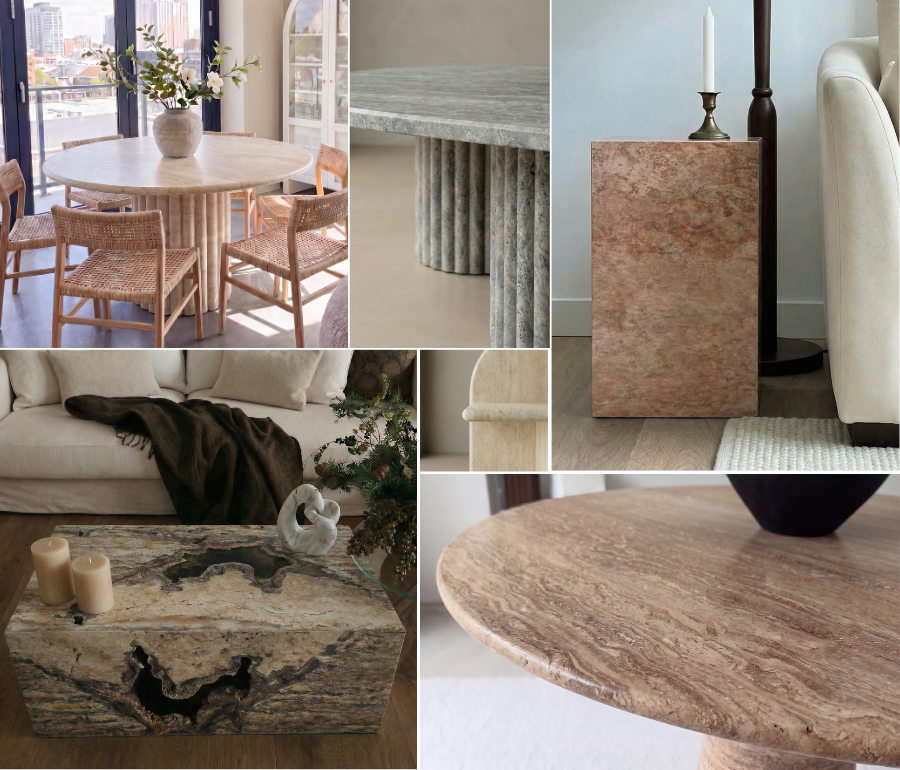
Turkish travertine has become one of the most recognizable natural stones in international architecture and interior design. Its distinctive porous texture, layered geological structure and wide spectrum of natural colors allow the material to move easily between contemporary, minimalist, Mediterranean, rustic and luxury interiors. From large-scale flooring and wall cladding to sculptural dining tables, bathroom sinks and statement furniture, travertine offers designers a combination of natural character and versatility.
Türkiye is particularly important in the global travertine industry because different quarry regions produce remarkably different visual characteristics. Cream and ivory tones, warm beige layers, silver-grey formations, deep walnut shades and even red variations can all be found within Turkish travertine selections. The way the block is cut—especially cross cut or vein cut—can further transform the appearance of the same stone.
For architects, interior designers and homeowners, choosing travertine therefore involves more than simply selecting a beige natural stone. Color variation, vein direction, finish, cut, application and the visual relationship between individual pieces all influence the final result.
In this guide, we explore seven distinctive types of Turkish travertine through eight different applications, beginning with Silver Travertine and continuing through Royal Blend, Imperial Blend, Light, Classic, Noce and Red Travertine. We also look at how Efesus Stone’s quarry and production experience connects raw Turkish travertine with architectural surfaces and finished natural stone furniture.
1. Silver Travertine: The Contemporary Side of Turkish Travertine
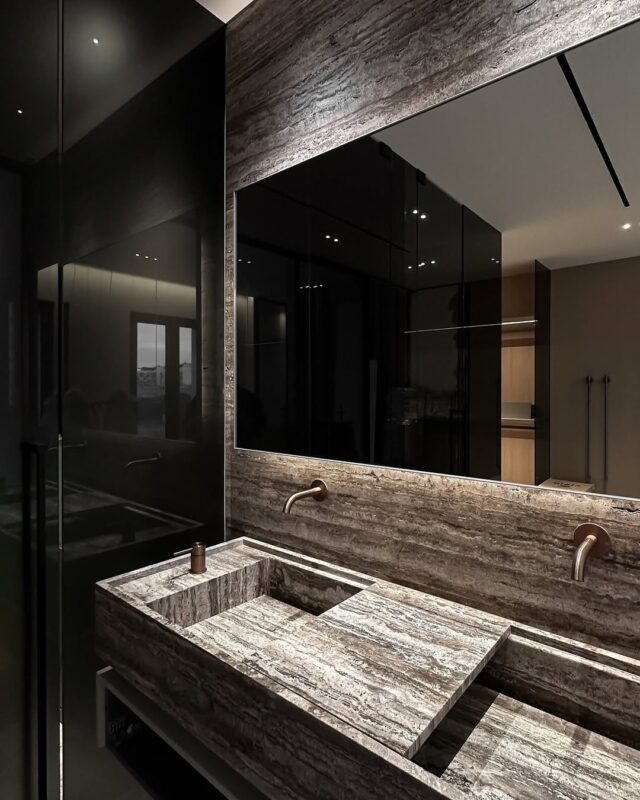
Silver Travertine is one of the most distinctive alternatives to traditional cream and beige travertine. Instead of a predominantly warm palette, the stone combines silver, grey, taupe, beige and occasionally darker brown layers. These tonal transitions give it considerably more visual depth and make it particularly suitable for contemporary interiors.
The Silver Travertine sink shown here demonstrates how the material can move beyond conventional flooring and wall applications. When used as a fabricated architectural element, the stone’s natural layers become part of the object’s design. The result is not simply a functional bathroom surface but a sculptural natural stone feature.
Silver Travertine works particularly well alongside dark surfaces, bronze or brushed metal fittings, smoked glass and warm architectural lighting. In bathrooms, the combination can create a sophisticated atmosphere without relying on highly polished or visually artificial materials.
Silver Travertine from the Emirdağ Quarry
An important part of the Efesus Stone natural stone portfolio is connected directly to the source. Efesus Stone operates a Silver Travertine quarry in Emirdağ, Afyonkarahisar, one of Türkiye’s important natural stone regions.
Quarry access is especially significant for architectural projects because travertine is inherently variable. Blocks extracted from different quarry levels can present differences in background tone, vein density and mineral movement. Understanding these variations allows material to be evaluated according to the visual requirements of a particular project.
The relationship between quarry extraction and manufacturing also becomes important when architects require coordinated material for floors, walls, stairs, bathroom elements or custom-cut components within the same project.
2. Silver Travertine Vein Cut: Linear Movement for Floors and Walls
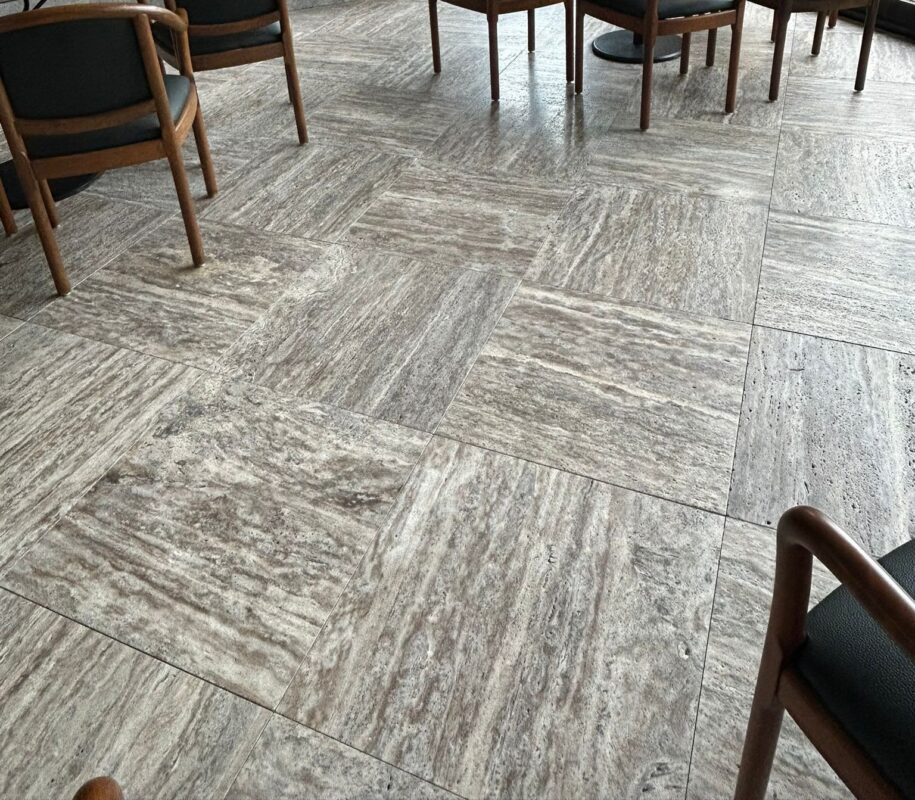
Silver Travertine Vein Cut Flooring
The second application demonstrates an essential characteristic of travertine: cutting direction can dramatically change the appearance of the material.
In a vein-cut slab or tile, the block is cut parallel to its natural sedimentary layers. Instead of the more cloud-like movement associated with cross-cut travertine, the surface reveals long, directional bands. Silver Travertine becomes particularly expressive in this format because its grey, beige and brown layers create strong natural lines.
The flooring shown here uses this linear structure as part of the overall design. Changing the orientation of individual pieces introduces rhythm while preserving the continuity of the material palette.
This makes Silver Travertine Vein Cut particularly interesting for:
- Interior flooring
- Feature walls
- Bathroom surfaces
- Hotel and hospitality projects
- Entrance and lobby areas
- Fireplace surrounds
- Staircases and architectural details
For large surfaces, installation planning becomes especially important. Designers can use the vein direction consistently to create visual continuity or deliberately rotate pieces to establish a geometric composition.
Silver Travertine therefore illustrates an important principle in natural stone design: the stone itself is only the beginning; cutting and layout determine how its geological character is experienced in architecture.
3. Royal Blend Travertine: Natural Variation as a Design Feature
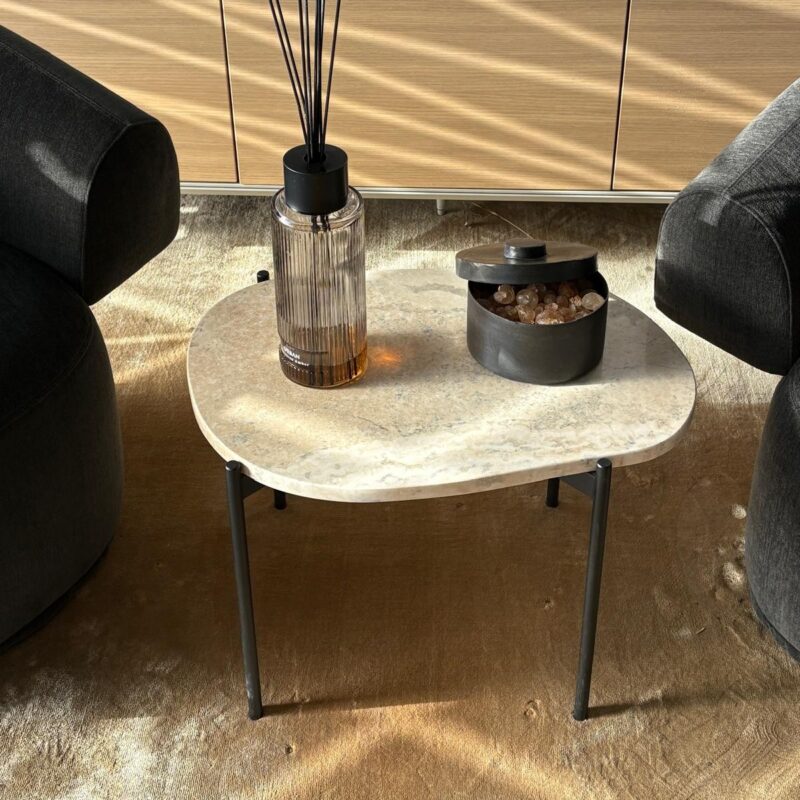
Royal Blend Travertine Side Table
Royal Blend Travertine introduces a different approach to travertine aesthetics. Rather than pursuing a perfectly uniform surface, this selection celebrates tonal variation. Beige, cream, taupe, grey and naturally changing mineral patterns can coexist within the material, giving every finished piece its own character.
The Royal Blend Travertine side table shown here demonstrates why this type of stone works particularly well for furniture. On a relatively compact surface, subtle differences in color and texture become visible architectural details.
Natural stone furniture has increasingly moved away from the idea that every table should look identical. In contemporary interiors, the geological individuality of marble, limestone and travertine is often precisely what gives an object its value.
Royal Blend Travertine can complement neutral upholstery, dark furniture, warm timber and metal details without overwhelming the surrounding space. This balance makes it suitable for coffee tables, side tables, consoles and other custom furniture pieces.
The material can also be considered for larger architectural applications where controlled natural variation is desirable. Flooring and wall surfaces created from mixed tonal selections can produce an organic appearance that is difficult to replicate with manufactured materials.
4. Imperial Blend Travertine: Dynamic Flooring with Natural Contrast
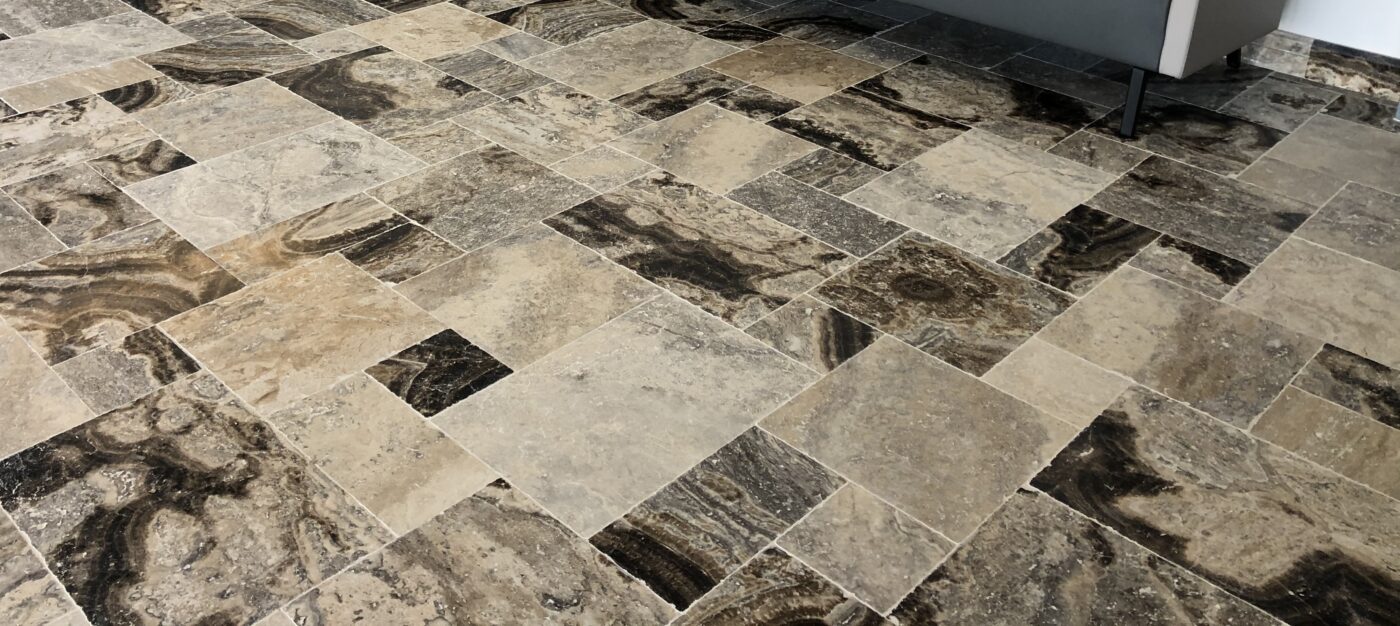
Imperial Blend Travertine Flooring
Imperial Blend Travertine demonstrates the decorative potential of combining different natural tones within a single floor composition. Instead of seeking complete uniformity, the installation uses variation as the main visual language.
Cream, beige, grey and darker brown areas create contrast across the surface, while the different tile dimensions introduce an additional layer of movement. The result is a floor that feels naturally aged and architecturally rich rather than mechanically repetitive.
This characteristic makes blended travertine particularly suitable for spaces where the floor is expected to contribute strongly to the overall identity of the project.
Depending on the selected finish and project requirements, travertine flooring can be considered for residential interiors, hospitality environments, terraces, courtyards and other architectural spaces.
One of the advantages of such mixed selections is their relationship with other materials. Timber, plaster, neutral textiles and metal can all be combined with the multiple tones already present within the stone.
Imperial Blend also highlights another important aspect of working with natural stone: variation should not automatically be treated as a defect. When correctly selected and intentionally arranged, variation becomes a design tool.
5. Light Travertine: A Timeless Turkish Natural Stone
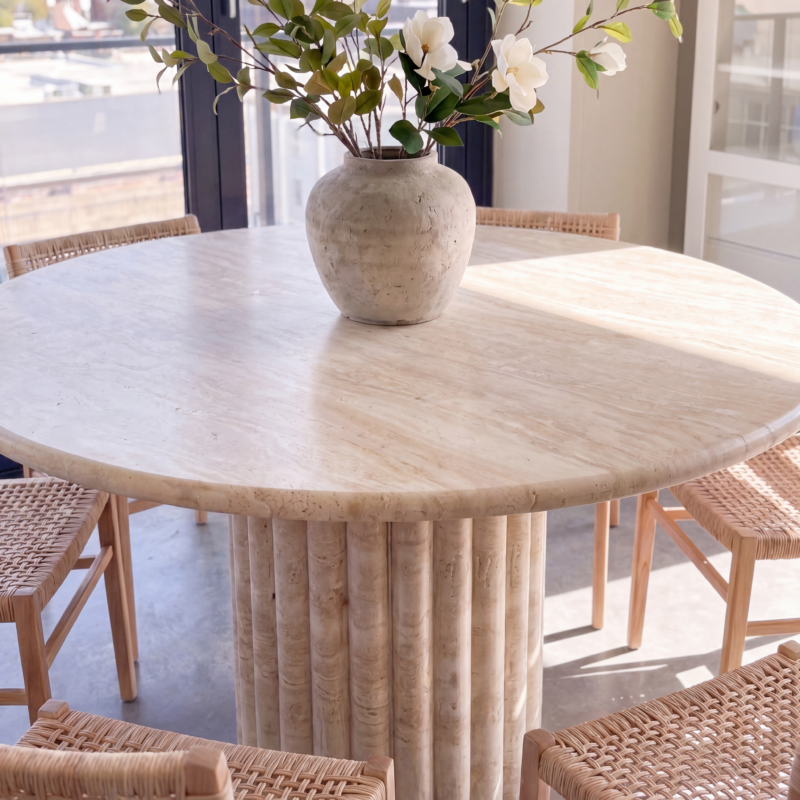
Light Travertine Dining Table with Fluted Base
Among Turkish travertines, Light Travertine is one of the most versatile selections. Its cream, ivory and soft beige palette creates a calm architectural background while the natural pores and subtle mineral movement prevent the material from appearing flat.
The dining table shown here transforms Light Travertine into a contemporary furniture piece. Its rounded tabletop softens the visual weight of the stone, while the fluted travertine base introduces texture and shadow.
This is an important example of how traditional natural stone can be interpreted through modern manufacturing. Travertine is no longer limited to tiles, slabs and exterior cladding. CNC processing, precision cutting, edge detailing and carefully planned fabrication allow it to become a three-dimensional design material.
Light Travertine works particularly well in interiors influenced by warm minimalism and contemporary Mediterranean design. Natural timber, linen, cream upholstery and muted earth tones can be combined with the stone to create spaces that feel refined without becoming visually cold.
Denizli Travertine and Efesus Stone
Denizli is internationally associated with Turkish travertine production, particularly light and classic beige selections. Efesus Stone’s Denizli travertine quarry provides another direct connection between the company and one of Türkiye’s most important travertine-producing regions.
This becomes especially relevant when material is required not only as slabs or tiles but also for customized architectural components and furniture.
The ability to work from natural stone extraction through manufacturing allows the characteristics of the raw material to be considered from the beginning of the production process. Depending on the project, travertine can be transformed into tiles, cut-to-size elements, stairs, wall cladding, countertops and custom-made furniture components.
6. Classic Travertine: From Architecture to Contemporary Furniture
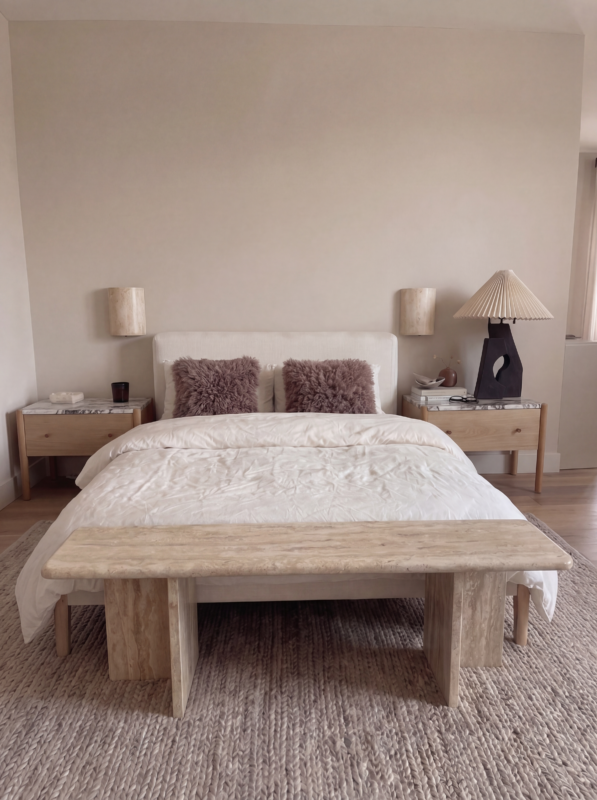
Classic Travertine represents the visual language most people traditionally associate with Turkish travertine: warm cream and beige tones, visible natural pores and softly layered mineral movement.
Its familiarity, however, does not make the material outdated. Contemporary designers are increasingly using Classic Travertine in simplified geometric forms that allow its natural surface to become the primary decorative element.
The bench shown here is a strong example. Instead of relying on ornamental detailing, the design uses substantial stone sections and clean proportions. The simplicity of the form makes the texture and tonal movement of the travertine more noticeable.
A travertine bench can function in several contexts, including bedrooms, entrance halls, dressing areas and larger living spaces. Similar design principles can also be applied to consoles, side tables and architectural seating.
Classic Travertine is equally established as an architectural material. Flooring, wall cladding, staircases, pool surrounds, exterior paving and façade applications remain important uses depending on the required technical specifications and surface treatment.
Cross Cut and Vein Cut Classic Travertine
Classic Travertine can present two substantially different appearances depending on how the block is processed.
Cross cut exposes a more irregular, cloud-like pattern. Natural pores and mineral formations appear in a less directional composition, making the surface visually softer.
Vein cut, by contrast, emphasizes the horizontal geological layers of the stone. The result is more linear and architectural.
Neither is inherently better. The appropriate choice depends on whether the project requires organic movement or stronger directional continuity.
7. Noce Travertine: Warm Brown Tones for Character-Rich Interiors
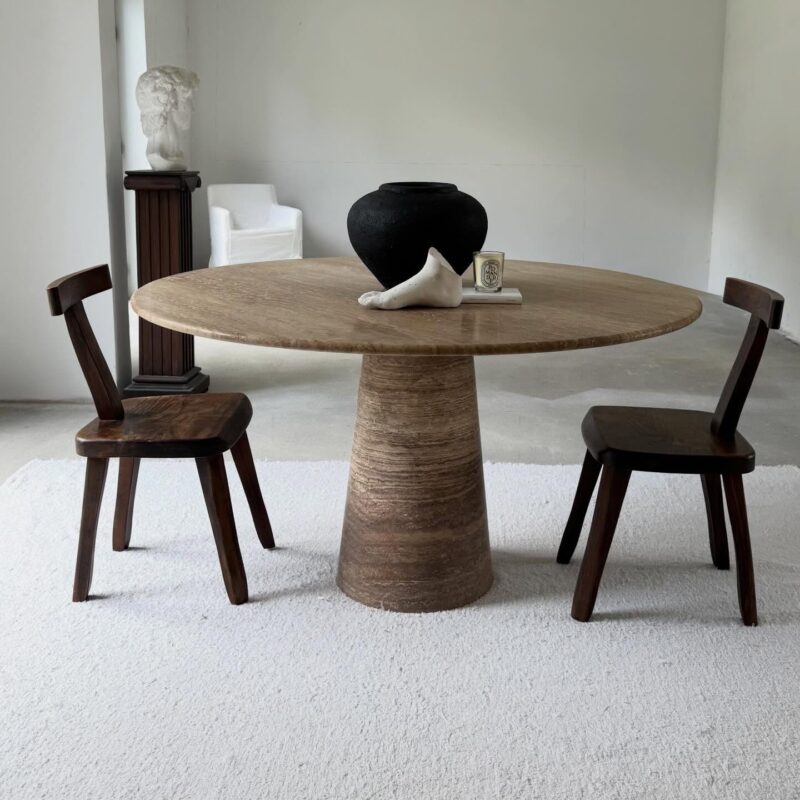
Noce Travertine moves away from the pale neutral tones that dominate many contemporary travertine interiors. Its brown, walnut, taupe and earthy layers give it a warmer and more grounded character.
The round dining table shown here uses this richness effectively. The simple circular top and central pedestal allow the stone’s layered structure to remain the main visual feature.
Noce Travertine is especially effective when designers want natural stone to create contrast rather than disappear into a neutral palette. Against light walls and soft textiles, its deeper tones can anchor the room. When paired with dark timber, it creates a more tonal and atmospheric composition.
Its potential extends beyond dining tables. Noce Travertine can be used for coffee tables, side tables, consoles, bathroom elements, wall surfaces and selected flooring applications.
The stone also demonstrates the diversity of Turkish travertine particularly well. Travertine should not be understood as a single cream-colored material. Different geological formations produce a broad spectrum of tones, and Noce occupies an important position at the darker, warmer end of that range.
8. Red Travertine: A Bold Alternative to Neutral Natural Stone
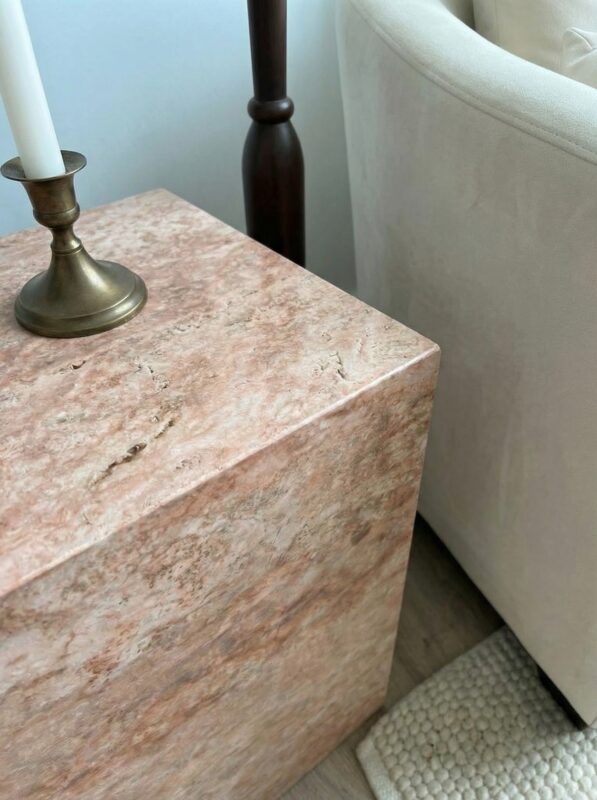
Red Travertine Cube Side Table
Red Travertine provides one of the most distinctive color expressions within the travertine family. Depending on the block and selection, its surface can combine dusty red, terracotta, salmon, rose, beige and earthy mineral tones.
Because of this stronger color identity, Red Travertine is particularly effective when used as a statement material.
The cube side table shown here demonstrates a restrained way of introducing it into an interior. The geometry is extremely simple, allowing the stone itself to provide the decoration. Its natural pores, color variation and mineral formations prevent the cube from feeling visually monolithic.
Red Travertine can be considered for statement furniture, side tables, coffee tables, feature walls, decorative surfaces and other applications where a warmer natural stone accent is desired.
It also pairs effectively with cream upholstery, off-white walls, natural timber and warm metallic details. Designers looking beyond conventional beige travertine can therefore use Red Travertine to retain the tactile character of the material while introducing substantially more color.
What Makes Turkish Travertine Different?
Türkiye’s travertine resources offer considerable diversity in color, geological structure and visual movement. This diversity allows architects to specify the same natural stone family for very different design languages.
A pale Light Travertine dining table can contribute to a soft minimalist interior. Silver Travertine can establish a cooler and more architectural atmosphere. Noce introduces earthy depth, while Red Travertine becomes a statement material. Blended selections such as Royal Blend and Imperial Blend embrace greater natural variation.
This flexibility is one of the reasons Turkish travertine continues to be relevant across residential, commercial and hospitality architecture.
The material can also be processed in numerous ways. Honed, polished, brushed, tumbled, filled and unfilled surfaces each influence the final appearance and tactile quality. Project requirements should therefore consider the stone, cut, finish and application together rather than treating them as independent decisions.
Cross Cut vs. Vein Cut Travertine: What Is the Difference?
The distinction between cross-cut and vein-cut travertine is fundamental when selecting the material.
Vein cut follows the geological layers of the block. This exposes long horizontal bands and creates a directional appearance. Silver Travertine is particularly dramatic when processed this way because its contrasting layers become clearly visible.
Cross cut intersects those layers from another direction, producing a more dispersed pattern. The resulting surface tends to show clouds, rings and irregular formations rather than continuous lines.
For designers, the decision should be aesthetic as well as architectural.
Vein-cut travertine is often selected when strong linearity, vertical emphasis or continuous visual movement is required. Cross-cut material can work especially well when the objective is a softer, more homogeneous surface.
The orientation of individual pieces during installation further changes the final effect, particularly across large floors and walls.
Where Can Turkish Travertine Be Used?
One of travertine’s greatest advantages is its range of potential applications. Appropriate material selection, engineering, finish and installation should always be determined according to the specific environment, but the stone can be processed for numerous architectural and decorative purposes.
Common applications include flooring, wall cladding, bathroom surfaces, sinks, countertops, staircases, fireplaces, façades, terraces, pool areas and custom architectural elements.
Furniture has also become an increasingly important category. Dining tables, coffee tables, side tables, consoles, benches and other objects allow designers to use natural stone as a three-dimensional element rather than simply as a surface covering.
The examples in this article demonstrate this transition clearly. The same natural stone family appears as a bathroom sink, floor, side table, dining table and bench.
Turkish Travertine from Quarry to Finished Design
The final appearance of a travertine product begins long before fabrication.
Block selection influences color consistency and geological movement. Cutting direction determines whether veins appear linear or cloud-like. Surface finishing changes texture and reflectivity. Fabrication determines proportions, joints and edge details. Finally, installation or furniture assembly determines how all of those decisions are experienced in the completed space.
For this reason, understanding the material from the quarry stage can be valuable for natural stone projects.
Efesus Stone combines quarry resources with natural stone manufacturing for architectural applications. Its Emirdağ Silver Travertine quarry in Afyonkarahisar and Denizli Travertine quarry connect two distinctive Turkish travertine sources with subsequent processing and project production.
This quarry-to-production relationship is particularly relevant for architects, designers, contractors and natural stone professionals sourcing Turkish travertine for international projects. Material can be evaluated not simply as an isolated sample but in relation to block characteristics, processing possibilities and the intended finished application.
From Efesus Stone to Efesus Home: Travertine Beyond Architectural Surfaces
Travertine’s role in contemporary design is expanding beyond conventional architectural applications.
While Efesus Stone focuses on natural stone materials, production and project-oriented applications, Efesus Home brings the same material language into furniture and interior objects. Dining tables, coffee tables, side tables, consoles, benches, sinks and custom pieces demonstrate how stone traditionally associated with architecture can become part of everyday interior design.
This connection is visible throughout the examples above.
Silver Travertine becomes a fabricated sink. Royal Blend becomes a compact side table. Light Travertine is shaped into a fluted dining table. Classic Travertine forms an architectural bench. Noce Travertine creates a sculptural pedestal table, while Red Travertine becomes a minimalist cube.
Rather than hiding natural differences between pieces, these designs can use the individuality of the material as part of their identity. Veins, pores, mineral deposits and tonal changes are geological characteristics that make each natural stone object unique.
How to Choose the Right Turkish Travertine
Selecting the right travertine should begin with the intended design rather than color alone. For bright, quiet interiors, Light or Classic Travertine can provide a neutral foundation. For cooler contemporary spaces, Silver Travertine introduces grey and taupe movement. Noce Travertine offers warmer brown tones, while Red Travertine works particularly well as an accent or statement stone.
Royal Blend and Imperial Blend are worth considering when variation itself is part of the design concept.
The second decision is the cut. Vein cut emphasizes geological layers; cross cut creates softer, less directional movement.
The third is finish. A polished surface behaves visually very differently from a honed, brushed, tumbled or naturally textured surface.
Finally, scale matters. A small stone sample cannot always communicate how variation will appear across a complete floor, wall or large furniture piece. For substantial projects, evaluating representative material, slabs or production selections can provide a more realistic understanding of the finished result.
Frequently Asked Questions About Turkish Travertine
What is Turkish travertine?
Turkish travertine is a natural limestone formed through mineral-rich water deposits over geological time. Türkiye contains significant travertine resources with colors ranging from ivory and beige to silver, brown and red.
What are the most popular colors of Turkish travertine?
Light beige and Classic Travertine remain widely recognized, while Silver Travertine has become particularly attractive for contemporary architectural projects. Noce, Red and blended selections provide alternatives for projects requiring stronger color or variation.
What is Silver Travertine?
Silver Travertine is characterized by combinations of grey, silver, taupe, beige and brown mineral layers. Vein-cut production can emphasize these layers and create a highly directional appearance.
Where does Efesus Stone’s Silver Travertine come from?
Efesus Stone operates a Silver Travertine quarry in Emirdağ, Afyonkarahisar, Türkiye. The material can be processed for architectural and custom natural stone applications.
Does Efesus Stone have a travertine quarry in Denizli?
Yes. Efesus Stone also has a travertine quarry in Denizli, a region internationally associated with Turkish light and classic travertine production.
What is the difference between vein-cut and cross-cut travertine?
Vein cut follows the natural sedimentary layers of the stone and creates linear bands. Cross cut intersects these layers and produces a more cloud-like, non-directional pattern.
Can travertine be used for furniture?
Yes. Travertine can be fabricated into dining tables, coffee tables, side tables, consoles, benches, sinks and other custom pieces. The design and structural construction should be planned according to the dimensions and intended use of the finished product.
Is every piece of travertine identical?
No. Travertine is a natural material, so color, pores, veins and mineral patterns vary between blocks and individual pieces. These variations are part of the material’s natural character.