
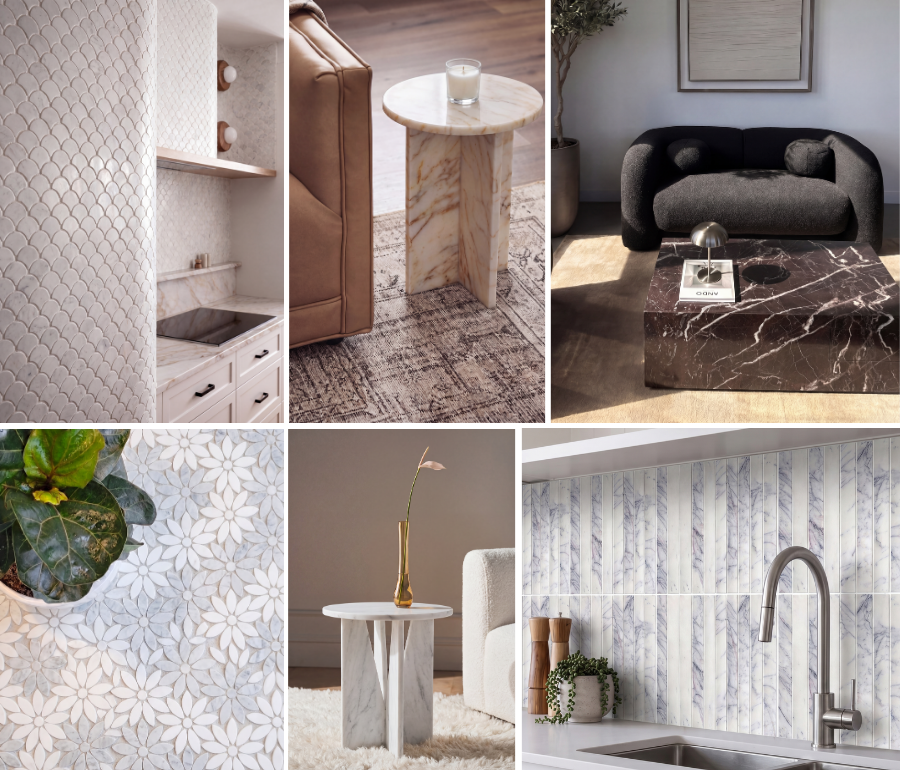
Turkey is one of the world’s most established natural stone sources, with marble varieties ranging from pure white and soft grey to burgundy, lilac and warm beige. Different quarry regions have developed their own recognizable stone identities, making Turkish marble an important material for residential interiors, hospitality projects, commercial spaces, bathrooms, flooring, wall cladding and custom-made furniture.
Among the many marble types from Turkey, certain varieties have become especially recognizable because of their color, veining, architectural versatility and use in international projects. Afyonkarahisar, the Marmara region, Muğla, Burdur and Elazığ are among the areas associated with distinctive Turkish natural stones.
The following selection introduces 10 of the best-known Turkish marble types, focusing not on an official ranking but on their visual character, architectural applications, international recognition and design potential.
1. Afyon White Marble
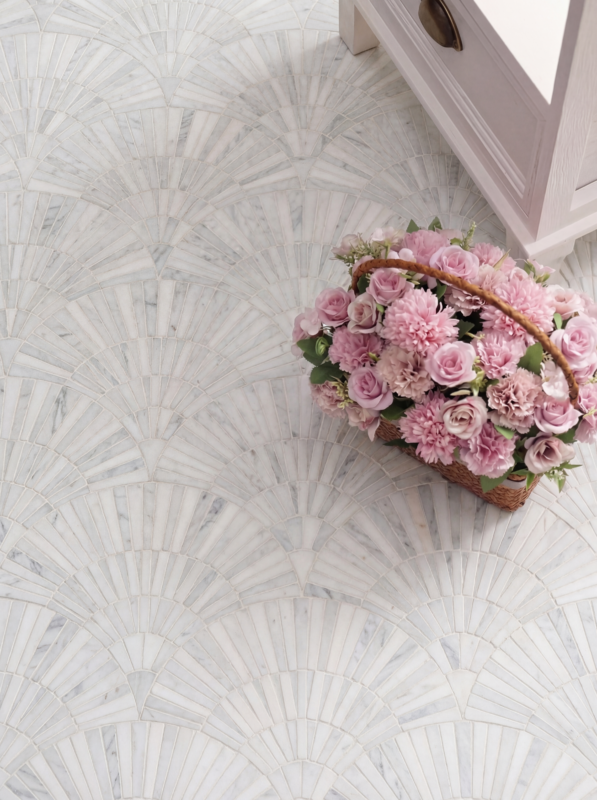
Afyon White Marble Fan Mosaic Flooring
Afyon White Marble is one of the signature white natural stones associated with Turkey and particularly with the Afyonkarahisar region. Its predominantly white background can include subtle grey movement and delicate natural variation, creating a clean surface without making every piece look completely identical.
One of the strengths of Afyon White Marble is its ability to work at different scales. Large-format flooring and wall applications emphasize the stone’s light color, while mosaics and waterjet-cut patterns reveal a more decorative side of the material. The fan-pattern marble mosaic shown here demonstrates how a white marble can gain visual rhythm through geometry rather than relying on dramatic veining.
Afyon White can be considered for bathrooms, flooring, wall cladding, mosaics, countertops, fireplaces, decorative elements and custom architectural details. Its neutral palette also makes it easier to combine with wood, brass, darker natural stones and contemporary interior materials.
For architects and designers searching for Turkish white marble, Afyon White remains an important material to consider because it can move between classical detailing and contemporary architectural applications.
2. Marmara White / Marmara Equator Marble
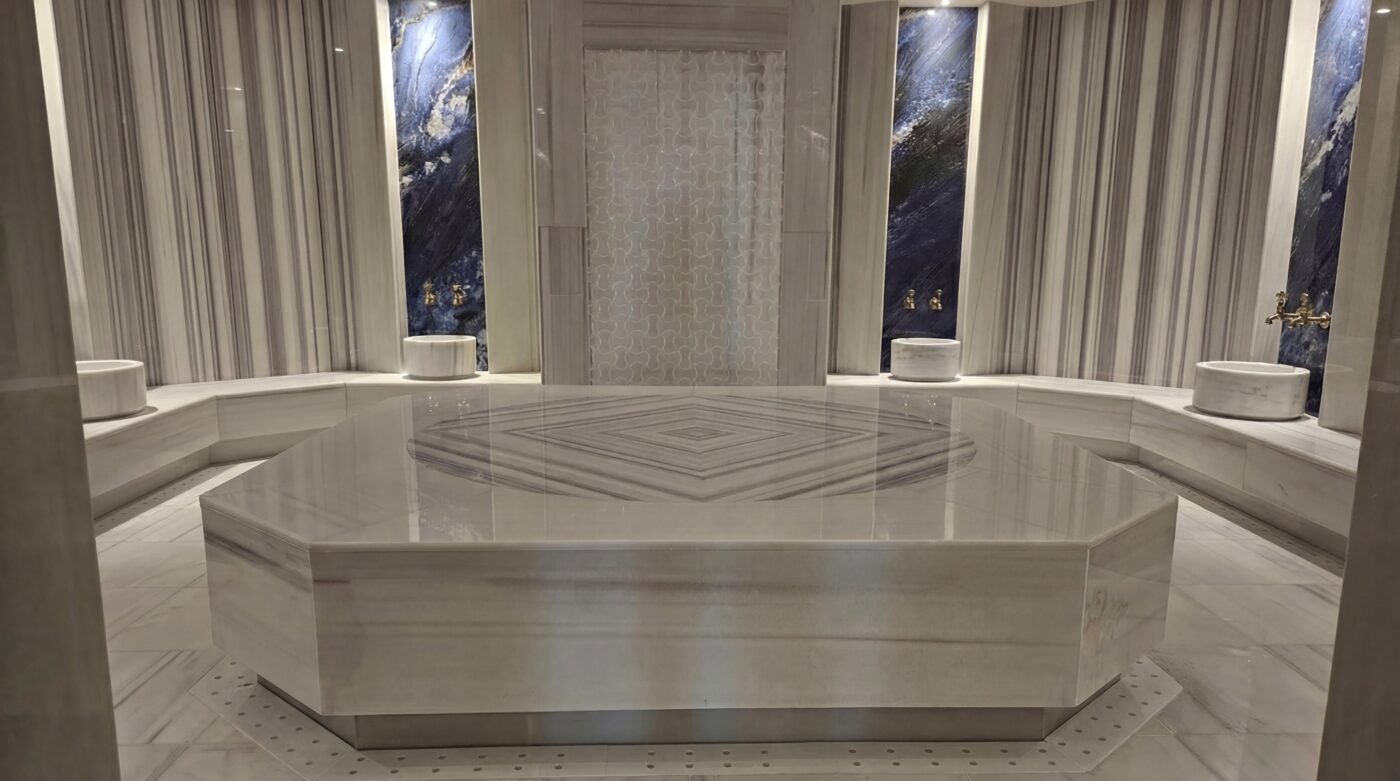
Marmara Marble Turkish Bath / Hammam Interior
Few Turkish stones are as immediately recognizable as Marmara Marble. Its white to light-grey background is crossed by relatively linear grey bands, creating the striped appearance for which Marmara White and Marmara Equator are internationally known.
This linear structure becomes especially effective when pieces are carefully selected and installed with attention to vein direction. Instead of treating each tile as an isolated surface, designers can use the natural bands to establish continuous visual movement across walls, floors, benches and architectural elements.
The image above demonstrates one of the stone’s most characteristic applications: a Turkish bath or hammam. Marmara Marble has a particularly strong connection with bathroom, spa and hammam architecture, where its cool grey-and-white palette works naturally with large stone surfaces.
Beyond hammams, Marmara Marble can be used for bathroom walls, flooring, vanity areas, stairs, wall cladding, countertops and bespoke architectural components. For international searches involving Turkish striped marble, Marmara Equator Marble and Marmara White Marble are among the most relevant names.
3. Elazığ Vişne Marble
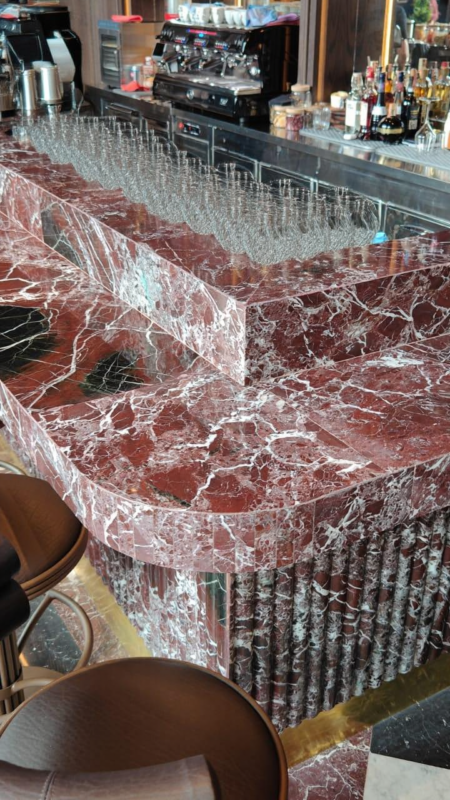
Elazığ Vişne Marble Bar Counter
Elazığ Vişne Marble represents a completely different side of Turkish marble. Rather than neutral white, grey or beige, this stone is characterized by a deep burgundy to cherry-red background intersected by contrasting white veins.
The strong contrast gives Elazığ Vişne Marble considerable visual presence. In the bar application shown above, the material is used across a large surface and continues onto detailed architectural sections, allowing its network of white veining to become one of the defining elements of the interior.
Because of its expressive color, Elazığ Vişne does not necessarily need to cover an entire room. It can be particularly effective as a focal material for bar counters, reception desks, dining tables, coffee tables, wall panels, fireplace surrounds and other statement pieces.
When paired with wood, brass, dark metal or neutral textiles, its burgundy color can become even more pronounced. For designers looking beyond conventional white marble, Elazığ Vişne demonstrates the diversity available within Turkish natural stone.
4. Milas Lilac Marble
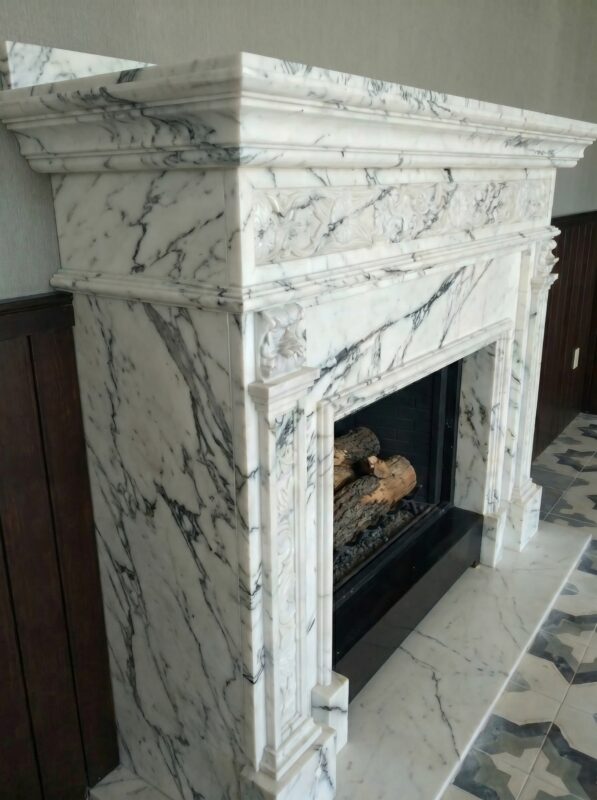
Milas Lilac Marble is known for its light background combined with distinctive grey, violet and lilac-toned veining. The contrast between the pale base and irregular darker veins makes each slab visually individual.
This character is particularly suitable for applications where the stone itself is intended to become an architectural feature. The carved fireplace shown here demonstrates this clearly. Detailed profiles and decorative carving give the material a classical form, while its irregular natural veining prevents the finished piece from appearing overly uniform.
Milas Lilac Marble can be used for fireplaces, feature walls, bathroom surfaces, vanity tops, flooring, tables, consoles and bespoke stone elements. Depending on slab selection and vein intensity, it can create anything from a relatively restrained white marble surface to a much more expressive composition.
For global design projects, Lilac Marble has become one of the recognizable names associated with premium white Turkish marble with purple or violet veining.
5. Muğla White Marble
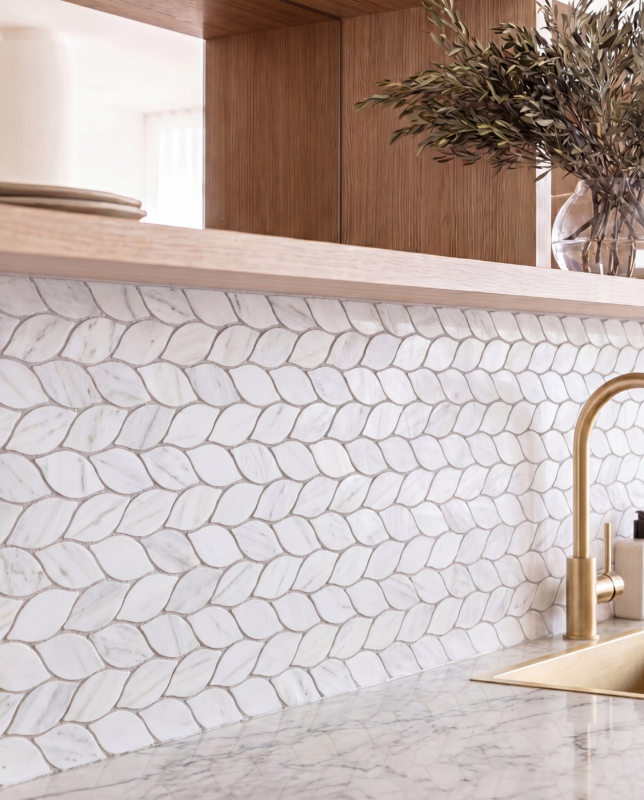
Muğla White Marble Mosaic Backsplash
Muğla is another important Turkish natural stone region associated with high-quality white marble. Muğla White Marble generally offers a light, clean appearance with subtle natural markings that allow it to function as both a primary architectural surface and a material for detailed decorative work.
The mosaic backsplash shown above illustrates the latter. Instead of using the stone as a conventional rectangular tile, individually shaped marble pieces form an organic repeating pattern. The subtle variation within the white stone prevents the installation from becoming visually flat.
Muğla White works especially well in kitchens and bathrooms, where it can be incorporated into backsplashes, mosaics, vanity areas, floors and wall coverings. It can also be considered for larger architectural surfaces, stairs and custom stone fabrication.
Its relatively neutral visual language gives architects considerable freedom when combining it with timber cabinetry, metallic fixtures and other natural stones.
6. Afyon Sugar Marble
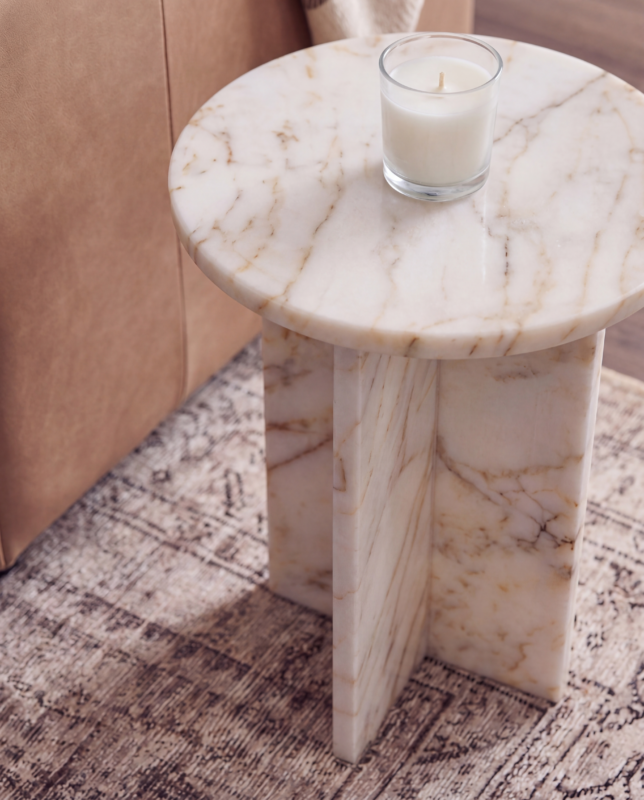
Afyon Sugar Marble is another notable marble associated with Afyonkarahisar. Its light crystalline appearance distinguishes it from more heavily veined white marbles and gives the material a soft visual depth when viewed under natural or artificial light.
While white marble is frequently associated with flooring and bathrooms, Afyon Sugar Marble also performs effectively at furniture scale. The side table pictured above allows the material to be viewed from several directions, revealing natural tonal movement across both the circular top and vertical supports.
This makes Afyon Sugar suitable for coffee tables, side tables, consoles, decorative objects, bathrooms, wall applications and other custom-fabricated elements in addition to conventional architectural surfaces.
The stone also illustrates an important characteristic of natural marble: even stones described broadly as “white marble” can have substantially different crystal structures, tones and visual identities depending on their geological origin.
7. Tundra Grey Marble
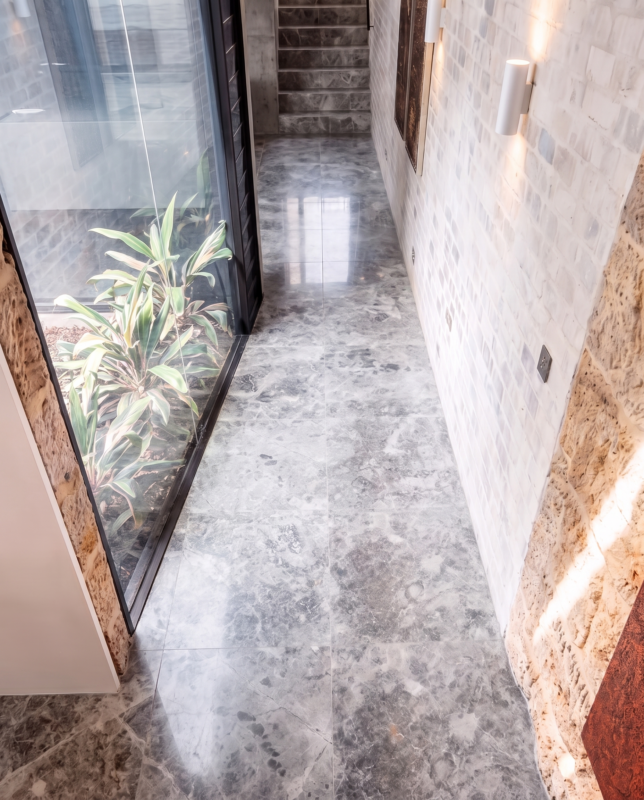
Tundra Grey Marble Interior Flooring
Grey has become an important neutral within contemporary architecture, and Tundra Grey Marble is one of the Turkish stones frequently associated with this palette. Its surface combines different shades of grey with cloud-like movement and natural tonal variation.
Compared with a uniformly manufactured grey surface, Tundra Grey provides considerably more depth. Individual tiles can range from relatively quiet sections to pieces with stronger mineral movement, allowing designers to create either a controlled selection or a deliberately varied installation.
The flooring shown here demonstrates how this variation becomes particularly effective across larger areas. Light entering the interior changes the appearance of the polished stone throughout the space and makes the grey surface feel less static.
Tundra Grey can be considered for flooring, bathrooms, wall cladding, stairs, fireplaces, commercial interiors and hospitality projects. Its neutral color also pairs easily with white marble, timber, black metal and warmer beige materials.
8. Diana Royal Marble
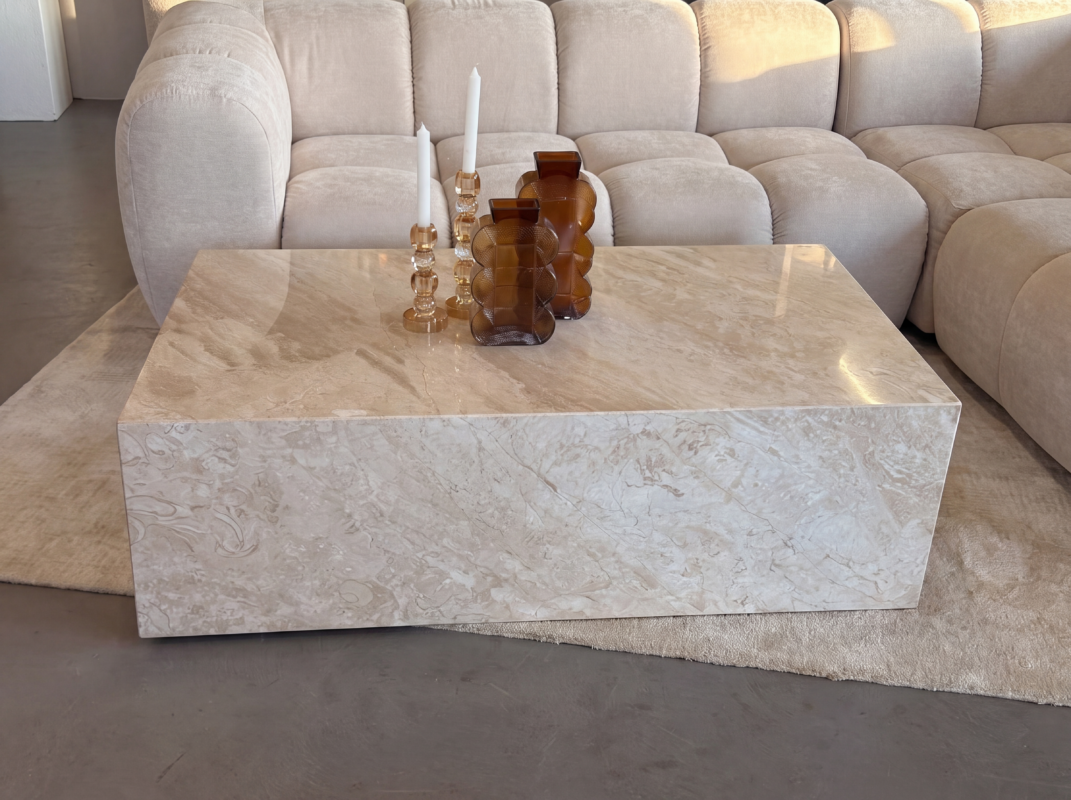
Diana Royal Marble Coffee Table
Diana Royal Marble introduces warmer tones into the list. Characterized by beige, cream and subtle earthy movement, it provides an alternative for interiors where pure white or cool grey marble may feel too stark.
The large coffee table shown above uses Diana Royal Marble as the dominant surface of the piece. Because the design has a simple geometric form, attention naturally shifts toward the stone’s cloudy movement and variations in tone.
Diana Royal is suitable for flooring, wall cladding, bathrooms, hotel interiors, fireplaces, stairs and custom furniture. Its warm neutral palette makes it particularly compatible with cream upholstery, timber, bronze details and other earthy interior finishes.
For architects sourcing beige Turkish marble, Diana Royal is a useful option when the objective is to maintain the visual richness of natural stone without introducing extremely strong color contrast.
9. Rosso Levanto Marble
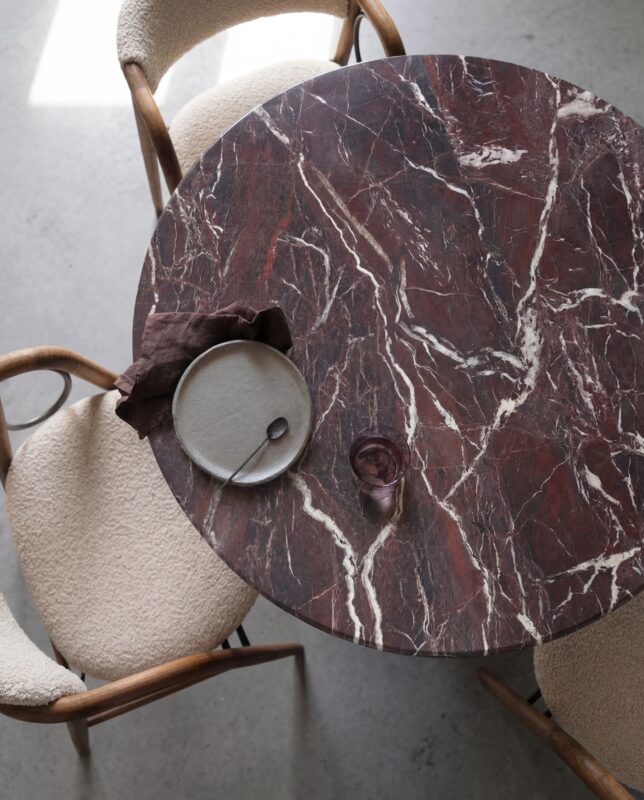
Rosso Levanto Marble Dining Table
Rosso Levanto is one of the most dramatic stones in this selection. Its deep red to burgundy background is crossed by irregular white and lighter mineral veins, creating a high-contrast natural pattern.
The dining table shown above demonstrates why this type of stone is frequently chosen for furniture and statement applications. A simple circular tabletop becomes visually dominant because the marble itself provides the decoration.
Rosso Levanto Marble works especially well for dining tables, coffee tables, side tables, bathroom vanities, sinks, wall panels, bar counters and other feature surfaces. It can be combined with cream upholstery and warm timber to soften the composition or paired with darker finishes for a more dramatic result.
In interiors dominated by neutral materials, even a relatively small Rosso Levanto element can become the visual anchor of the room.
10. Afyon Grey / Blue Moon Marble
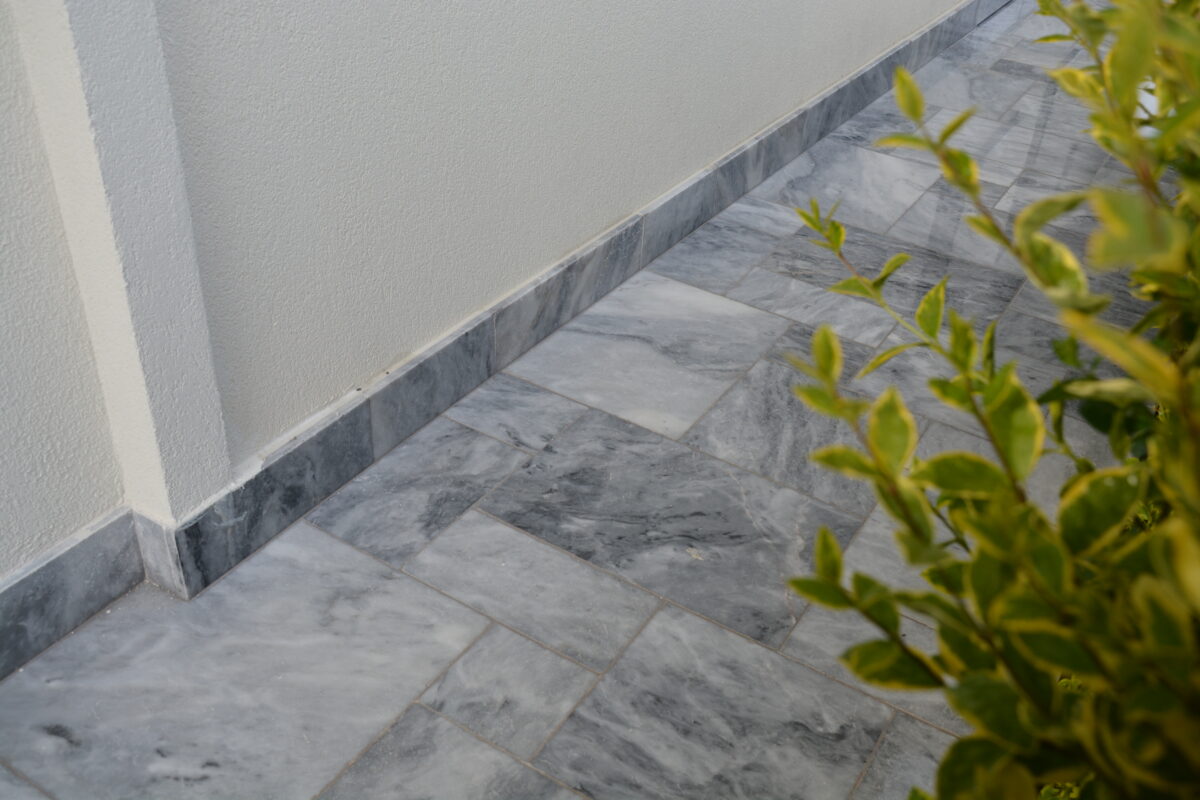
Afyon Grey / Blue Moon Marble Flooring
Completing the selection is Afyon Grey Marble, also known in the market as Blue Moon Marble. The stone is characterized by grey, silver and blue-grey tones with natural cloudy movement that creates considerable variation across the surface.
The flooring application shown above illustrates how the stone behaves across multiple pieces. Rather than producing an artificial repeating pattern, each section contributes different shades and markings while remaining within the same overall grey palette.
Afyon Grey can be used for interior flooring, wall cladding, bathrooms, stairs, fireplaces and custom-made stone elements. Its cooler appearance makes it particularly suitable for contemporary interiors where designers want more natural movement than a uniform grey surface can provide.
For international projects searching for grey Turkish marble, Blue Moon and Afyon Grey provide another distinctive option originating from Turkey’s natural stone landscape.
Why Is Turkish Marble Important in Global Architecture?
The importance of Turkish marble cannot be reduced to a single white or beige variety. One of Turkey’s greatest strengths as a natural stone source is the diversity of materials available within the country.
The ten stones above demonstrate this range clearly: Afyon White and Muğla White provide light neutral surfaces; Marmara Marble introduces linear grey movement; Tundra Grey and Afyon Grey address contemporary grey palettes; Diana Royal offers warmer beige tones; while Elazığ Vişne and Rosso Levanto introduce strong burgundy colors.
This variety gives architects, interior designers, contractors and natural stone distributors the opportunity to source materials for very different design concepts from the same country of origin.
Another important advantage is fabrication versatility. Depending on the properties of the selected material and project requirements, Turkish marble can be transformed into slabs, cut-to-size tiles, mosaics, stairs, countertops, wall panels, fireplaces, sinks, tables and other bespoke architectural components.
Turkish Marble for Architecture and Custom Design
Selecting marble for a project involves more than choosing a color from a photograph. Slab selection, vein direction, finish, thickness, dimensions, edge details and fabrication methods can substantially change how the final material appears.
Large architectural surfaces may require consistent block and slab selection, while custom furniture often benefits from carefully positioning the most expressive areas of a slab. Vein matching can also become important for wall panels, fireplaces and large-format installations.
Finishing is another consideration. Polished surfaces emphasize color and veining, while honed finishes generally create a softer and more matte appearance. Other finishes may be selected depending on the stone and intended application.
For this reason, architects and buyers sourcing marble from Turkey should evaluate not only the marble variety but also the supplier’s ability to select, process and fabricate the material according to project specifications.
Efesus Stone and Turkish Marble Production
Efesus Stone by Reisoğlu Mermer works with Turkish natural stones for architectural and international project requirements, combining long-standing natural stone experience with modern fabrication capabilities.
With a company history dating back to 1943, the production approach extends beyond supplying standard slabs and tiles. Natural stone can be processed for cut-to-size architectural elements, mosaics, CNC applications, waterjet designs and project-specific fabrication.
This is particularly important for materials such as Afyon marble, where the same stone may be required in several different formats within one project. Flooring, wall cladding, stairs, mosaics and custom architectural components can require different dimensions and fabrication methods while still needing to maintain visual continuity.
For architects, contractors, designers and natural stone distributors, working directly with an experienced Turkish stone producer can also simplify material selection and technical communication during the sourcing process.
How to Choose the Right Turkish Marble
There is no single Turkish marble that is ideal for every project. The appropriate material depends on the desired visual effect, application, finish, maintenance expectations and technical requirements.
For light and bright interiors, Afyon White, Muğla White and Afyon Sugar are strong candidates. Marmara Marble works particularly well when linear grey movement is part of the design concept. Tundra Grey and Afyon Grey suit contemporary grey palettes, while Diana Royal provides warmer beige tones.
For statement applications, Elazığ Vişne, Rosso Levanto and Milas Lilac provide considerably stronger visual contrast.
The final decision should therefore be based on actual slab or production selection whenever possible rather than relying exclusively on a small sample. Natural marble contains geological variation, and this variation is precisely what gives each finished project its individual character.
Frequently Asked Questions About Turkish Marble
What is Turkish marble?
Turkish marble refers to natural marble quarried in different regions of Turkey. The country produces numerous white, grey, beige, red and veined marble varieties used in architectural and interior design projects worldwide.
What are the most famous Turkish marbles?
Well-known examples include Afyon White Marble, Marmara Marble, Milas Lilac Marble, Muğla White Marble, Elazığ Vişne Marble, Tundra Grey Marble and several other regional varieties.
Where does Afyon White Marble come from?
Afyon White Marble is associated with the Afyonkarahisar region of Turkey, one of the country’s historically important natural stone production areas.
What is Marmara Equator Marble?
Marmara Equator is a Turkish marble recognized for its white-to-light-grey background and distinctive parallel grey stripes. It is particularly associated with bathrooms, hammams, flooring and wall applications.
Is Turkish marble suitable for furniture?
Yes. Depending on the selected material and engineering of the piece, marble can be fabricated into dining tables, coffee tables, side tables, consoles, sinks and other custom furniture. Afyon Sugar, Diana Royal and Rosso Levanto are examples shown in this article.
What colors of marble are available from Turkey?
Turkish marble is available in a broad palette including white, cream, beige, grey, blue-grey, burgundy, red and lilac-veined varieties.
Can Turkish marble be custom fabricated?
Yes. Natural stone can be produced in slabs and tiles or fabricated into cut-to-size pieces, mosaics, stairs, countertops, fireplaces, sinks, CNC details and other project-specific elements depending on the characteristics of the stone.
What should architects consider when sourcing Turkish marble?
In addition to color, architects should evaluate slab selection, variation, dimensions, thickness, finish, vein direction, fabrication requirements, installation conditions and the technical suitability of the selected material for the intended application.