
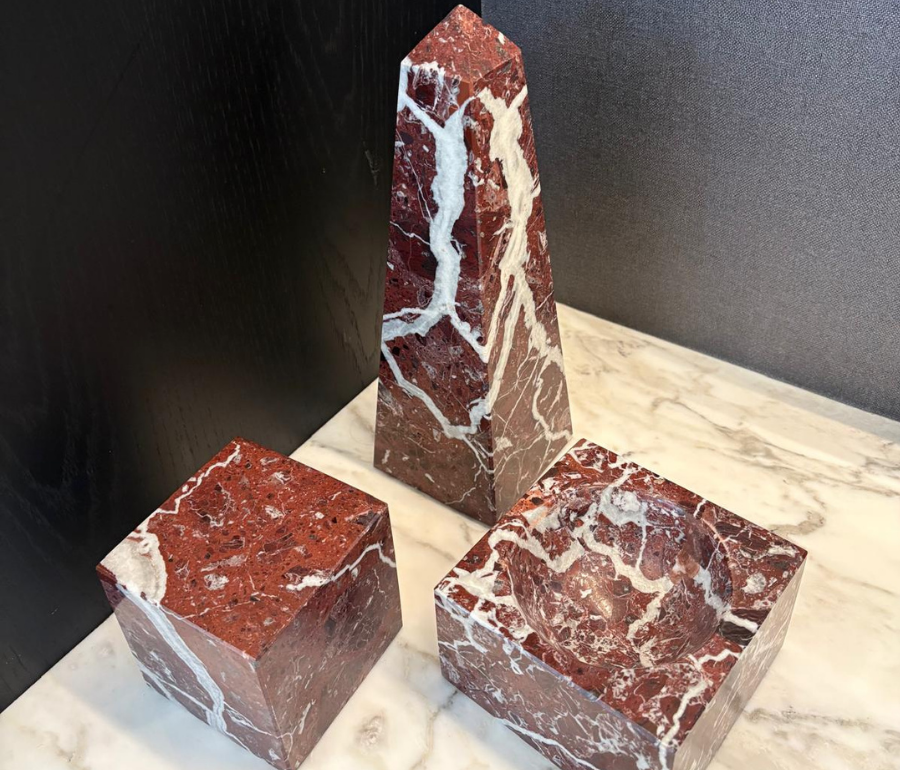
Natural stone has long been recognized as one of architecture’s most enduring materials, valued not only for its durability but also for its ability to shape the identity of a space. Every slab tells a geological story through unique veining, mineral formations, and natural color variations that cannot be replicated by engineered materials. Rather than serving as a simple surface finish, natural stone establishes atmosphere, defines focal points, and creates visual continuity throughout an interior.
Among the world’s most distinctive decorative marbles, Rosso Levanto Marble is celebrated for its rich burgundy background intersected by expressive white calcite veining. Quarried in Italy, this iconic marble has been specified for luxury residences, boutique hotels, prestigious commercial interiors, and custom furniture for decades. Its deep color palette immediately introduces warmth, sophistication, and architectural character, allowing even small applications to become visually dominant elements within a project.
One of the greatest strengths of Rosso Levanto Marble is its versatility. While it is widely recognized for wall cladding and statement surfaces, it performs equally well in smaller architectural components such as sinks, coffee tables, fireplace surrounds, reception desks, and decorative flooring. Repeating the same marble across multiple scales creates a unified material language while allowing each application to express a different aspect of the stone’s natural beauty.
This article explores three distinctive applications of Rosso Levanto Marble. The first examines custom marble sink designs, the second focuses on sculptural natural stone coffee tables, and the third highlights checkerboard flooring created by combining Rosso Levanto Marble with Burdur Beige Marble. Together, these examples demonstrate how a single natural stone can create different architectural expressions throughout an interior.
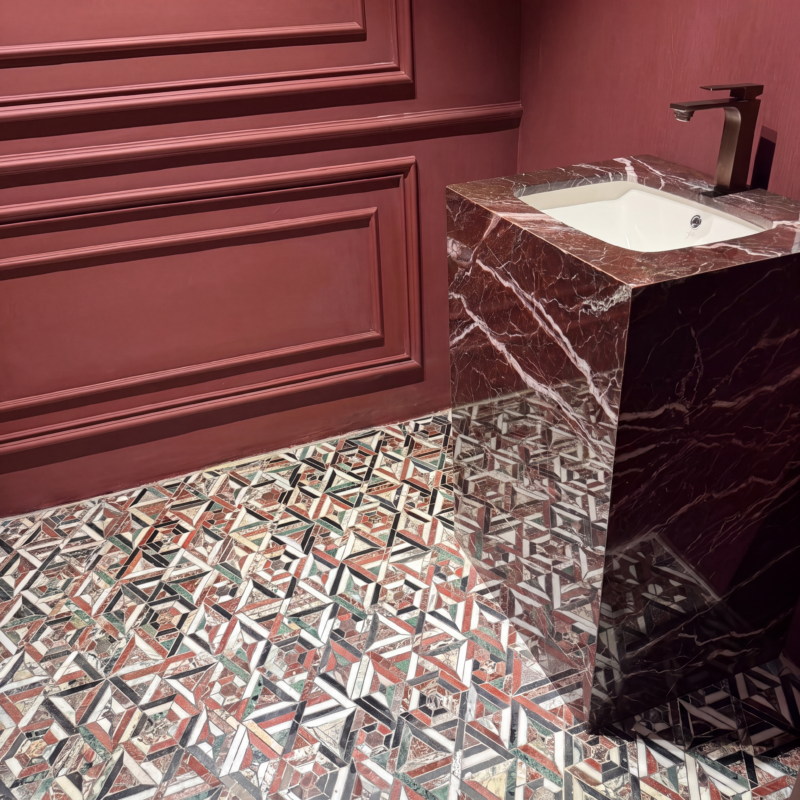
Custom Sink Crafted from Rosso Levanto Marble
Custom Sink Designs with Rosso Levanto Marble
Bathrooms have evolved into carefully designed wellness spaces where material selection plays an essential role in defining the overall atmosphere. Instead of relying on standard ceramic fixtures, architects increasingly specify natural stone elements that introduce individuality and architectural depth. Among these, Rosso Levanto Marble offers a distinctive alternative through its dramatic color palette and naturally expressive veining.
The deep burgundy background immediately distinguishes the sink from surrounding materials. White calcite veins move naturally across the surface, creating a composition that changes depending on viewing angle and lighting conditions. Since every marble block forms differently over millions of years, no two Rosso Levanto sinks are identical, making each installation entirely unique.
Monolithic sink designs emphasize the stone’s sculptural quality. Whether carved from a solid block or fabricated through precision slab construction, the goal is to preserve visual continuity across every visible surface. When the veining continues seamlessly from the countertop to the sink body, the entire piece appears to have been carved from a single mass of natural stone.
Material coordination is equally important. Rosso Levanto Marble pairs exceptionally well with warm neutral plaster walls, textured limestone finishes, walnut cabinetry, brushed brass fixtures, and matte black faucets. While darker surrounding materials strengthen the marble’s dramatic appearance, lighter finishes allow the burgundy tones to become the primary focal point without overwhelming the space.
Careful slab selection is fundamental during fabrication. The strongest veins should be positioned where they enhance the geometry of the sink rather than interrupt it. Corners, front edges, and integrated drain areas require precise planning to preserve the natural movement of the stone. High-quality fabrication ensures that transitions between surfaces remain visually continuous.
Surface finish significantly influences the final appearance. A polished finish deepens the burgundy color while increasing contrast within the white veining. A honed finish offers a softer, more understated character that complements contemporary minimalist interiors. The appropriate finish should be selected according to both aesthetic preference and the overall design concept.
Lighting further enhances the architectural presence of Rosso Levanto Marble. Natural daylight reveals subtle tonal variations throughout the day, while warm artificial lighting enriches the stone’s depth and visual warmth. Wall-mounted sconces, concealed LED lighting, or carefully positioned ceiling fixtures can all emphasize the marble’s unique mineral composition.
Rather than functioning solely as a bathroom fixture, a Rosso Levanto Marble sink becomes a sculptural centerpiece that establishes the visual identity of the entire bathroom. This ability to combine craftsmanship, natural beauty, and architectural permanence explains why it continues to be specified in high-end residential and hospitality projects worldwide.
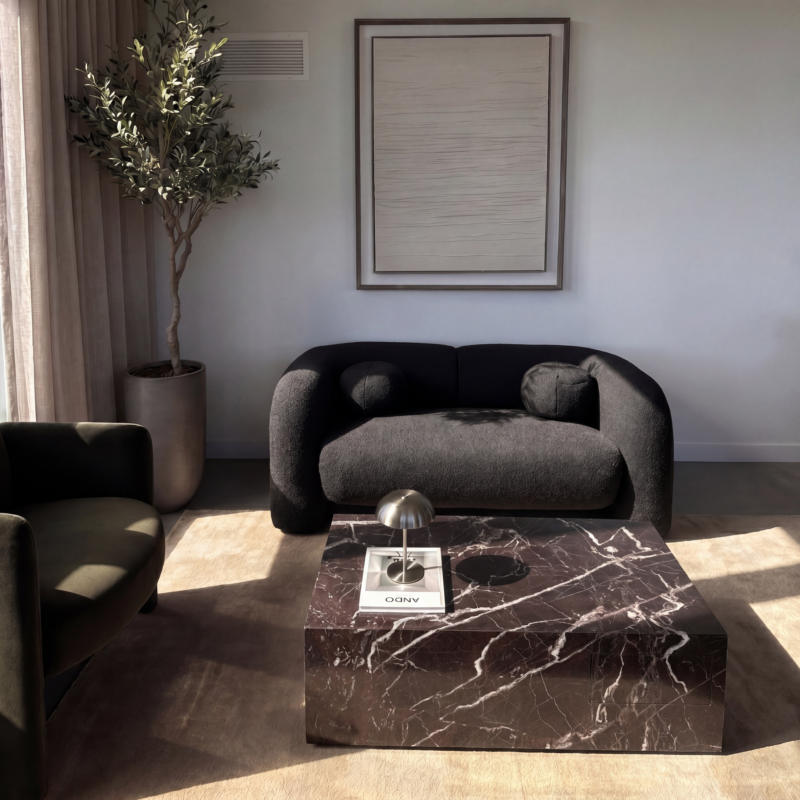
Sculptural Coffee Table Crafted from Rosso Levanto Marble
Sculptural Coffee Table Designs with Rosso Levanto Marble
Natural stone furniture has become an important part of contemporary interior architecture. Coffee tables, side tables, consoles, and custom furniture pieces are no longer treated only as functional objects; they are increasingly designed as architectural elements that define the atmosphere of a room. Rosso Levanto Marble is particularly suitable for this approach because its saturated burgundy background and expressive white veining create immediate visual impact, even when used in compact furniture applications.
Simple geometric forms allow the marble to remain the primary design feature. Rectangular blocks, softly rounded volumes, monolithic bases, and substantial tabletops emphasize the weight and permanence of the stone without relying on excessive ornamentation. When the form is restrained, attention naturally shifts toward the mineral movement, color transitions, and unique veining of the marble.
Vein continuity plays a major role in the quality of a Rosso Levanto Marble coffee table. If the strongest white veins continue from the tabletop onto the side panels, the furniture appears to have been carved from a single block. Achieving this result requires careful slab mapping before fabrication. The top, front, and side surfaces must be planned together so that the natural pattern remains visually connected across every corner.
Random cutting can interrupt the flow of the stone and make the table appear fragmented. By contrast, precise vein matching gives the furniture a more refined and cohesive character. This is especially important in minimalist designs, where the marble surface carries most of the visual responsibility and every joint remains visible.
The deep color of Rosso Levanto Marble requires thoughtful coordination with surrounding materials. Neutral sofas in cream, beige, warm gray, or soft brown allow the coffee table to remain the main focal point without making the room feel overly dark. Natural oak, walnut flooring, textured rugs, linen upholstery, and matte wall finishes create a softer environment around the marble and balance its rich burgundy tone.
Metal details can shift the style of the furniture significantly. Brushed brass and bronze reinforce the warmth of the marble, while matte black steel gives the table a more contemporary and graphic appearance. Fully stone-clad designs create a stronger monolithic effect, whereas slim metal bases make the furniture appear visually lighter. The most suitable construction depends on the dimensions of the room, the weight of the stone, and the intended architectural language.
Surface finish also changes how the marble is perceived. A polished finish intensifies the burgundy background and creates stronger contrast between the dark surface and white veins. It also reflects surrounding light, making the table more visually active throughout the day. A honed finish offers a softer, more tactile appearance and may be better suited to interiors that prioritize natural textures and reduced reflectivity.
Scale should always be considered carefully. In large living rooms, a wide and low Rosso Levanto Marble coffee table can anchor the seating arrangement and create a strong central composition. In smaller interiors, compact side tables or thinner tabletop designs allow the material to remain present without overwhelming circulation or reducing visual openness.
Repeating Rosso Levanto Marble in other areas of the interior can strengthen material continuity. A coffee table may be connected visually to a fireplace surround, console table, decorative pedestal, or bathroom sink fabricated from the same stone. Controlled repetition creates a unified design language while allowing each application to express a different aspect of the marble.
Slab Selection and Craftsmanship in Custom Natural Stone Furniture
The final quality of custom marble furniture depends heavily on slab selection. Rosso Levanto Marble can vary significantly in burgundy intensity, vein thickness, and the distribution of white calcite formations. Since a coffee table is viewed from close range and from multiple angles, the selected slab must be evaluated not only for color but also for how its veining will interact with the furniture form.
A large central vein may be positioned intentionally across the tabletop to create a strong visual axis. Finer, branching veins can be distributed across the surface to produce a more balanced and intricate composition. In interiors that already contain several patterned materials, quieter slabs may be more appropriate. In restrained spaces, more expressive slabs can become the main decorative feature.
Edge detailing directly influences the perceived thickness and weight of the table. Solid stone produces a naturally substantial appearance, while mitered construction can create the impression of a thick block with less material. In a mitered design, the tabletop and side panels are cut at 45-degree angles and joined precisely. Accurate fabrication is essential to preserve clean edges and natural vein continuity.
Structural planning is equally important because natural stone furniture can be extremely heavy. Hidden steel frames may be incorporated to improve stability and long-term performance, particularly in large tables. Protective pads beneath the base help prevent damage to both the flooring and the marble edges. Transportation routes, doorway dimensions, lifting requirements, and final installation should all be evaluated before production begins.
Appropriate surface protection supports long-term use. Natural stone sealers can reduce the speed at which liquids penetrate the surface, while coasters and protective pads help minimize contact with hot objects, acidic beverages, and abrasive accessories. Spills should be cleaned promptly, and pH-neutral products should be used for routine care.
When slab selection, structural design, vein planning, and fabrication quality are considered together, a Rosso Levanto Marble coffee table becomes more than a decorative trend. It develops into a long-lasting architectural furniture piece that gains character over time and offers different visual details from every viewpoint.
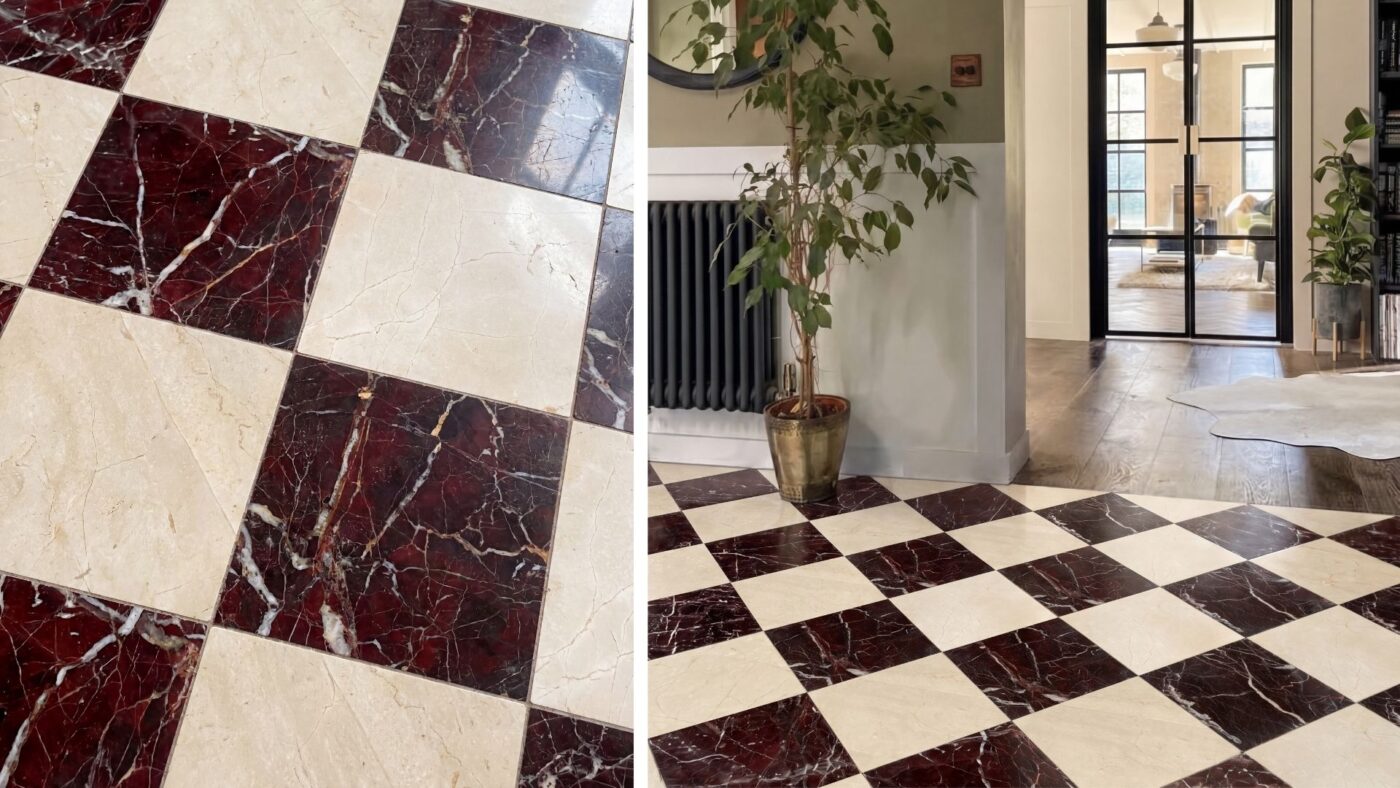
Checkerboard Flooring Designed with Rosso Levanto Marble and Burdur Beige Marble
Checkerboard Flooring with Rosso Levanto and Burdur Beige Marble
Natural stone flooring has a major influence on how an interior is perceived because it forms one of the largest and most continuous architectural surfaces. Color, module size, layout direction, joint planning, and stone selection all affect the rhythm and scale of the room. Combining Rosso Levanto Marble with Burdur Beige Marble in a checkerboard layout creates a distinctive floor that connects classical geometry with the natural variation of genuine stone.
Checkerboard flooring has been used for centuries in residences, public buildings, hospitality interiors, and formal entrance halls. Although it is often associated with traditional European architecture, the pattern can be adapted easily to contemporary projects by changing the dimensions, finish, and surrounding materials. Large-format modules create a cleaner and more architectural interpretation, while smaller squares produce a denser rhythm suited to corridors, entryways, and decorative zones.
Rosso Levanto introduces depth through its burgundy background and expressive white veining. Burdur Beige provides a quieter visual field with warm cream and beige tones. This relationship is important because pairing two highly active stones can make the floor appear visually crowded. The more restrained appearance of Burdur Beige allows Rosso Levanto to remain prominent while maintaining balance across the entire surface.
The checkerboard pattern becomes clearer because of the contrast between the two marbles. However, the transition is warmer and softer than a conventional black-and-white floor. Burgundy and beige create a layered palette that works naturally with timber furniture, bronze finishes, warm plaster walls, and neutral fabrics. This makes the combination suitable for interiors seeking visual definition without relying on an extremely sharp monochrome contrast.
Module size should respond to the dimensions of the room. Oversized squares can strengthen the scale of a hotel lobby, gallery, restaurant, or spacious residential entrance. Medium modules work well in dining rooms and circulation areas, while smaller pieces may be used for framed zones, stair landings, and decorative borders. The layout should be planned in relation to walls, door openings, columns, and fixed furniture to avoid narrow or irregular cuts at the edges.
The orientation of the checkerboard pattern also changes the spatial effect. Aligning the modules with the walls creates a formal and orderly composition. Rotating the pattern diagonally introduces greater movement and can make a narrow room feel wider. In either arrangement, accurate setting-out is essential because even minor alignment errors become visible across the repeated geometry.
Slab selection must be completed before fabrication and installation. Rosso Levanto pieces should be distributed so that extremely dark or heavily veined sections do not collect unintentionally in one area. Burdur Beige tiles should also be reviewed for tonal variation. Mapping the pieces in advance allows the finished floor to appear deliberately composed rather than randomly assembled.
Surface finish influences both the appearance and functional performance of the flooring. Polished marble produces stronger reflections and intensifies the contrast between burgundy and beige. It may be suitable for formal interiors with controlled traffic conditions. Honed finishes reduce glare and create a softer, more contemporary surface. The choice should consider the location, anticipated foot traffic, maintenance requirements, and slip-resistance needs of the project.
Lighting further changes how the checkerboard floor is perceived. Daylight makes the beige sections appear lighter and reveals subtle tonal shifts within the Rosso Levanto pieces. Warm artificial lighting strengthens the burgundy and cream palette, while neutral lighting provides a more accurate view of both stones. Pendant fixtures, wall sconces, and concealed lighting can be positioned to support the geometry rather than producing distracting reflections.
Creating Balance Between Expressive and Neutral Natural Stones
Successful natural stone combinations depend on balance rather than contrast alone. Rosso Levanto Marble has a strong visual identity, so pairing it with a calmer stone allows its color and veining to remain legible. Burdur Beige Marble performs this role effectively because its warm neutral background relates naturally to the red and brown undertones within Rosso Levanto.
This combination can extend beyond checkerboard flooring. Burdur Beige may be used on larger wall surfaces, staircases, or surrounding floor areas, while Rosso Levanto appears in borders, thresholds, reception desks, furniture, or decorative inserts. Repeating the burgundy stone selectively creates continuity without allowing it to dominate every part of the project.
Rosso Levanto can also be paired with other light natural stones. Afyon White Marble creates a brighter and more graphic contrast, while Carrara Marble introduces softer gray veining. Light travertine produces a more textured and earth-based palette. The appropriate pairing depends on the desired atmosphere, the scale of the application, and the materials already present within the interior.
When using multiple stones, designers should compare actual slabs rather than relying only on small samples or digital images. Natural stone can vary between blocks, and undertones that appear compatible in photographs may behave differently under project lighting. Viewing the stones together helps confirm whether the beige, white, gray, or cream tones support the burgundy background of Rosso Levanto.
Joint color also affects the relationship between the stones. A neutral grout close to Burdur Beige creates a softer overall field, while a slightly darker joint emphasizes the grid. In most refined interiors, restrained joint colors allow the marble modules and their natural variation to remain the primary visual feature.
Using Rosso Levanto Marble Across Different Architectural Scales
One of the strongest advantages of Rosso Levanto Marble is its ability to retain a recognizable identity across very different applications. In a custom sink, the stone is experienced at close range through water, light, and touch. In a coffee table, it becomes a sculptural furniture material positioned at the center of the living space. In checkerboard flooring, it contributes to a repeated geometric system that defines the scale and movement of the interior.
Repeating the same marble at different scales creates material continuity without requiring every surface to use the same finish or format. A polished Rosso Levanto sink may be paired with a honed furniture piece and calibrated floor tiles. Although the tactile qualities differ, the shared burgundy color and white veining connect the applications visually.
This strategy is especially effective in custom residences and boutique hospitality projects where separate rooms should feel related without appearing identical. A guest may first encounter Rosso Levanto in the entrance flooring, see it again as a coffee table in the lounge, and later experience it as a sink in a private bathroom. Each application performs a different function while contributing to the same architectural narrative.
Scale also changes the way the stone’s pattern is perceived. On a sink or table, individual veins can become central compositional elements. On a floor, the marble is divided into modules, allowing the burgundy color to establish rhythm across a larger area. Designers can use this difference intentionally, selecting expressive slabs for furniture and more evenly colored sections for repeated flooring units.
Controlled repetition is generally more effective than covering every surface with a highly distinctive marble. Rosso Levanto has enough visual strength to define selected focal points. Balancing it with Burdur Beige, warm plaster, natural timber, or restrained metal finishes allows the marble to remain noticeable while preserving comfort and clarity throughout the interior.
Planning Rosso Levanto Marble for Long-Term Architectural Value
Long-term performance begins with selecting the correct material for each application. Sink fabrication requires careful evaluation of the stone’s structure, vein direction, edge details, and exposure to water. Furniture requires attention to weight, support, transportation, and surface protection. Flooring demands accurate calibration, substrate preparation, joint planning, and finish selection according to traffic conditions.
Natural variations should be reviewed and incorporated into the design rather than treated as flaws. White calcite veins, tonal changes, and mineral markings are part of Rosso Levanto Marble’s identity. Careful placement allows these characteristics to strengthen the final composition. Highly veined areas may become focal points, while calmer sections can support repeated architectural surfaces.
Maintenance should also be considered during design development. pH-neutral cleaning products are appropriate for routine care, while acidic and abrasive chemicals should be avoided. Suitable protective treatments can help reduce absorption depending on the finish and application. Spills should be cleaned promptly on furniture and vanity surfaces, and entrance flooring may benefit from preventive measures that reduce the movement of grit across polished stone.
Professional fabrication is particularly important when the marble is used in complex forms. Mitered corners, integrated basins, curved edges, and vein-matched furniture panels require precise cutting and experienced assembly. The quality of these details directly affects whether the finished object appears monolithic or visibly constructed from separate pieces.
Rosso Levanto Marble continues to be specified because it combines a memorable natural color with broad design flexibility. Its burgundy background can define a small object or contribute to a large patterned floor without losing its identity. When paired with Burdur Beige Marble, it creates a balanced contrast that supports both classical references and contemporary architectural interpretations.
Through thoughtful slab selection, controlled repetition, precise craftsmanship, and coordinated lighting, Rosso Levanto Marble can connect bathrooms, living areas, entrance halls, hospitality interiors, and custom furniture within one consistent material language. Its ability to move from detailed objects to expansive surfaces makes it more than a decorative marble; it becomes an architectural material capable of shaping the character of an entire project.