
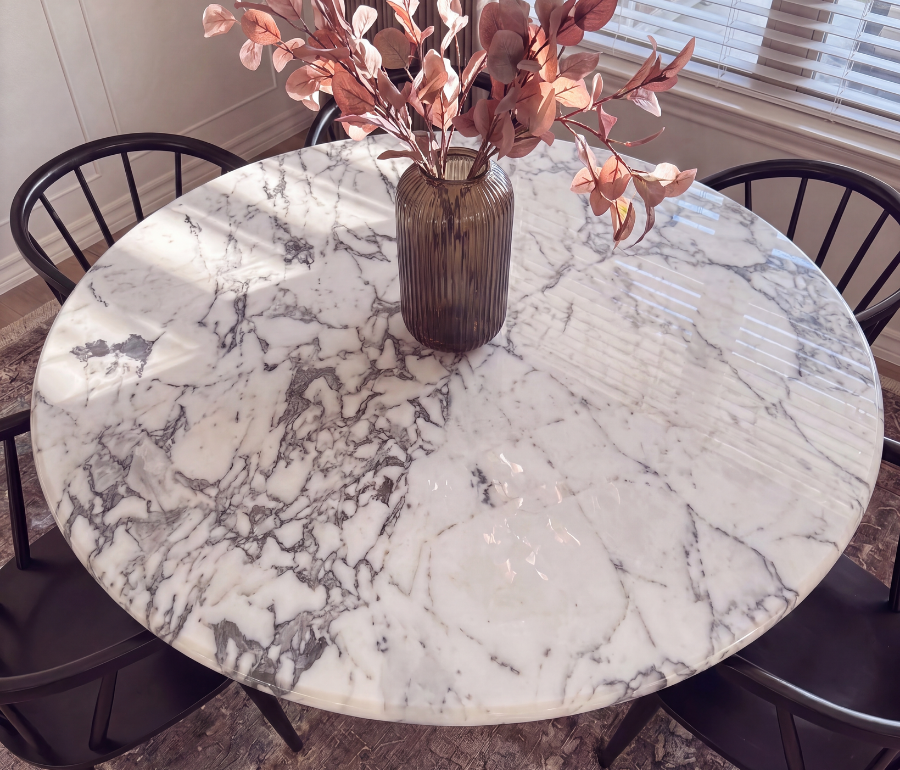
Choosing marble for a dining table is about much more than selecting a color. The stone’s veining, background tone, slab selection, table dimensions, edge profile, surface finish, base design, and the character of the surrounding interior all influence the final result. Because natural marble is formed over millions of years, every slab has its own visual identity, making each marble dining table naturally unique.
From dramatic Calacatta and Panda White to softer Muğla Calacatta and Muğla White, white marble offers an exceptionally broad design language. Some varieties become the focal point of a dining room through expressive veining, while others create a quieter architectural backdrop that works naturally with wood, metal, neutral textiles, and contemporary furniture.
This guide explores how to choose the right marble for a dining table, what characteristics should be considered before production, and how four distinctive marble varieties—Calacatta Marble, Panda White Marble, Muğla Calacatta Marble, and Muğla White Marble—can create very different dining experiences.
Why Choose Natural Marble for a Dining Table?
A dining table is often one of the largest pieces of furniture in an interior. Its material therefore has a significant effect on the overall atmosphere of the room. Natural marble brings together visual depth, substantiality and individuality in a way that manufactured surfaces cannot reproduce exactly.
One of marble’s greatest strengths is variation. Two slabs extracted from the same stone can show differences in vein direction, density, background tone and movement. When the material is carefully selected and fabricated, these natural differences become part of the furniture design rather than imperfections.
Marble also offers designers considerable flexibility. It can be fabricated into round, oval, rectangular and custom-shaped dining tables and paired with architectural bases ranging from simple stone pedestals to fluted or sculptural forms.
For homeowners, interior designers and architects, the most important question is therefore not simply “Is marble suitable for a dining table?” but rather “Which marble is most suitable for this particular dining table and interior?”
1. Calacatta Marble Dining Table: Bold Veining as the Main Design Feature
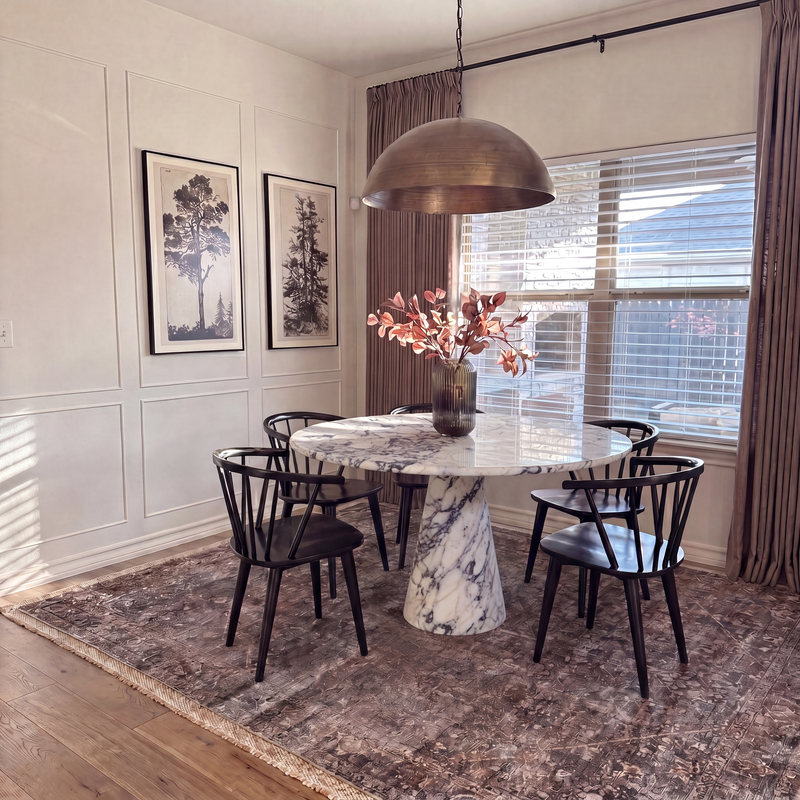
Calacatta marble is one of the most recognizable choices for statement dining tables. Its generally light background combined with pronounced grey, violet-grey or occasionally warmer veins gives the stone strong visual movement.
The round Calacatta marble dining table shown here demonstrates an important principle of natural stone furniture design: when the stone itself has a distinctive pattern, the furniture form does not need to be excessively complicated.
A round tabletop and central pedestal allow the marble to remain the visual focus. The curved geometry also provides a continuous surface on which the natural veins can be appreciated from different viewing angles.
Where Does a Calacatta Marble Dining Table Work Best?
Calacatta works particularly well in contemporary, transitional and luxury interiors where the dining table is intended to function as a focal point.
Neutral walls, dark dining chairs and warm wooden flooring can create a balanced background for the pronounced marble pattern. Instead of competing with the surrounding furniture, the natural veining becomes an organic decorative element within the room.
Calacatta is particularly worth considering when you want:
- A statement marble dining table
- Noticeable natural veining
- Strong contrast against a light background
- A sculptural round or oval table
- A centerpiece for an otherwise restrained interior
When selecting Calacatta for furniture, however, slab selection becomes especially important. The position of major veins should be considered in relation to the tabletop shape before cutting begins.
2. Panda White Marble Dining Table: High-Contrast Contemporary Design
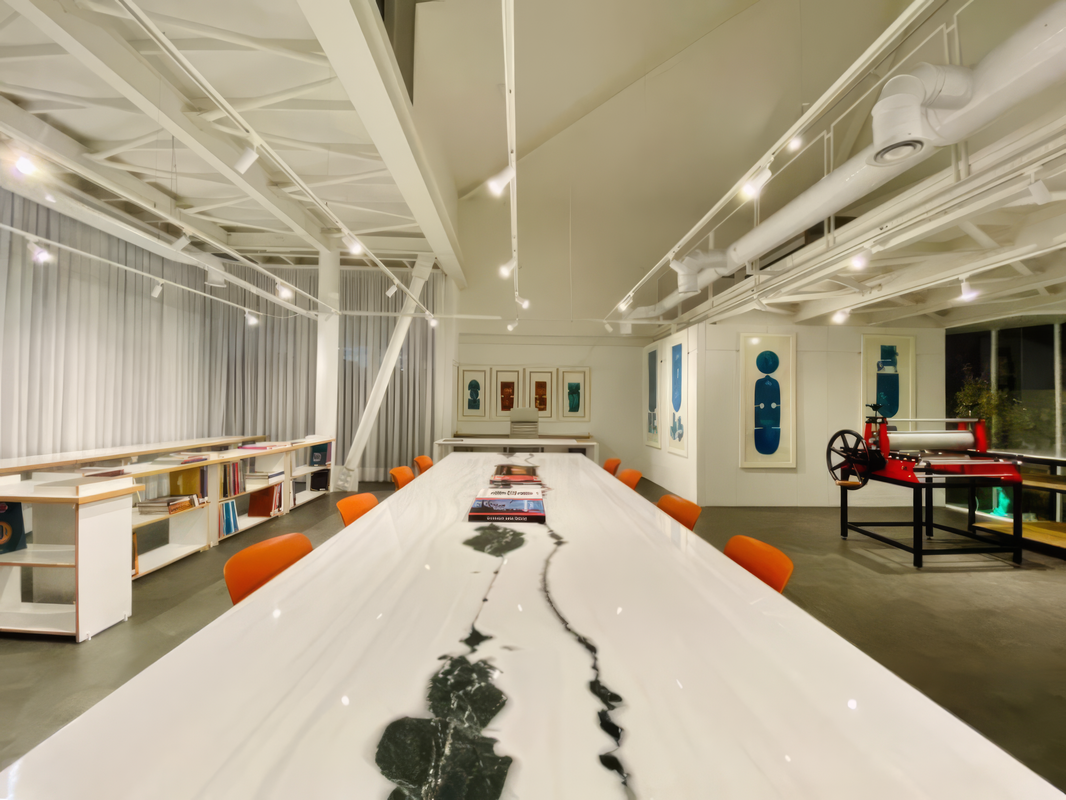
Panda White Marble Dining Table
For interiors requiring considerably stronger visual contrast, Panda White marble offers a very different interpretation of the white marble dining table.
Its defining feature is the relationship between a predominantly white background and dramatic black veining. In some slabs, the dark movement appears in large expressive sections rather than fine linear veins. This can transform a large tabletop into an almost graphic composition.
The long Panda White marble table shown here demonstrates why slab dimensions and vein placement matter so much in large-format furniture.
On an extended dining or conference table, the stone is viewed across a much larger surface area. The direction and distribution of the dark veins therefore become part of the overall architectural composition.
Panda White for Large Dining and Statement Tables
Panda White is particularly effective for:
- Large-format dining tables
- Conference and meeting tables
- Contemporary interiors
- Monochrome design schemes
- Statement furniture
- Interiors with black architectural details
Because of its dramatic appearance, surrounding materials are often most successful when kept relatively restrained.
White, black, grey, natural wood and muted metal finishes allow Panda White marble to remain visually dominant without making the room feel excessively busy.
For designers, slab layout should be evaluated before fabrication. On a large Panda White dining table, an uncontrolled cut can interrupt the strongest parts of the pattern, while careful positioning can turn the same slab into an intentional design feature.
3. Muğla Calacatta Marble Dining Table: Architectural Detail Meets Natural Stone
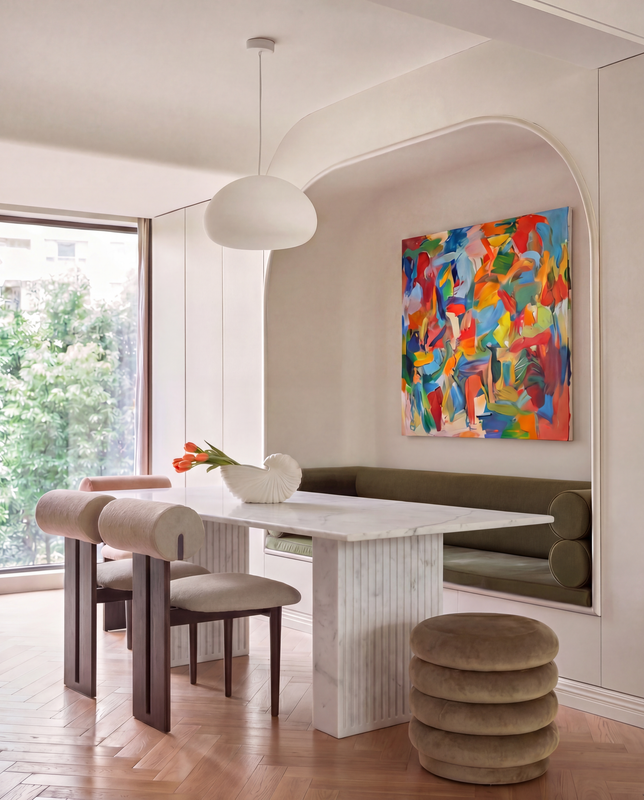
Muğla Calacatta Marble Dining Table
Muğla Calacatta marble provides another approach to light-colored marble furniture. Its white background and natural grey movement can create an elegant surface without necessarily producing the extremely dramatic contrast associated with Panda White.
This makes the material particularly versatile in residential interiors.
The table shown here also illustrates how stone selection and fabrication details can work together. Instead of relying entirely on the marble pattern, the design introduces fluted stone bases. Vertical grooves create shadow, texture and rhythm beneath the relatively clean tabletop.
This relationship between surface and form is increasingly important in contemporary natural stone furniture. Marble is no longer used only as a flat top placed over another material. It can become the structural and decorative language of the entire piece.
Why Choose Muğla Calacatta?
Muğla Calacatta can be a strong option when the project requires:
- A bright natural stone dining table
- Moderate rather than extremely bold veining
- Custom marble bases
- Fluted architectural details
- Contemporary residential furniture
- A combination of visual softness and natural variation
The marble pairs especially well with warm wood flooring, muted upholstery, curved furniture and soft neutral palettes.
In this type of setting, the table can attract attention without overwhelming the rest of the interior.
4. Muğla White Marble Dining Table: A Softer Approach to White Marble
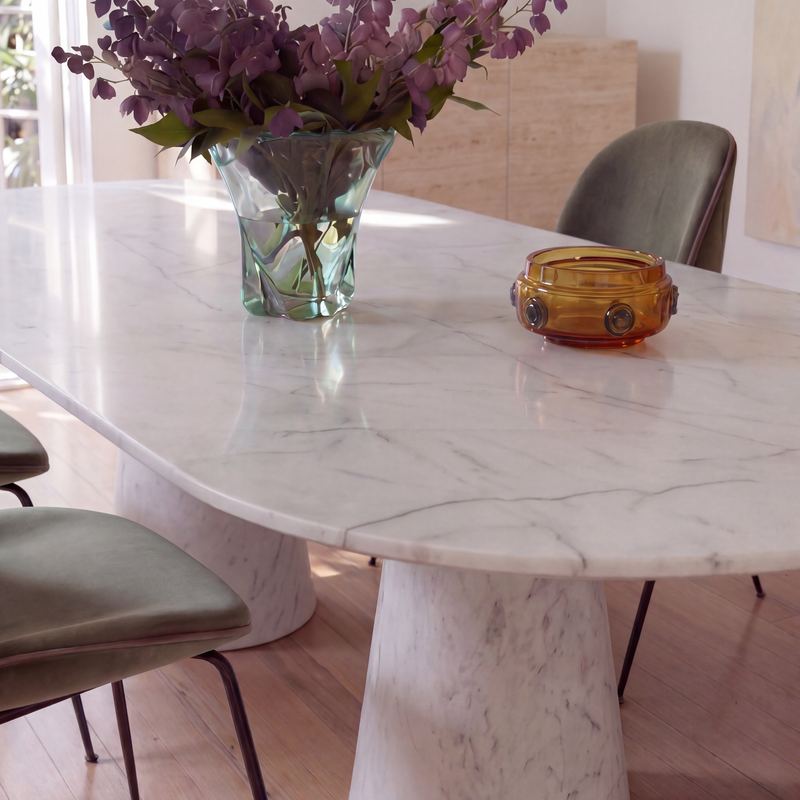
Muğla White Marble Dining Table
Not every marble dining table needs dramatic veining.
Muğla White marble is particularly valuable when the objective is to create a light, calm and versatile dining environment. Its predominantly white appearance and softer grey movement allow the geometry of the furniture to play a larger role.
The oval table shown here demonstrates this balance well. Rather than competing with the surrounding artwork, lighting and furniture, the marble becomes part of the overall material palette.
This makes Muğla White particularly suitable for interiors where several design elements need to coexist.
When Is Muğla White a Good Choice?
Consider Muğla White marble when you prefer:
- A predominantly white dining table
- Softer natural veining
- Minimal or contemporary interiors
- Oval and rectangular table designs
- Light-filled dining spaces
- Easy coordination with different furniture colors
It can work particularly well with timber floors, neutral walls, green or beige upholstery, brushed metals and contemporary lighting.
For designers working on restrained interiors, this versatility can be more valuable than highly dramatic veining.
Calacatta vs. Panda White vs. Muğla Calacatta vs. Muğla White
Although all four stones can be used to create white marble dining tables, their visual effects are noticeably different.
| Marble | General Appearance | Veining Character | Best Suited For |
|---|---|---|---|
| Calacatta Marble | Light, expressive | Pronounced grey/darker movement | Statement residential dining tables |
| Panda White Marble | High-contrast black & white | Very bold and graphic | Large contemporary statement tables |
| Muğla Calacatta Marble | White with defined natural movement | Moderate to expressive | Contemporary and architectural furniture |
| Muğla White Marble | Clean, predominantly white | Softer grey movement | Minimal and light interiors |
There is therefore no single “best marble for a dining table.” The right choice depends on the desired level of contrast, table dimensions, surrounding materials and overall design concept.
What Should You Consider When Choosing Marble for a Dining Table?
1. Look at the Full Slab, Not Only a Small Sample
This is one of the most important steps when selecting natural marble.
A small sample can communicate the general color of the stone, but it cannot show the complete vein movement of a full slab. This distinction becomes even more important for dining tables because the tabletop may occupy a substantial portion of the slab.
For stones such as Panda White or Calacatta, two areas from the same slab can look dramatically different.
Whenever possible, the tabletop should therefore be planned against the actual slab.
2. Match the Veining to the Table Shape
Different table geometries interact differently with marble patterns.
A round dining table can highlight radial movement and create a compact composition. An oval table offers a longer visual field while retaining softer edges. Rectangular tables provide the largest uninterrupted canvas for directional veins.
The best shape is therefore not determined solely by room dimensions. It can also be influenced by the marble itself.
3. Consider the Table Base as Part of the Stone Design
The tabletop usually receives the most attention, but the base can significantly change the character of a marble dining table.
Possible configurations include cylindrical pedestals, conical bases, double pedestals, slab legs and fluted architectural supports.
Using the same marble on the top and base creates a monolithic appearance, while introducing texture to the base can create contrast without adding another material.
Fluting, for example, changes how light interacts with the stone and can make a relatively simple white marble base much more architectural.
4. Select the Right Surface Finish
Surface finish influences both appearance and daily experience.
A polished marble surface enhances color depth and reflection, often making veining appear more pronounced. A honed finish creates a softer, more matte appearance with reduced reflection.
Neither option is universally superior.
The correct finish should be selected according to the intended design, maintenance expectations and characteristics of the specific stone.
5. Think About Everyday Use
Marble is a natural material and should be treated accordingly.
It can react to acidic substances, and spills such as lemon juice, vinegar, wine or certain sauces should not be left on the surface for extended periods. Coasters, placemats and appropriate cleaning products can help with everyday care.
A suitable natural-stone sealer may also be applied depending on the marble and intended use. Sealers can help reduce absorption but do not make natural marble completely stain-proof or maintenance-free.
This distinction is important when purchasing a natural marble dining table: its natural characteristics are part of the material.
Which Marble Dining Table Is Best for Your Interior Style?
For a minimal interior, Muğla White can provide the cleanest visual result.
For a contemporary luxury interior, Calacatta or Muğla Calacatta can introduce stronger natural movement while retaining a light overall palette.
For a bold architectural interior, Panda White can become a defining feature of the room.
But interior style should not be treated as a strict rule. A dramatic stone can create an effective contrast in an otherwise minimalist room, just as a subtle white marble can balance a highly decorative interior.
The objective should be to establish the desired visual hierarchy: Should the table dominate the room, or should it complement the room?
That question often makes marble selection considerably easier.
Round, Oval or Rectangular Marble Dining Table?
Table shape is another key decision.
Round Marble Dining Tables
Round tables encourage a centralized seating arrangement and can work particularly well in square or compact dining areas. A central stone pedestal can also reduce visual interruption around the perimeter.
Oval Marble Dining Tables
Oval tables combine some of the practicality of rectangular tables with softer geometry. They are particularly suitable for contemporary residential interiors and allow natural veining to extend across a longer surface.
Rectangular Marble Dining Tables
Rectangular tables are ideal for larger dining spaces and long-format slabs. They also provide excellent opportunities to showcase linear or directional marble patterns.
For very large pieces, engineering, weight, transportation and installation requirements should always be considered during the design stage.
Does Every Marble Dining Table Look Different?
Yes—and this is one of the defining characteristics of natural stone.
Veining, shade, mineral distribution and pattern density vary from slab to slab. A finished table should therefore not be expected to reproduce another natural marble table exactly.
For custom furniture, this variation can be an advantage.
Instead of manufacturing identical surfaces repeatedly, designers can select slabs according to the character required for each project. Veins can be positioned intentionally, bases can be coordinated with tabletop sections, and dimensions can be developed around available material.
The result is furniture in which the material itself contributes directly to the design.
Frequently Asked Questions About Marble Dining Tables
What is the best marble for a dining table?
There is no universal best variety. Calacatta is suitable for expressive statement pieces, Panda White for strong black-and-white contrast, Muğla Calacatta for refined natural movement, and Muğla White for cleaner and softer interiors. The best choice depends on the design and intended use.
Is marble suitable for everyday dining tables?
Yes. Marble can be used for everyday dining furniture when appropriate care is taken. Spills should be cleaned promptly, particularly acidic liquids, and suitable cleaning products should be used.
Should a marble dining table be polished or honed?
Both finishes are possible. Polished marble provides greater reflection and usually emphasizes color and veins, while honed marble has a softer matte appearance. Selection should depend on the desired aesthetic and practical requirements.
Are marble dining tables custom-made?
They can be. Custom production allows designers to specify the stone, slab selection, dimensions, tabletop geometry, edge profile, surface finish and base configuration.
Can marble dining tables have fluted bases?
Yes. Fluting can be applied to suitable stone components to introduce depth and vertical texture. It is particularly effective on pedestal and architectural table bases.
How do you clean a marble dining table?
For routine cleaning, use a soft cloth and a cleaner suitable for natural stone. Abrasive products and strongly acidic cleaning agents should be avoided.
Does marble need sealing?
Depending on the marble, finish and intended use, a suitable natural-stone sealer may be recommended. Sealing can reduce absorption but does not make the surface completely resistant to staining or etching.
Why does my marble table look different from the product photograph?
Natural marble varies. Differences in veining, shade and pattern are expected and are part of the material’s natural character.
Custom Marble Dining Tables and Natural Stone Selection
The success of a marble dining table begins before fabrication.
Stone selection, slab layout, dimensions, vein direction, edge treatment, base geometry and finish should be considered as parts of the same design process. This is particularly important for highly expressive stones such as Calacatta and Panda White, where a few centimeters of movement in the cutting layout can noticeably alter the finished appearance.
Efesus Home brings the natural stone expertise of Reisoğlu Marble, established in 1943, into custom furniture production. Dining tables can be developed in different marble varieties, dimensions, shapes, finishes and base configurations according to the requirements of residential, hospitality and interior design projects.
Ultimately, choosing the right marble is not about finding the stone with the most dramatic pattern or the whitest background. It is about finding the material whose natural character works with the proportions, architecture and atmosphere of the intended space.
A well-selected slab allows the dining table to become more than a functional surface—it becomes an individual expression of natural stone.