
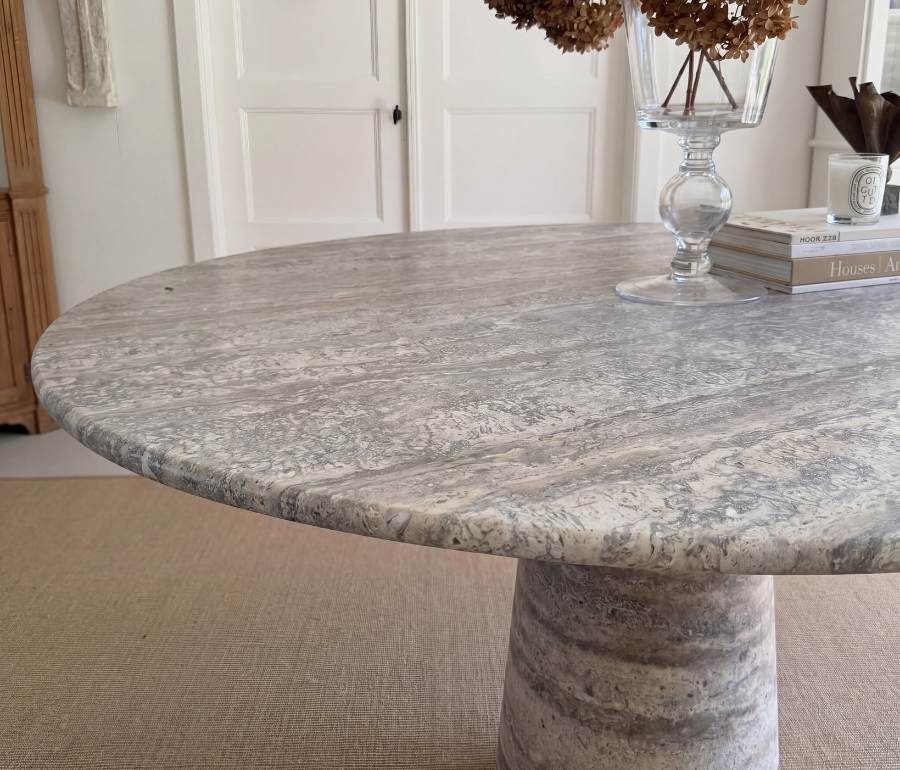
Silver Travertine has moved far beyond its traditional role as an architectural stone for flooring, wall cladding, façades, and bathrooms. With its distinctive layers of silver, grey, taupe, and earthy beige, this natural stone has become an increasingly expressive material in contemporary furniture and decorative design.
What makes Silver Travertine particularly interesting for furniture is its ability to work at very different scales. A large dining table can showcase the stone as a strong architectural surface, while a small cabinet handle can introduce the same natural texture as a subtle detail. Designers can also combine Silver Travertine with glass, wood, metal, or resin to create pieces in which the stone becomes part of a broader material composition.
From sculptural tables and consoles to decorative furniture details, here are five ways Silver Travertine can be incorporated into contemporary interiors.
1. Silver Travertine Dining Table: Turning Natural Stone into a Centerpiece
A dining table is one of the most effective ways to showcase the natural character of Silver Travertine. Because of the stone’s layered structure and variations between grey, beige, cream, and silver tones, a large tabletop provides enough surface area for its geological pattern to become an important part of the design.
The oval Silver Travertine dining table shown here combines a broad stone top with a substantial pedestal base. Instead of relying on complex decorative elements, the design allows the movement of the stone itself to define the piece. The rounded form also softens the visual weight normally associated with solid natural stone furniture.
Silver Travertine dining tables work particularly well in neutral interiors featuring warm whites, natural woods, linen, wool, and other tactile materials. The cooler grey areas of the stone introduce contrast, while its beige undertones prevent the table from feeling disconnected from warmer interior palettes.
From a design perspective, this makes Silver Travertine particularly versatile. Depending on the slab selection, finish, proportions, and surrounding materials, the same stone can suit contemporary, organic modern, minimalist, or more eclectic interiors.
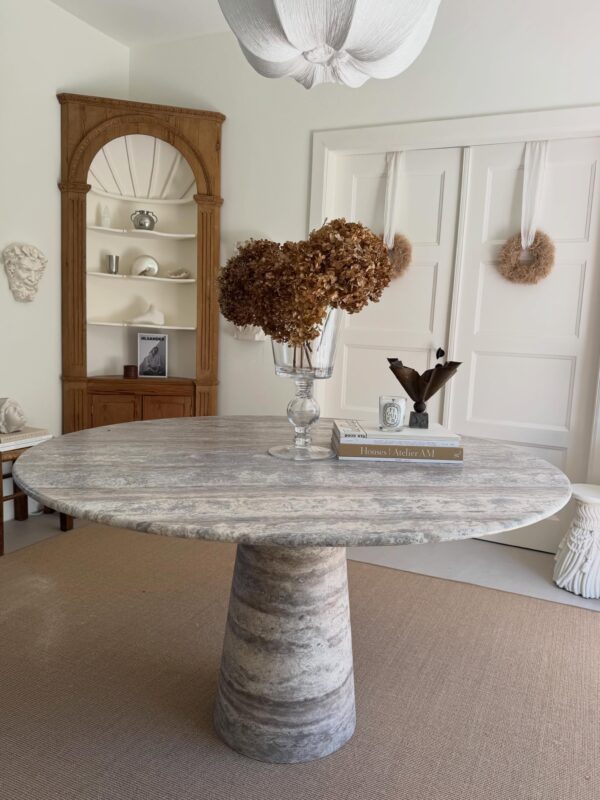
Silver Travertine Oval Dining Table With Sculptural Pedestal Base
2. Silver Travertine and Epoxy Resin Coffee Table
One of the more experimental approaches to Silver Travertine furniture is combining the stone with epoxy resin.
Travertine naturally contains pores, cavities, and irregular formations created during its geological development. Instead of completely concealing these characteristics, furniture design can use them as part of the visual concept. Resin can highlight selected voids and create a striking relationship between the natural irregularity of stone and the smooth appearance of the filled areas.
In the rectangular coffee table shown here, the stone’s layered formations continue across the top and vertical surfaces, giving the piece a monolithic appearance. Dark resin-filled areas create strong focal points and emphasize the individuality of the material.
This type of design demonstrates an important characteristic of natural stone furniture: variation does not necessarily need to be treated as an imperfection. Carefully selected slabs and intentional fabrication can transform natural differences into defining features.
An epoxy and Silver Travertine coffee table can therefore function not only as practical furniture but also as a one-of-a-kind statement piece.
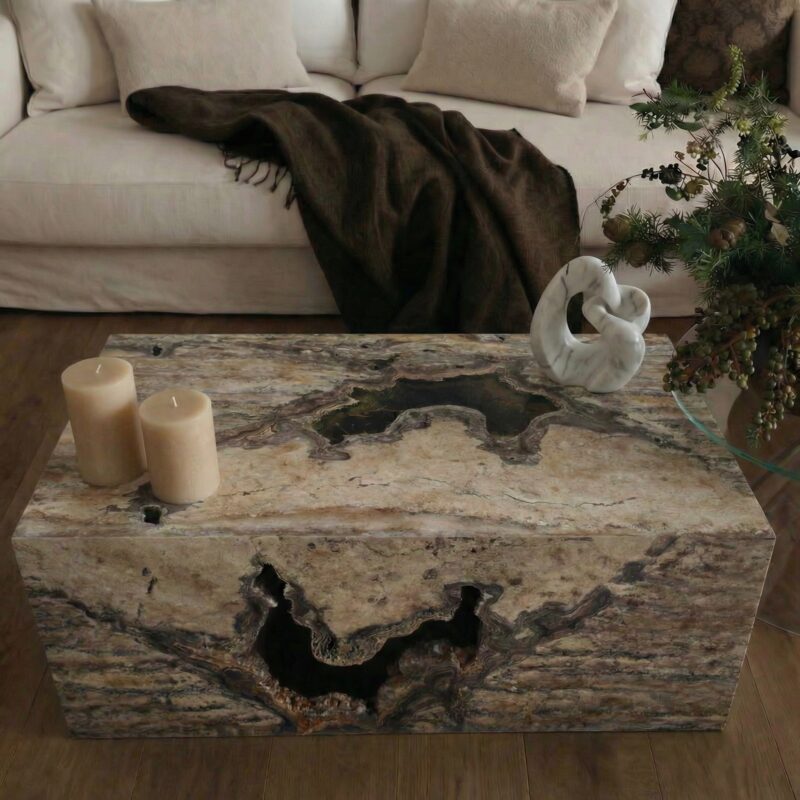
Silver Travertine Coffee Table With Dark Epoxy Resin Details
3. Glass Coffee Table with Sculptural Silver Travertine Sphere Legs
Silver Travertine does not always have to appear as a conventional tabletop. It can also become the structural and sculptural element supporting another material.
This coffee table concept uses rounded Silver Travertine spheres beneath a transparent glass top. The glass keeps the visual composition open and allows the stone bases to remain fully visible. Instead of hiding the supporting structure, the design makes it the central decorative feature.
The spherical forms also reveal Silver Travertine from a different perspective. Its natural horizontal layers wrap around the curved surfaces, creating individual patterns on every stone element.
The combination of Silver Travertine and glass creates an effective contrast between material qualities: glass appears light, transparent, and precise, while travertine feels solid, tactile, and naturally irregular.
This approach is particularly suitable for interiors where designers want to introduce natural stone without the visual mass of a completely stone-clad coffee table.
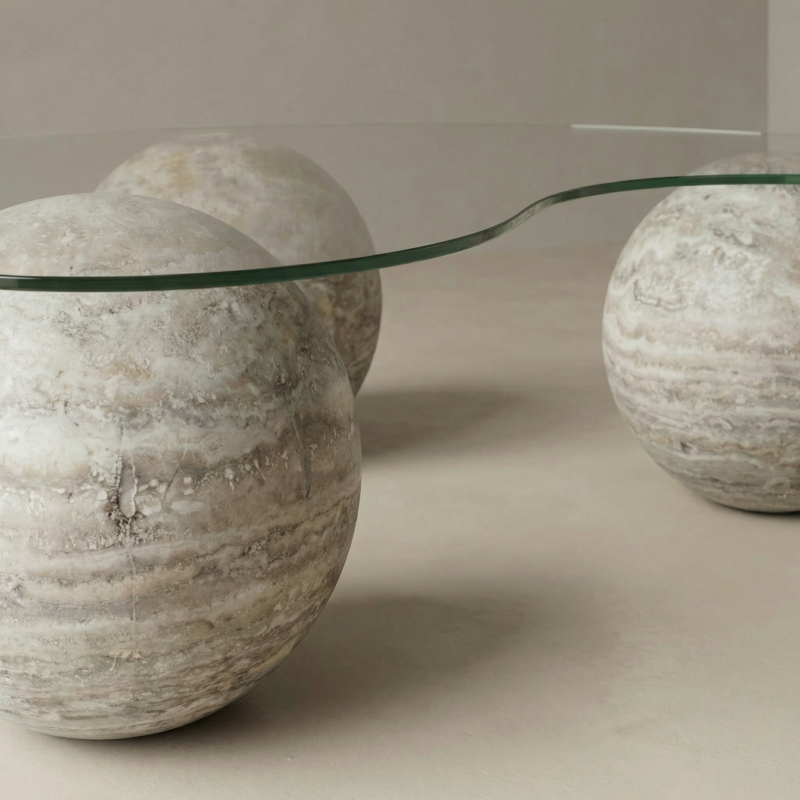
Glass Coffee Table With Sculptural Silver Travertine Sphere Legs
4. Silver Travertine Console Table for Entryways and Living Spaces
Console tables provide another strong application for Silver Travertine because their relatively narrow proportions allow the stone to become an architectural element without dominating the room.
The console shown here uses a long Silver Travertine top supported by vertically arranged stone legs. The design is restrained, but the directional pattern of the travertine introduces texture and depth. Rounded edges on the tabletop further soften the geometry of the piece.
A Silver Travertine console can be used in an entrance hall, living room, corridor, dining area, or behind a sofa. When positioned against a light wall, its grey and earthy layers become particularly visible.
It can also be combined with contrasting decorative materials. Dark ceramics, bronze or brass objects, wood, glass, and textured fabrics all interact differently with the stone’s neutral palette.
For architects and interior designers, this versatility makes Silver Travertine especially useful when a furniture piece needs to connect several materials already present within an interior.
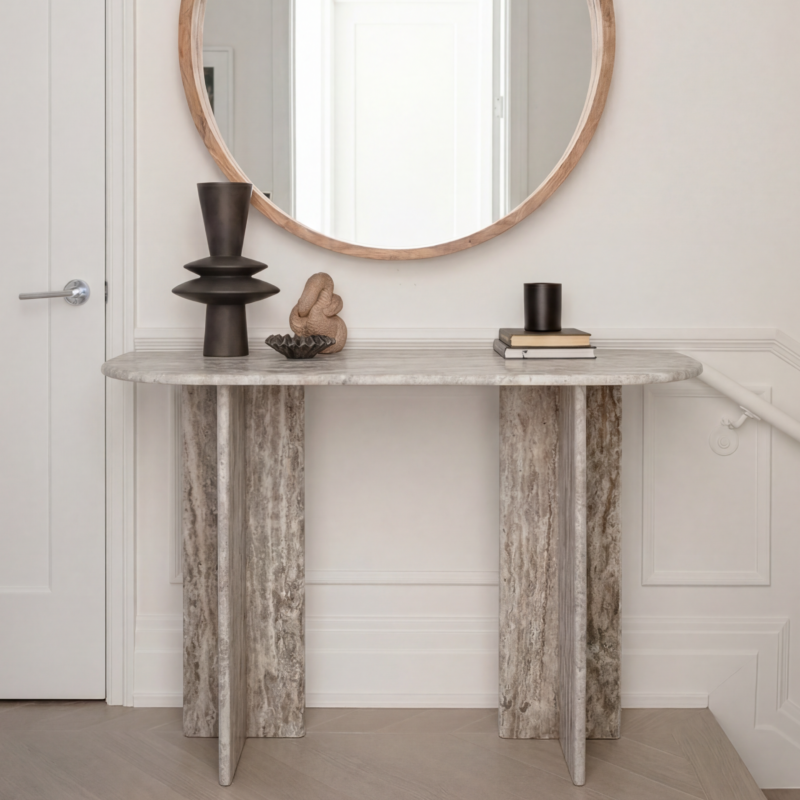
Silver Travertine Console Table With Architectural Stone Legs
5. Silver Travertine Cabinet Handles: Natural Stone in the Smallest Details
Natural stone furniture design does not need to involve an entire table or console. Silver Travertine can also be introduced through much smaller architectural and furniture details.
The element shown in the image is best described in English as a Silver Travertine cabinet handle, cabinet pull, or stone cabinet pull. For global SEO, Silver Travertine Cabinet Pull is the strongest terminology to use.
Here, a rectangular piece of Silver Travertine forms the visible grip of the cabinet hardware. Against the dark wood cabinetry and metallic mounting detail, the pale natural stone creates a small but noticeable material contrast.
This type of application is particularly interesting for custom kitchens, bathroom vanities, wardrobes, sideboards, and bespoke cabinetry. It also offers designers a way to repeat a natural stone used elsewhere in an interior at a much smaller scale.
For example, Silver Travertine used for a console, vanity top, wall surface, or table can be echoed through custom cabinet pulls. The result is a subtle material connection between furniture and architecture rather than an obvious repetition.
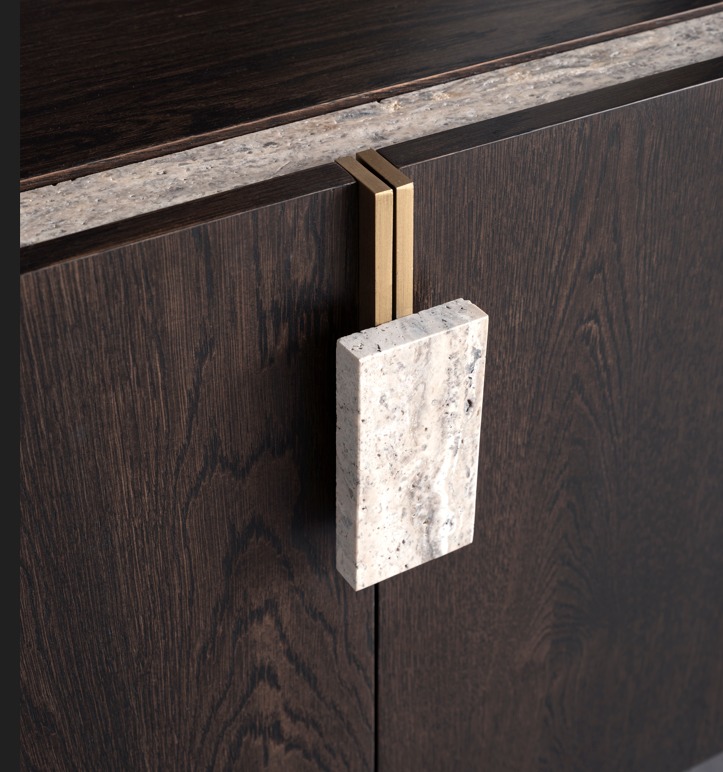
Custom Silver Travertine Cabinet Pull With Dark Wood Cabinetry
Why Silver Travertine Works So Well in Furniture Design
The appeal of Silver Travertine furniture comes largely from the material’s visual variation. Unlike a uniformly manufactured surface, each section of natural travertine can contain different concentrations of silver-grey, taupe, beige, cream, and darker mineral movement.
Cut direction can also significantly affect its appearance. Vein-cut Silver Travertine emphasizes linear geological layers, while different cutting orientations can produce a more clouded or varied pattern. This gives designers considerable freedom when selecting material for tabletops, vertical furniture surfaces, legs, decorative objects, or smaller details.
Finishing is equally important. Honed surfaces create a softer, more understated appearance, while polished surfaces emphasize color and pattern more strongly. Depending on the intended design, travertine pores may also be filled or intentionally incorporated into the aesthetic.
This means Silver Travertine furniture should not be considered simply as furniture made from a grey stone. Slab selection, cut direction, finish, fabrication, edge profile, and material combinations all influence the final character of the piece.
What Materials Pair Well with Silver Travertine?
One reason Silver Travertine is so adaptable in contemporary furniture is its neutral but complex color palette. Rather than presenting a single grey tone, the stone frequently combines cool and warm shades within the same surface.
Glass creates one of the lightest combinations and works particularly well when the travertine forms sculptural legs or bases. Dark wood produces stronger contrast and emphasizes the lighter mineral characteristics of the stone. Brass and bronze can introduce warmth, while blackened metal creates a sharper contemporary relationship.
Textiles in ivory, oatmeal, taupe, brown, charcoal, and muted earthy colors can also complement Silver Travertine furniture without competing with its natural movement.
From Large Furniture to Decorative Details
Perhaps the most interesting quality of Silver Travertine is its ability to retain its identity regardless of scale.
It can form the entire visual mass of a dining or coffee table, become a pair of architectural console legs, appear as sculptural spheres beneath glass, or be reduced to a small cabinet pull only a few centimeters wide.
This flexibility opens opportunities beyond standard stone furniture. Silver Travertine can be considered for dining tables, coffee tables, side tables, consoles, pedestals, shelves, bathroom furniture, decorative trays, objects, lamp bases, cabinet hardware, and other custom-made interior elements.
Rather than treating travertine only as a surface material, contemporary design increasingly allows natural stone to become part of the furniture’s actual form.
Silver Travertine Furniture FAQ
Is Silver Travertine suitable for furniture?
Yes. Silver Travertine can be fabricated for dining tables, coffee tables, side tables, consoles, decorative objects, furniture components, and custom interior details. The appropriate construction and finish should be selected according to the intended application.
Can Silver Travertine be combined with glass?
Yes. Glass and Silver Travertine work particularly well together. Transparent glass can expose sculptural stone bases while reducing the visual weight of the overall furniture design.
Can Silver Travertine be combined with epoxy resin?
Yes. Resin can be incorporated into selected natural cavities or design areas, creating a contemporary contrast with the geological texture of the stone.
What colors work with Silver Travertine furniture?
Warm white, cream, beige, taupe, brown, charcoal, black, natural wood tones, and muted earthy shades generally coordinate well with its silver-grey and beige variation.
Can Silver Travertine be used for custom cabinet handles?
Yes. Small pieces of the stone can be fabricated as custom cabinet pulls or handles, allowing Silver Travertine to appear as a detailed furniture accent rather than a large surface.
Is every Silver Travertine furniture piece identical?
No. Travertine is a natural stone, so veining, pores, tonal variation, and pattern differ from piece to piece. Material selection is therefore an important part of custom furniture production.