
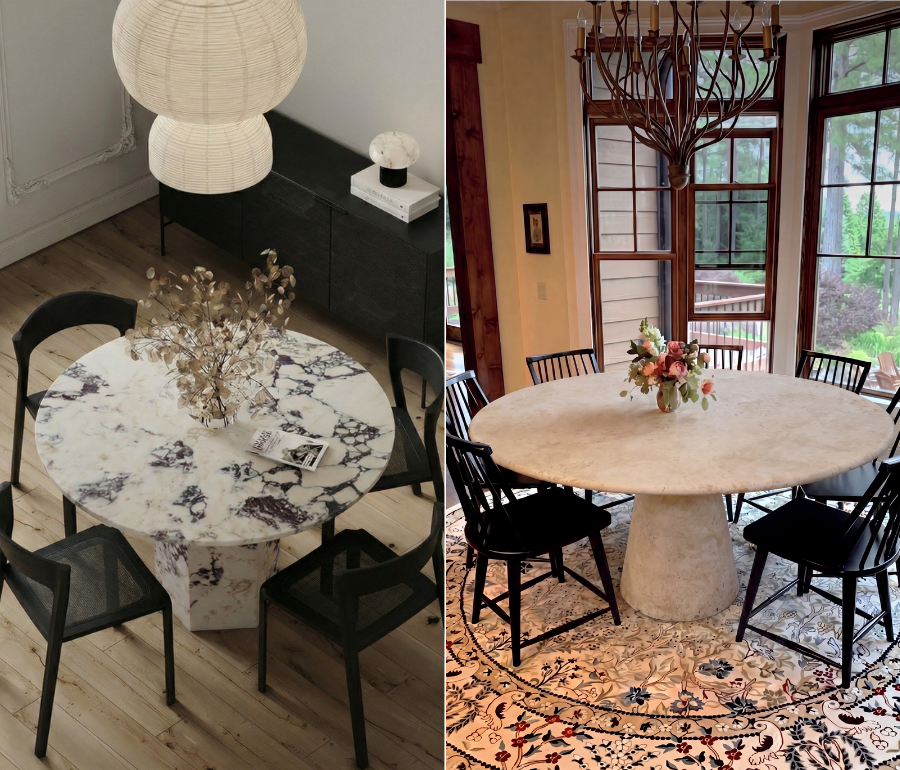
Natural stone furniture has become an important part of contemporary interior design, especially in dining rooms, living spaces, bedrooms, hotel interiors and high-end residential projects. Among the many natural stones used in furniture production, marble and travertine remain two of the most popular choices.
Although both materials are natural stones, they create very different visual effects. Marble is generally associated with expressive veining, polished surfaces and stronger visual contrast, while travertine is known for its softer tonal movement, porous structure and warm architectural character.
The right choice depends on much more than appearance. The furniture type, room style, surface finish, maintenance expectations, stone color, edge detail and even the surrounding materials should all be considered.
In this guide, we compare travertine vs. marble furniture through four examples: Calacatta Marble, Light Travertine, Elazığ Cherry Marble and Light Travertine side tables. By looking at these stones in real furniture applications, it becomes easier to understand which natural stone may be more suitable for your interior.
What Is the Main Difference Between Marble and Travertine Furniture?
Marble and travertine are both natural stones, but their geological formation gives them noticeably different structures and visual characteristics.
Marble typically has a more compact structure and is especially recognized for its natural veining. Depending on the variety, the veins may be subtle and delicate or dramatic enough to become the main visual feature of a room.
Travertine, on the other hand, naturally contains pores and linear formations. Its appearance is usually more earthy, architectural and understated. The stone can be filled or unfilled depending on the intended design and application.
In furniture, these differences create two distinct design languages.
Marble furniture generally offers:
- More prominent veining
- Higher visual contrast
- A refined and decorative character
- Strong statement potential
- A wide range of polished and honed appearances
Travertine furniture generally offers:
- Softer tonal transitions
- Natural pores and texture
- Warm beige and cream palettes
- A more organic architectural character
- Strong compatibility with minimalist interiors
Neither material is inherently better. The better choice is the one that matches the intended design.
1. Calacatta Marble Furniture: When Natural Veining Becomes the Design
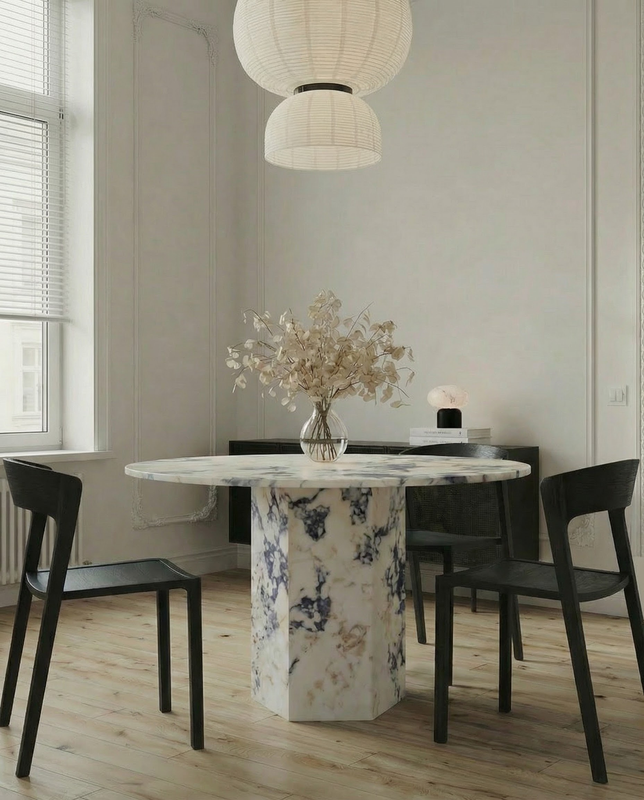
Calacatta marble is one of the strongest examples of how marble can transform a piece of furniture into the focal point of an interior.
The round Calacatta marble dining table shown here features a light background and expressive dark veining. Because both the tabletop and pedestal are produced from stone, the marble becomes the dominant visual material rather than just a surface covering.
Calacatta works particularly well when the designer wants the table itself to attract attention.
Its natural veining means that the exact appearance of each dining table depends on the slab selected for production. Two tables made from Calacatta marble may therefore share the same general material character while still looking noticeably different.
Why Choose Calacatta Marble for Furniture?
Calacatta can be particularly suitable for:
- Dining tables
- Coffee tables
- Console tables
- Side tables
- Bathroom vanities
- Statement furniture
- Custom stone furniture
Its strong vein movement works especially well in rooms with restrained surrounding materials.
Dark wooden chairs, warm timber floors, neutral upholstery or simple wall finishes allow Calacatta to remain the visual centerpiece.
For furniture production, slab selection is particularly important because vein placement should ideally be planned according to the shape of the final piece.
2. Light Travertine Dining Table: Softer and More Architectural
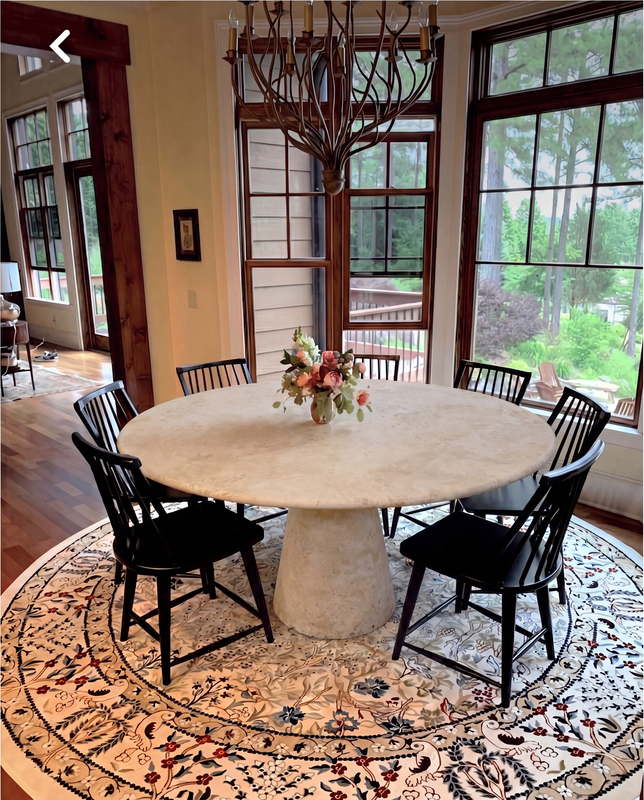
Light Travertine Round Dining Table
Light Travertine creates a completely different atmosphere.
Instead of high-contrast veining, it offers natural beige and cream tones with soft movement across the surface. This allows the furniture to become a substantial part of the interior without necessarily dominating it.
The round Light Travertine dining table shown here demonstrates how effectively travertine works in warm residential interiors.
The simple pedestal structure highlights the natural appearance of the material, while the soft beige tones coordinate naturally with wooden flooring, black dining chairs and traditional interior elements.
This versatility is one of the major reasons travertine continues to be widely used in contemporary furniture design.
Why Choose Light Travertine Furniture?
Light Travertine is especially effective for:
- Dining tables
- Coffee tables
- Side tables
- Consoles
- Benches
- Pedestal furniture
- Sculptural natural stone pieces
Its neutral color allows it to work with both warm and cool interior palettes.
In minimalist interiors, the stone adds texture without introducing excessive visual movement. In more decorative spaces, it can provide a quieter counterbalance to patterned textiles, artwork and furniture.
Marble vs. Travertine: Which Has the Stronger Visual Impact?
This is one of the clearest differences between the two materials.
Marble varieties such as Calacatta and Elazığ Cherry typically create stronger visual contrast because of their vein patterns and color differences.
Travertine usually communicates through texture and subtle tonal movement instead.
This means the decision can often be simplified to one question:
Do you want the natural stone furniture to become the visual focal point, or do you want it to integrate more quietly into the architecture?
For a statement piece, expressive marble may be the stronger choice.
For softer integration, Light Travertine may be more appropriate.
However, this is not an absolute rule. Travertine can also become sculptural when used in bold furniture forms, while a relatively uniform marble can produce a restrained result.
3. Elazığ Cherry Marble Coffee Table: Dramatic Color in Natural Stone Furniture
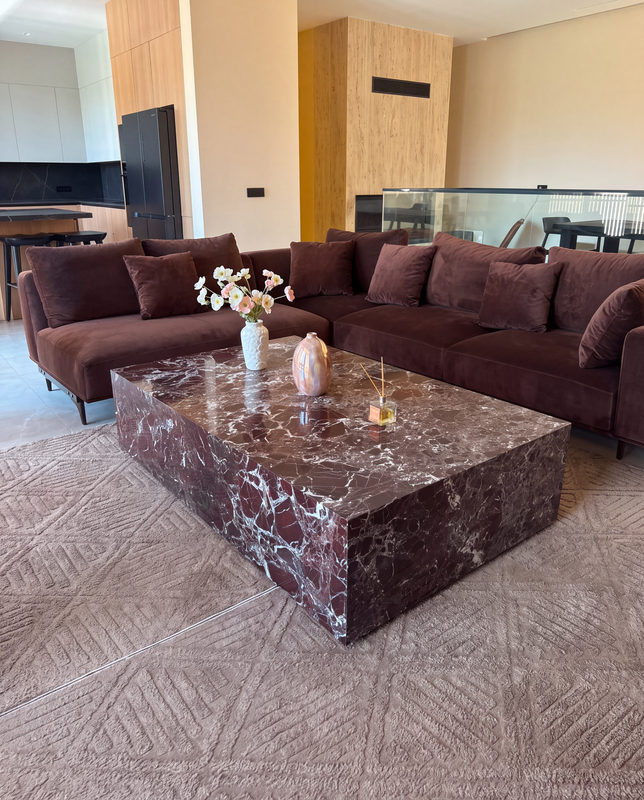
Elazığ Cherry Marble Coffee Table
Not all marble furniture needs to be white.
Elazığ Cherry Marble is one of the most distinctive examples of colored natural stone furniture. Its deep burgundy-red background combined with dramatic white veining creates an unmistakable visual character.
The rectangular coffee table shown here uses the marble across both horizontal and vertical surfaces, creating a monolithic appearance.
Because the form itself is simple, attention is directed almost entirely toward the natural stone.
This type of design is especially effective when a furniture piece is intended to provide contrast within the living room.
A red marble coffee table can coordinate with brown, beige, cream, burgundy and warm wood tones while simultaneously introducing strong natural movement.
Where Does Elazığ Cherry Marble Work Best?
Elazığ Cherry can be used for:
- Coffee tables
- Cube side tables
- Console tables
- Dining tables
- Bathroom vanities
- Decorative objects
- Custom interior elements
In large furniture pieces, its visual intensity should be considered carefully.
A highly decorative stone usually benefits from simpler surrounding surfaces, allowing its color and veins to remain clearly visible.
4. Light Travertine Side Table: Travertine as a Sculptural Material
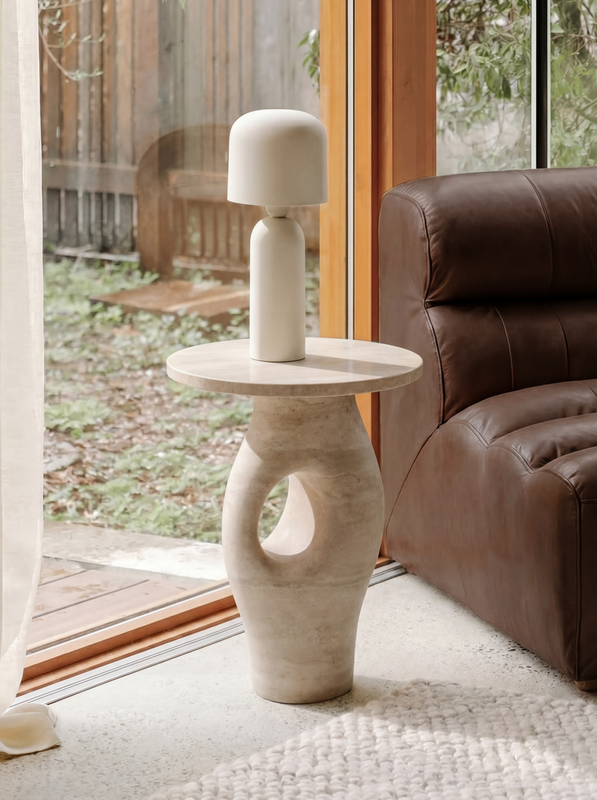
Light Travertine Sculptural Side Table
Travertine is not limited to simple rectangular or pedestal furniture.
One of its strongest qualities in modern furniture design is its ability to work with sculptural forms.
The Light Travertine side table shown here combines a circular top with a carved base featuring a large organic opening. The result demonstrates how the design can attract attention through shape rather than strong color contrast.
This is an important distinction between travertine and dramatic marble.
With marble, the stone pattern itself often becomes the focal point.
With Light Travertine, the quieter surface allows designers to experiment more freely with volume, negative space and sculptural geometry.
This makes travertine particularly relevant for contemporary interiors focused on organic forms and architectural furniture.
Travertine vs. Marble Furniture: Visual Comparison
| Feature | Marble Furniture | Travertine Furniture |
|---|---|---|
| Visual Character | Stronger veining and contrast | Softer and more organic |
| Texture | Usually smoother and more compact | Naturally porous and textured |
| Color Range | White, grey, black, red, green and more | Mainly cream, beige, silver and brown |
| Statement Potential | Very high with dramatic stones | High through form and texture |
| Minimal Interiors | Works best with careful stone selection | Naturally compatible |
| Sculptural Furniture | Suitable | Particularly effective |
| Polished Finish | Common | Possible, though honed finishes are popular |
| Honed Finish | Common | Very common |
| Natural Variation | Veins and color variation | Pores, bands and tonal variation |
Which Is Better for a Dining Table: Marble or Travertine?
Both materials can be used successfully for dining tables.
The choice depends on the intended visual result.
Choose Marble When:
You want the table to become one of the main visual features of the dining room.
Calacatta, for example, creates a striking surface through its strong veins. Colored marbles can make an even stronger statement.
Marble is particularly effective when:
- You prefer noticeable veining
- You want stronger visual contrast
- The dining table should function as a statement piece
- The room has relatively restrained materials
- You prefer a polished or refined appearance
Choose Travertine When:
You want a softer, warmer and more architectural table.
Light Travertine works especially well in interiors where natural materials, timber, textured fabrics and neutral colors are already present.
Travertine is particularly effective when:
- You prefer cream and beige tones
- You want softer natural movement
- You like sculptural furniture
- The interior uses organic shapes
- You prefer a quiet, architectural aesthetic
Which Is Better for a Coffee Table?
Coffee tables are smaller than dining tables but occupy a very central position in most living rooms.
For this reason, both marble and travertine can work exceptionally well.
A dramatic marble such as Elazığ Cherry can transform the coffee table into the primary decorative element of the room.
Travertine, meanwhile, can be used to create large solid volumes without making the space feel excessively busy.
The right choice depends largely on the surrounding upholstery.
For example, deep burgundy or brown furniture can coordinate beautifully with red marble, while cream, beige and natural linen furniture often works particularly well with Light Travertine.
Which Stone Works Better for Side Tables?
Side tables are ideal for experimenting with natural stone.
Because their dimensions are smaller, designers can use more distinctive forms or stronger stone patterns without overpowering the room.
Travertine is particularly successful in sculptural side table designs because its neutral surface allows the shape of the furniture to remain clear.
Marble side tables, by contrast, can introduce color and veining into otherwise restrained spaces.
In practice, both materials work well; the decision depends on whether form or stone pattern should receive more attention.
Travertine vs. Marble: Texture Differences
Texture is one of the most important differences between the two materials.
Travertine is naturally porous. Small cavities and holes are part of its geological character.
Depending on the desired result, travertine can be:
- Filled
- Unfilled
- Honed
- Polished
- Brushed
- Tumbled
For furniture, filled and honed surfaces are often preferred where a smoother functional surface is required.
However, leaving some of the natural pores visible can emphasize the architectural character of the stone.
Marble generally presents a more compact surface. Its visual texture comes primarily from mineral veins rather than open pores.
As a result, marble often feels visually more decorative while travertine feels more tactile.
Marble vs. Travertine: Color Differences
The color range of marble is considerably broader.
Marble can include:
- White
- Grey
- Black
- Burgundy
- Green
- Beige
- Brown
- Purple-toned varieties
This makes marble particularly useful when color is an important part of the furniture concept.
Travertine typically remains within a more natural earthy palette, including:
- Light cream
- Beige
- Ivory
- Silver-grey
- Walnut
- Noce brown
- Warm golden tones
For neutral interior design, this limited palette can actually be an advantage because travertine combines easily with many other natural materials.
Which Natural Stone Is Easier to Combine with Other Materials?
Both work well, but differently.
Marble Combinations
Marble works particularly effectively with:
- Brass
- Stainless steel
- Dark timber
- Light timber
- Glass
- Velvet
- Leather
- Painted surfaces
Strongly veined marble usually works best when the other materials are relatively restrained.
Travertine Combinations
Travertine combines particularly naturally with:
- Oak
- Walnut
- Linen
- Bouclé
- Leather
- Plaster
- Concrete
- Bronze
- Neutral fabrics
This is one reason Light Travertine is frequently seen in contemporary organic interiors.
Marble vs. Travertine Maintenance
Both natural stones require appropriate care.
Neither material should be treated like a fully synthetic, maintenance-free surface.
Acidic liquids such as lemon juice, vinegar and some cleaning products can react with calcium-based natural stones. Spills should therefore be cleaned relatively quickly.
For routine maintenance:
- Use a soft cloth
- Prefer pH-neutral natural stone cleaners
- Avoid harsh acidic cleaning products
- Clean spills promptly
- Use coasters where appropriate
- Consider a suitable natural stone sealer
A sealer may help reduce absorption, but it does not make marble or travertine completely stain-proof or acid-resistant.
Is Travertine More Porous Than Marble?
Generally, yes.
Travertine naturally has visible pores and cavities, while marble usually has a more compact structure.
However, this does not automatically make travertine unsuitable for furniture.
Travertine furniture can be filled and finished according to the intended application. The correct fabrication method is therefore just as important as the stone selection itself.
For dining and coffee tables, surface treatment can be selected according to the expected level of use.
Does Marble Require More Attention Than Travertine?
Not necessarily in every application.
Both stones require appropriate natural stone care.
A polished marble dining table may show certain marks differently from a honed travertine table, while an unfilled travertine surface may require different cleaning considerations.
Rather than asking which material requires less care overall, it is more useful to consider:
Which stone, finish and furniture design best match the way the piece will actually be used?
Travertine or Marble for Minimalist Interiors?
Travertine is often particularly suitable for minimalist interiors because its soft colors and subtle movement integrate naturally into restrained spaces.
Light Travertine can add material depth without making the space visually busy.
Marble can also be used successfully in minimal interiors, but the vein intensity becomes more important.
A dramatic marble in a minimalist room can create a deliberate focal point, while a softer marble can maintain the calm visual language.
Travertine or Marble for Luxury Interiors?
Both materials can create luxury interiors, but they communicate luxury differently.
Marble often creates a more expressive and classical sense of luxury through veining, polish and color contrast.
Travertine creates a quieter, architectural type of luxury based on proportion, texture, craftsmanship and material authenticity.
In contemporary interiors, this difference is particularly relevant.
Luxury does not necessarily require dramatic material. A carefully designed Light Travertine table can feel just as refined as a strongly veined marble table.
Can Marble and Travertine Be Used Together?
Yes.
Using both materials within the same interior can create a more layered natural stone palette.
For example, a dramatic marble coffee table can be combined with Light Travertine side tables. Alternatively, a travertine dining table can be paired with marble decorative objects or console pieces.
The key is to control:
- Color temperature
- Vein intensity
- Surface finishes
- Furniture proportions
- Overall material balance
Natural stones do not need to match exactly. In many interiors, controlled contrast creates a more sophisticated result.
How to Decide Between Travertine and Marble Furniture
When making the final decision, consider five main questions.
1. Do You Want Strong Veining?
Choose marble if expressive natural patterns are an important part of the design.
2. Do You Prefer Softer Neutral Tones?
Light Travertine may be more suitable if you prefer cream, beige and warm natural colors.
3. Should the Furniture Be the Focal Point?
Dramatic marbles such as Calacatta or Elazığ Cherry can create stronger visual impact.
4. Is the Furniture Form Sculptural?
Travertine works particularly well when the design relies heavily on curves, volumes and carved forms.
5. What Materials Surround the Furniture?
The stone should be evaluated together with flooring, wall colors, upholstery, timber and metal finishes rather than selected in isolation.
Frequently Asked Questions About Travertine vs. Marble Furniture
Is marble or travertine better for furniture?
Neither is universally better. Marble is often preferred for stronger veining and visual contrast, while travertine is ideal for softer textures, neutral colors and architectural furniture designs.
Is travertine suitable for dining tables?
Yes. Travertine can be used for dining tables, including custom pedestal and sculptural designs. Appropriate surface finishing and maintenance should be considered according to the intended use.
Is marble good for everyday furniture?
Yes. Marble can be used for dining tables, coffee tables, side tables and consoles when cared for appropriately.
Is travertine more porous than marble?
Travertine naturally contains more visible pores. These can be filled or left partially open depending on the intended aesthetic and application.
Can travertine furniture be polished?
Yes. Travertine can receive different finishes, although honed and matte appearances are especially common in contemporary furniture.
Which looks more luxurious, marble or travertine?
Both can create premium interiors. Marble usually produces a stronger visual statement, while travertine creates a softer architectural and material-driven look.
Which is better for a minimalist interior?
Travertine is particularly easy to integrate into minimalist interiors because of its neutral colors, but restrained marble varieties can also work very effectively.
Can marble and travertine furniture be used in the same room?
Yes. Combining different natural stones can create depth, provided that their colors, finishes and patterns are coordinated carefully.
Travertine and Marble Furniture by Efesus Home
Natural stone furniture begins with selecting the right material for the right design.
A dining table, coffee table or side table should not be designed independently from the stone. Vein direction, natural pores, slab size, color variation, surface finish, edge detail and furniture geometry all influence the final result.
Efesus Home brings the natural stone expertise of Reisoğlu Marble, established in 1943, into furniture and decorative product design. Different marble and travertine varieties can be fabricated into custom dining tables, coffee tables, side tables, consoles and other architectural furniture according to project requirements.
Marble provides expressive veining, broad color variety and dramatic statement potential. Travertine brings softer natural movement, texture and an architectural character.
The right material therefore depends on the atmosphere the project is intended to create.
For some interiors, the strong veins of Calacatta or the deep burgundy tones of Elazığ Cherry will be the natural choice. For others, the warm and quiet character of Light Travertine will integrate much more naturally.
The most successful natural stone furniture is not simply made from an attractive stone. It is created when material, form, proportion, finish and interior architecture are considered together.