
Green marble has become one of the most distinctive natural stone choices in contemporary interior design and architecture. Moving beyond conventional white, beige, and grey surfaces, green marble introduces color while preserving the depth, texture, and individuality associated with natural stone. From pale mineral greens to deep forest tones, each variety offers a different visual character and can completely change the atmosphere of an interior.
The appeal of green marble also comes from its versatility. Depending on the stone and its veining, it can appear refined and subtle or dramatic and expressive. Green marble can be transformed into flooring, mosaics, bathroom vanities, sinks, wall panels, bookmatched installations, coffee tables, consoles, and other custom architectural elements. This range makes it relevant for residential interiors as well as hotels, restaurants, retail spaces, and other high-end commercial projects.
Among the many options available, Emerald Marble, Rain Forest Green Marble, Verde Guatemala Marble, Ice Jade Marble, and Verde Forest Marble demonstrate just how diverse the green marble category can be.
Why Green Marble Stands Out in Interior Design
Unlike uniform manufactured surfaces, natural green marble carries geological patterns that vary from slab to slab. White veins, darker mineral formations, cloudy areas, contrasting lines, and changes in green intensity create surfaces that cannot be reproduced identically. This natural variation is especially important when stone is intended to become a focal point rather than simply a background material.
Green also works surprisingly well with a broad architectural palette. Warm woods soften its mineral appearance, brass and bronze details introduce warmth, while white marble creates contrast and visual balance. Black elements can produce a more dramatic composition. The result can therefore range from classical and decorative to minimalist and contemporary.
Another advantage is scale. Green marble does not need to cover an entire room to have an impact. A small mosaic floor can introduce color subtly, while a large bookmatched wall can make the natural stone the dominant architectural feature.
Emerald Marble: Soft Green Tones for Decorative Mosaics
Emerald Marble demonstrates how green natural stone can be used with a lighter, more delicate approach. Its mixture of soft green, grey-green and pale mineral tones makes it particularly suitable for mosaic applications where multiple individual pieces come together to create movement across the surface.
In elongated mosaic formats, the changing direction and intensity of the natural pattern become part of the design. Rather than presenting one uninterrupted slab, smaller pieces reveal different sections of the stone, producing a varied surface that remains connected through its green palette.
This type of application works particularly well for entrance areas, powder rooms, bathrooms, decorative floors and selected residential spaces. When surrounded by white cabinetry or neutral walls, Emerald Marble can provide enough color to define the floor without visually overwhelming the room.
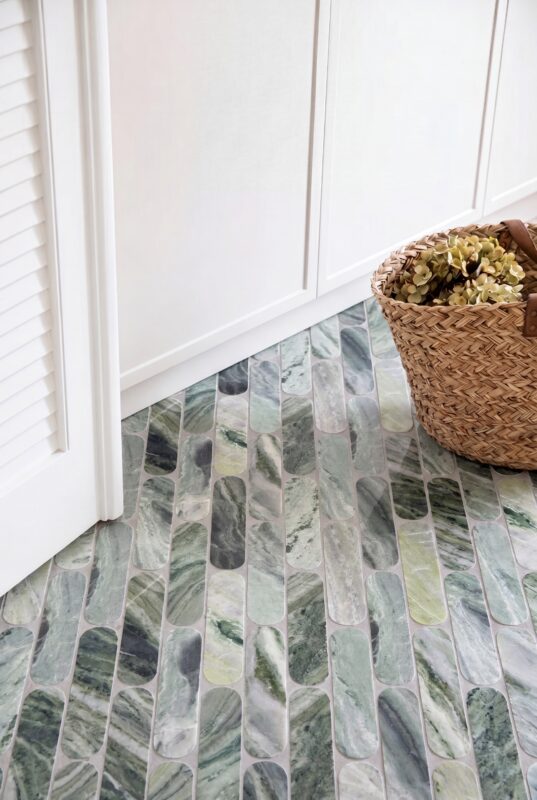
Emerald Marble Mosaic Flooring With Natural Green Tones
Rain Forest Green Marble: Dramatic Veining for Statement Furniture
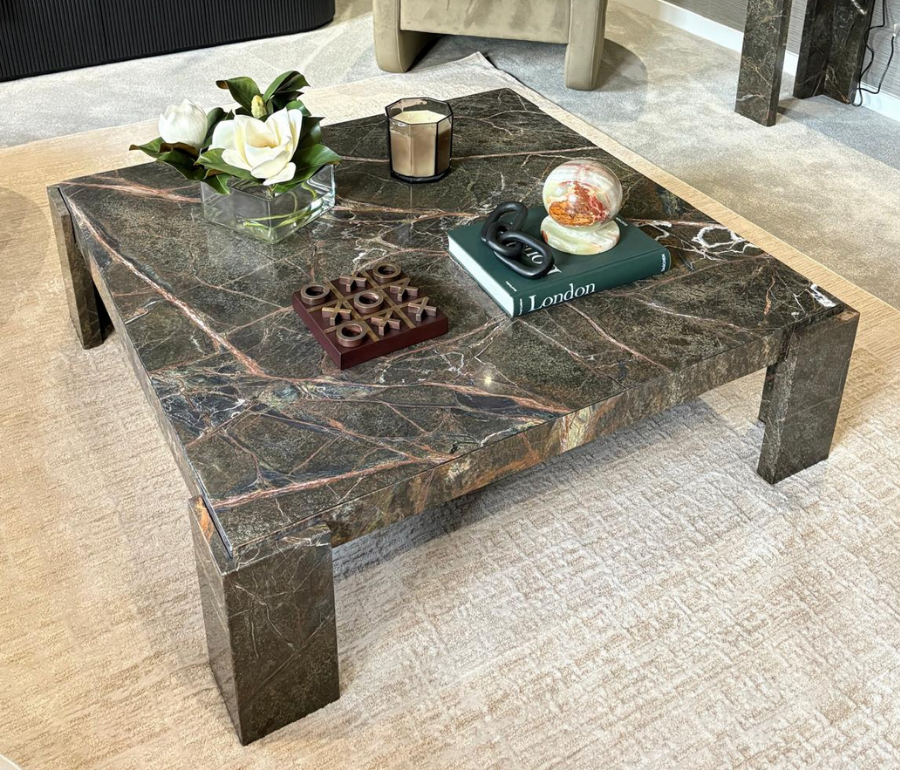
Rain Forest Green Marble has a very different character. Its surface often features an intricate network of veins and mineral markings that resemble branches, landscapes or organic formations. These characteristics make the material especially effective for furniture pieces where the stone can be observed at close range.
A Rain Forest Green marble coffee table, for example, allows a relatively compact piece of furniture to become a focal point. On a broad tabletop, the veins remain visible as continuous natural drawings. A polished surface can further emphasize color depth and contrast.
For designers, the important consideration is slab selection. Because the pattern can vary significantly, choosing the exact section of stone for the tabletop becomes part of the design process. Positioning a strong vein through the center can create a dramatic composition, while selecting a quieter section can result in a more understated piece.
The stone pairs particularly well with neutral upholstery, dark cabinetry, warm fabrics and metallic details, allowing its complex surface to remain visually prominent.
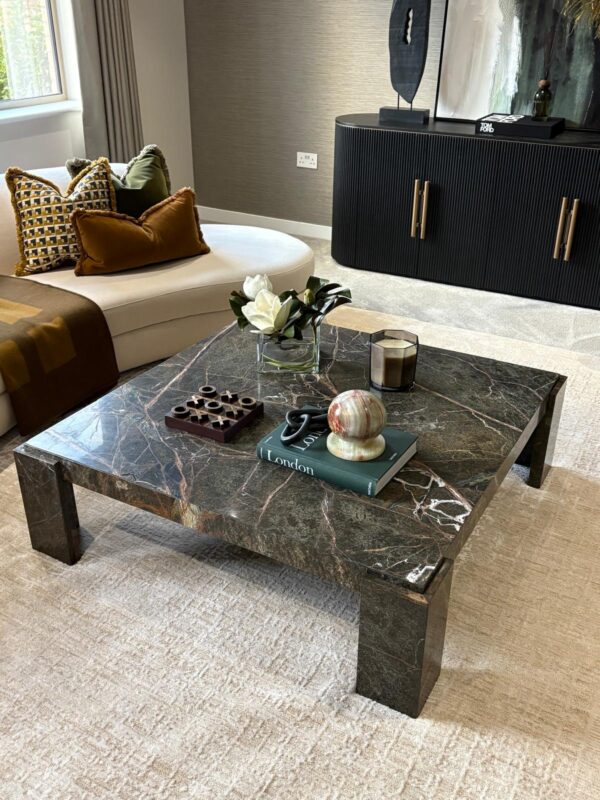
Rain Forest Green Marble Coffee Table In A Contemporary Interior
Verde Guatemala Marble: Combining Green Marble with Other Natural Stones
Green marble becomes even more versatile when incorporated into multi-material mosaic designs. Verde Guatemala Marble, recognized for its rich green appearance, can provide a strong contrast against lighter stones such as white marble.
In decorative flooring, small Verde Guatemala pieces can function almost like graphic elements. Instead of covering the entire surface in green, designers can use the stone strategically to define repeating motifs. White marble creates the visual foundation, while green inserts establish rhythm and contrast.
Metallic details can add another dimension. Brass-toned components positioned between green and white marble introduce warmth and create a more ornamental composition. This combination can work especially well in entrance halls, bathrooms, dressing areas and other interiors where the floor itself is intended to become part of the decoration.
The approach also demonstrates an important principle when designing with strong natural stones: a material does not always need to dominate a surface. Carefully positioned green marble accents can sometimes create a stronger result than full-scale coverage.
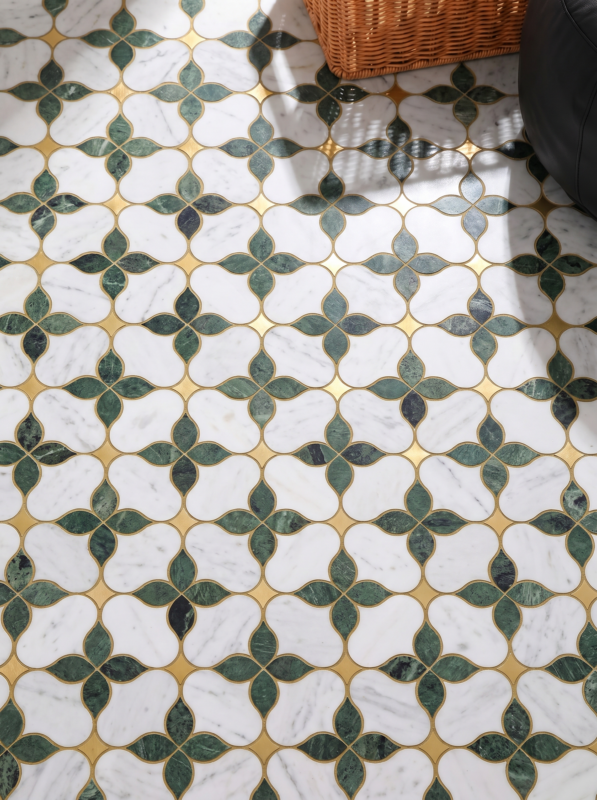
Verde Guatemala Marble Combined With White Marble And Brass Mosaic Details
Ice Jade Marble: Artistic Bookmatch Walls and Feature Surfaces
Some natural stones reveal their full visual potential only when installed at architectural scale. Ice Jade Marble is particularly striking in this context because its green, white, grey and dark mineral formations can create highly expressive compositions.
Bookmatching is one of the most effective techniques for highlighting this character. Adjacent slabs are arranged so that their natural patterns mirror one another across a central axis. When slab selection and cutting are carefully coordinated, the resulting surface can resemble an abstract artwork.
For this reason, Ice Jade bookmatch marble can be used for feature walls, reception areas, hotel interiors, living rooms, luxury retail spaces and other architectural focal points. Rather than adding artwork over the wall, the stone itself becomes the artwork.
Large-format applications also emphasize why viewing complete slabs is important before fabrication. Small samples can communicate the stone’s color, but they cannot fully represent the movement and composition visible across an entire slab.
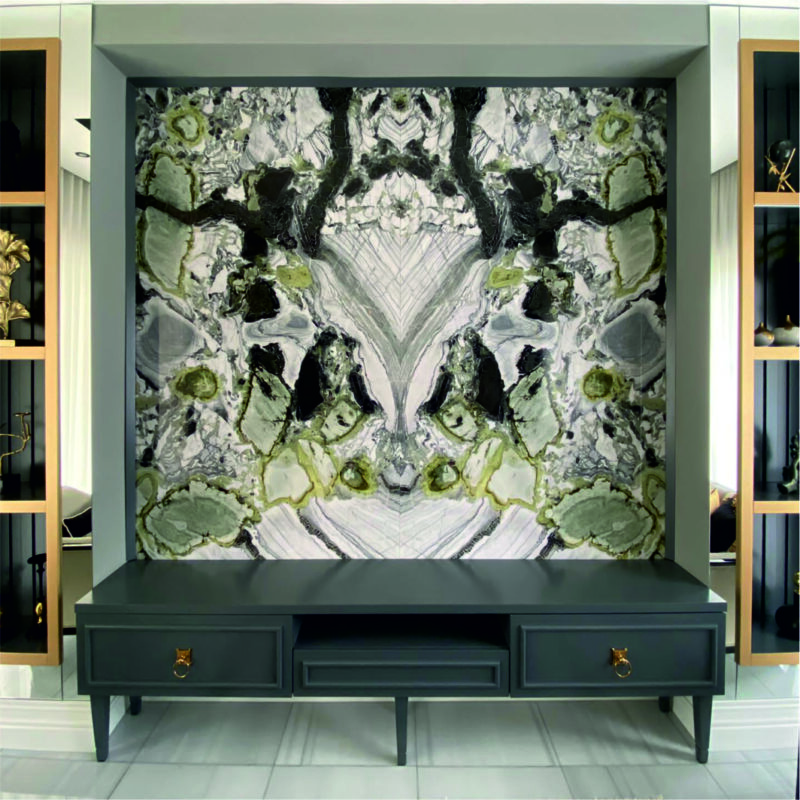
Ice Jade Marble Bookmatch Feature Wall With Natural Green Patterns
Rain Forest Green Marble Furniture: From Coffee Tables to Consoles
Rain Forest Green Marble can extend beyond coffee tables into larger furniture pieces such as consoles and dresuars. Here, the vertical surfaces become just as important as the top.
When the material continues from the tabletop down through substantial stone legs, the furniture can achieve a monolithic appearance. Careful fabrication can also help align visual movement between adjoining surfaces, creating the impression that the piece has been formed from a continuous volume of stone.
This type of furniture works particularly well in entrance halls, living rooms, hotel lobbies and reception spaces. Because a console typically sits against a wall, its horizontal surface and vertical supports can both remain clearly visible.
Edge detailing also influences the final appearance. Rounded or profiled edges soften the strong mineral character, while simple straight edges create a more architectural result. Consequently, the same marble can support very different furniture styles depending on fabrication choices.
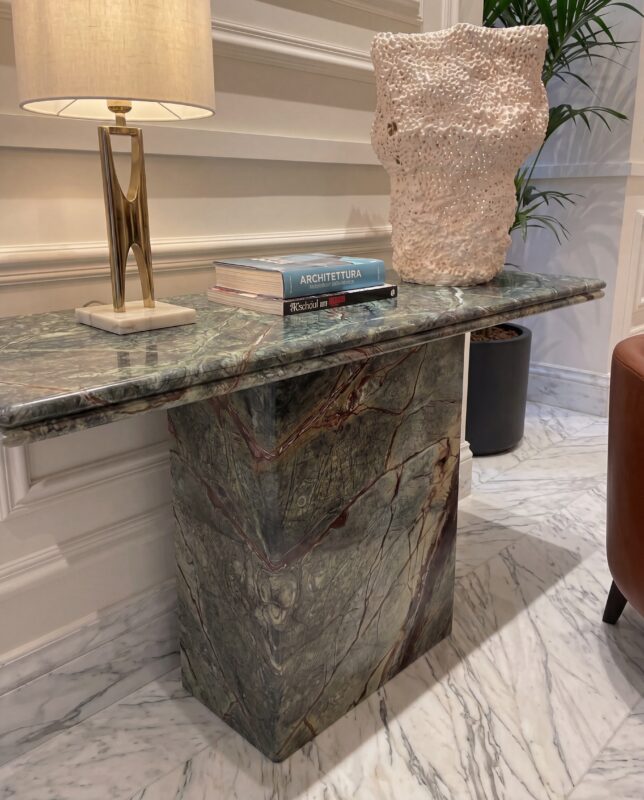
Rain Forest Green Marble Console Table With Natural Veining
Verde Forest Marble: Green Marble for Bathroom Vanities and Sinks
Bathrooms provide another strong application for green marble because they allow the material to be used across both horizontal and vertical surfaces. Verde Forest Marble, with its layered green tones and contrasting natural movement, can transform a conventional vanity into a central design feature.
A countertop and integrated marble sink fabricated from the same material create visual continuity. Instead of placing a separate basin on top of the counter, the sink can become part of the overall stone composition. The thickness of the front edge can further emphasize the material and give the vanity a substantial architectural appearance.
Green marble also works particularly well with timber cabinetry. Wood introduces warmth while the marble contributes depth and mineral texture. Brass fixtures can reinforce warmer undertones, while white wall mosaics keep the surrounding environment light.
For wet-area applications, however, aesthetics should always be considered alongside technical requirements. Correct fabrication, installation, sealing where appropriate, and ongoing maintenance are important for preserving natural marble surfaces.
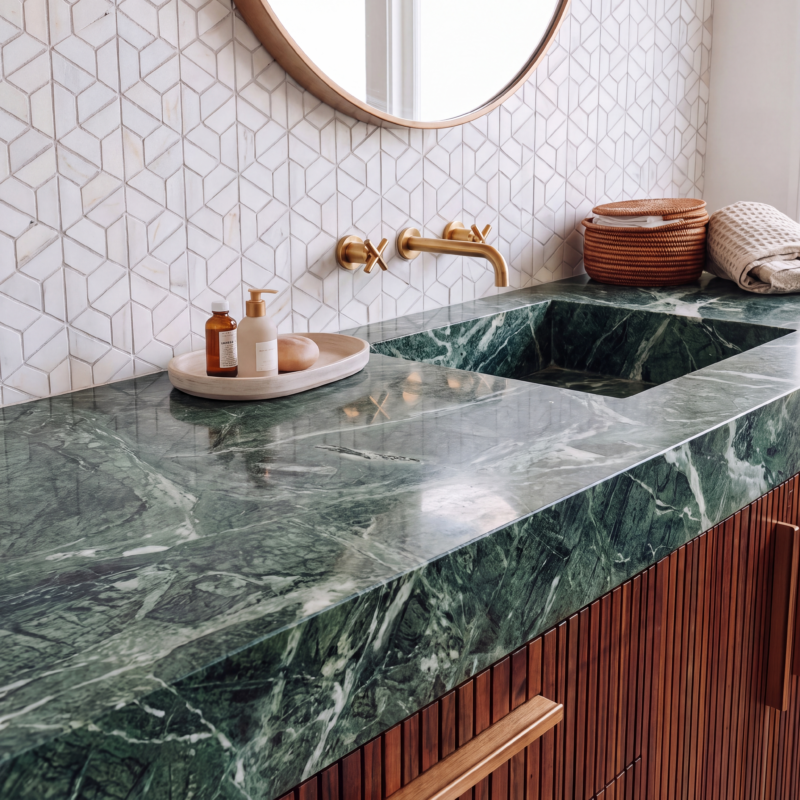
Verde Forest Marble Bathroom Vanity And Integrated Sink
Where Can Green Marble Be Used?
The diversity among green marble varieties allows them to be specified for many different interior applications. Common possibilities include flooring and decorative mosaics, bathroom walls and vanities, integrated sinks, kitchen or selected countertop applications, feature walls, bookmatched panels, coffee and side tables, dining tables, consoles, reception desks, fireplace surrounds, wall cladding and custom architectural elements.
The appropriate stone, finish and construction should always be selected according to the specific application. A decorative wall and a frequently used floor, for example, have very different performance requirements.
This is particularly important with natural marble. Selection should not be based on color alone. Designers and architects should also consider surface finish, expected traffic, exposure to moisture, maintenance requirements, slab dimensions, vein direction and the fabrication details of the project.
How to Combine Green Marble with Other Materials
One of the reasons green marble is so effective in interior design is its ability to interact with other colors and materials.
White marble is among the most natural combinations. The white surface provides visual space while allowing green elements to appear more clearly. This relationship works especially well in mosaic designs, where contrast can be controlled through the proportion of each stone.
Wood offers a warmer alternative. Walnut and other medium-to-dark timber tones can complement deep green stones and create interiors with a richer material palette. Lighter woods can produce a softer and more contemporary appearance.
Brass and bronze are also effective companions for green marble. Their warm metallic tones contrast with cooler greens and can be introduced through faucets, furniture details, mosaic inserts, lighting or decorative accessories.
For more dramatic spaces, black finishes provide another option. Dark cabinetry or metalwork can intensify deeper green tones and create a stronger architectural composition.
Polished or Honed Green Marble?
Surface finish can significantly change how green marble appears.
A polished finish generally intensifies color, vein contrast and surface reflection. It can be particularly effective on statement furniture, decorative walls and selected interior surfaces where the natural pattern is intended to attract attention.
A honed finish provides a softer, more matte appearance. Reflections are reduced, giving the material a quieter and often more contemporary character. Depending on the application, honed surfaces can work well in bathrooms, flooring and minimalist interiors.
The choice should not be made solely according to appearance. Location, expected use, slip considerations, cleaning requirements and the characteristics of the individual marble should also influence the specification.
Choosing the Right Green Marble for a Project
There is no single green marble that is ideal for every interior. The best choice depends on the visual objective and technical requirements of the project.
For a delicate mosaic floor, a lighter stone such as Emerald Marble can introduce natural green tones without dominating the space. Verde Guatemala can create stronger contrast when combined with white marble or decorative metallic elements. Rain Forest Green works particularly well when expressive natural veining is desired for tables and furniture. Ice Jade can be selected when large-scale bookmatching and dramatic wall compositions are the priority. Verde Forest can bring rich green movement to bathroom vanities, sinks and other substantial surfaces.
Slab inspection is especially valuable for expressive stones. Since every block and slab is naturally different, designers should consider not only the general stone variety but also the specific slabs available for the project.
Vein direction should also be planned before fabrication. This is essential for bookmatched walls, large tabletops, waterfall details and furniture pieces where multiple surfaces meet.
Green Marble in Contemporary Architecture
The renewed interest in richly patterned natural materials has expanded the role of green marble in contemporary architecture. Instead of being limited to traditional decorative interiors, it is increasingly used alongside minimal cabinetry, simple furniture forms and restrained architectural details.
This contrast is precisely what makes the material effective. A highly expressive stone can become even more prominent when the surrounding architecture remains simple.
For architects and interior designers, green marble therefore offers two different strategies. It can be used extensively to establish the identity of an entire space, or selectively as a focal material. A bookmatched wall may dominate a room, while a single marble console or mosaic floor can introduce the same natural character on a smaller scale.
Natural Variation Is Part of Green Marble’s Character
No two slabs of natural marble are exactly identical. Variations in shade, veining, mineral distribution and pattern are inherent characteristics of the material rather than manufacturing defects.
This is particularly visible in green stones with expressive geological structures. One Rain Forest Green slab may feature dense branching veins, while another may appear more open. Ice Jade slabs can form completely different bookmatch compositions depending on where they are cut from the block.
For this reason, photographs and samples should be considered references rather than guarantees of identical patterning. For major architectural applications, reviewing current slabs before final fabrication allows designers to select the composition most appropriate for the project.
Frequently Asked Questions About Green Marble
What are some of the best green marble types?
Emerald Marble, Rain Forest Green Marble, Verde Guatemala Marble, Ice Jade Marble and Verde Forest Marble are distinctive options for interior design. Each offers different shades, vein structures and design possibilities.
Is green marble suitable for bathrooms?
Yes. Green marble can be used for bathroom vanities, sinks, walls, mosaics and selected flooring applications. The exact stone, finish, installation system and maintenance requirements should be evaluated according to the project.
Can green marble be used for furniture?
Yes. Natural marble is frequently fabricated into coffee tables, dining tables, side tables, consoles and other custom furniture. Rain Forest Green is particularly effective when dramatic veining is desired.
What colors work well with green marble?
White, cream, beige, black and natural wood tones can all complement green marble. Brass and bronze details are also commonly paired with green stone to introduce warmer accents.
What is bookmatched green marble?
Bookmatching uses adjacent slabs arranged so that their vein patterns mirror each other. Stones with strong natural movement, such as Ice Jade, can create dramatic symmetrical feature walls using this technique.
Is every green marble slab the same?
No. Natural variation means each slab has its own distribution of color, veins and mineral patterns. Slab selection is therefore an important stage of projects involving large or visually prominent surfaces.