
Few natural stones are as closely connected to the architectural history of Turkey as Turkish Marmara Marble. Quarried on Marmara Island in the Sea of Marmara, this distinctive white marble has been used for centuries in monumental buildings, traditional Turkish hammams, palaces, flooring, wall cladding and decorative architectural elements. Today, it continues to attract architects and designers around the world through its recognizable white background, grey linear movement and wide range of selections.
Marmara Marble is not defined by a single appearance. Depending on the selection and block structure, the stone can range from clean white surfaces with subtle movement to highly graphic parallel grey stripes or dramatic black-and-white patterns. This diversity makes the Marmara family particularly valuable for projects where different surfaces need to remain visually connected while performing different architectural roles.
From Marmara White and Marmara Sperenza to Epica Light and Panda White Marble, the Marmara family demonstrates why Turkey remains one of the world’s most important sources of white natural stone.
What Makes Turkish Marmara Marble Unique?
The visual identity of Marmara Marble begins with its characteristic white base and grey veining. In its classic striped selections, parallel grey lines run across the surface with an unusually structured appearance. This distinctive pattern is one reason Marmara is internationally known under names such as Marmara Equator, Striped Marble and Pajama Marble. (efesusstone.com)
Other selections move away from these regular stripes. Marmara White offers a cleaner and more homogeneous appearance, while Panda White introduces much stronger black veining against a white background. The result is an unusually broad design spectrum originating from the same historic natural-stone region.
Marmara Marble is suitable for a wide variety of architectural applications, including floors, walls, staircases, bathrooms, hammams, countertops, tables and custom decorative elements. Different finishes, including polished, honed and sandblasted surfaces, further expand the architectural possibilities. (efesusstone.com)
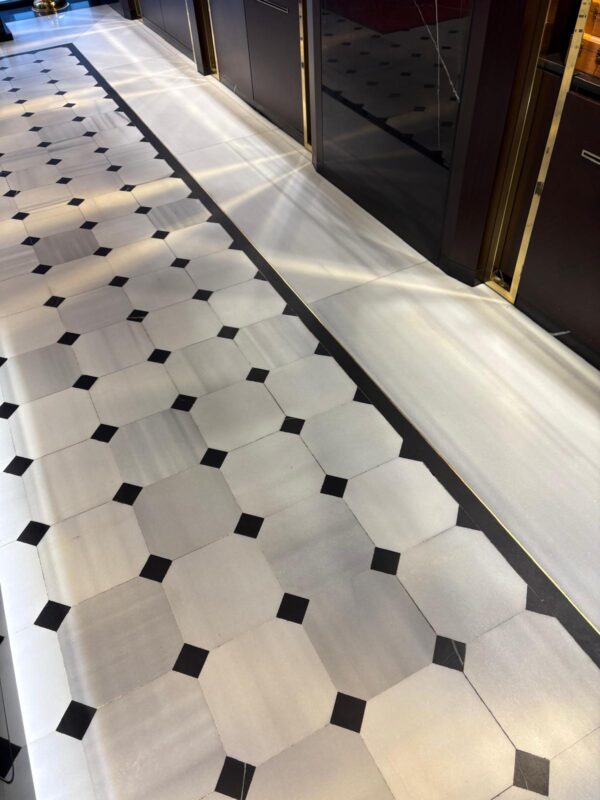
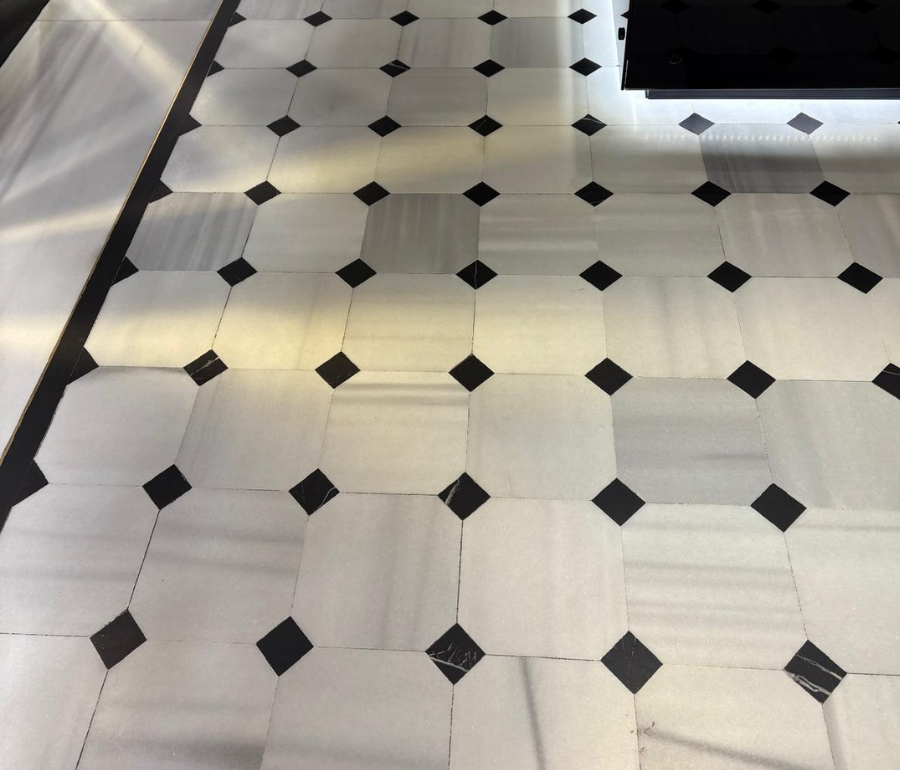
Marmara White Marble Checkerboard Flooring with Nero Marquina Marble
Marmara White Marble: A Refined Expression of Turkish White Stone
Marmara White Marble represents the quieter side of the Marmara family. Compared with strongly striped selections, it has a predominantly light white surface and more restrained veining. This makes it especially suitable for interiors where designers want the authenticity of natural marble without introducing excessive visual movement.
In flooring, Marmara White can work as a continuous surface or as part of a geometric composition. Combining it with a contrasting stone such as Nero Marquina creates a clear black-and-white architectural rhythm while allowing the natural variations of the marble to remain visible.
The stone is also highly adaptable to bathrooms, kitchens, wall applications and large-format flooring. Its light surface reflects natural and artificial light effectively, which can help create a brighter visual environment in both residential and commercial interiors. (efesusstone.com)
From Marmara Island to Global Architecture: Efesus Stone’s Marmara Quarry
The story of Marmara Marble begins on Marmara Island, located in the Sea of Marmara and connected administratively to Balıkesir, Turkey. The island has an exceptionally long history of marble extraction and has supplied stone for architecture across different historical periods. Efesus Stone notes the presence of Marmara Marble in structures associated with Roman, Byzantine and Ottoman architecture, among other historic applications. (efesusstone.com)
Efesus Stone sources multiple marble selections from its Marmara White Marble quarry, allowing architects, designers and natural-stone buyers to work with different visual characteristics from the Marmara family. Quarry selections listed by Efesus Stone include Sperenza, Epica Dark, Epica Light and Insula Alba, while the company’s quarry materials also present Panda White among its Marmara quarry stones. (efesusstone.com)
This quarry connection is particularly important for international architectural projects. Natural marble varies from block to block, so understanding the quarry origin, selection and vein structure is essential when specifying stone for large surfaces, bookmatching, stairs or custom fabrication.
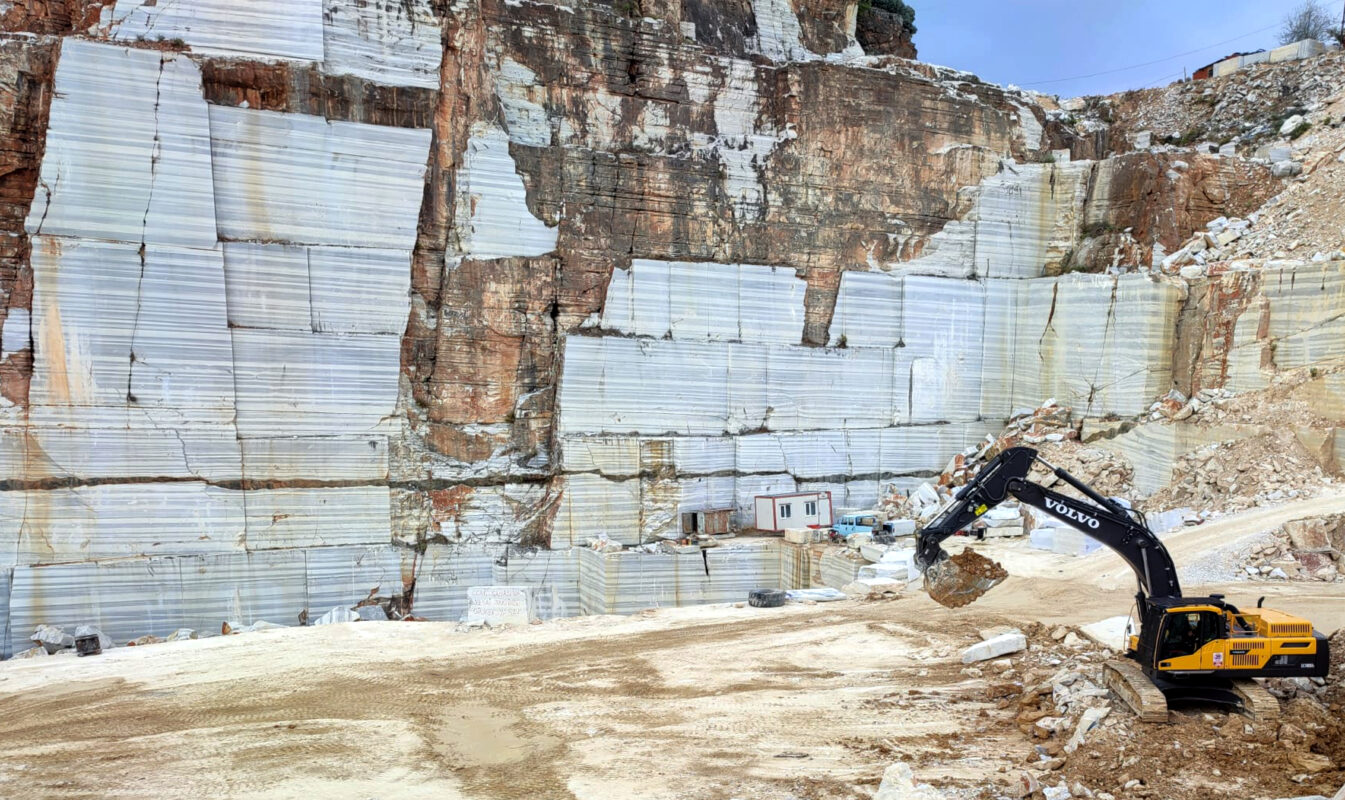
Efesus Stone Marmara White Marble Quarry in Marmara Island, Turkey
Marmara Sperenza: Turning Linear Veins into Architectural Geometry
One of the most expressive ways to use Marmara Marble is to make its natural lines part of the architecture itself.
Marmara Sperenza Marble is particularly effective when vein direction is carefully planned. In bookmatched wall applications, individual pieces can be positioned so that the grey movement converges into symmetrical geometric compositions. Rather than treating the stone merely as cladding, this approach transforms the natural pattern into a major design element.
The effect becomes especially powerful in Turkish hammams and spa environments. Marmara Marble has a longstanding association with hammam architecture, and its pale surface works naturally with the bright, continuous stone environments typical of these spaces. Efesus Stone specifically lists Turkish baths, bathrooms and monumental buildings among the applications for marble extracted from its Marmara quarry. (efesusstone.com)
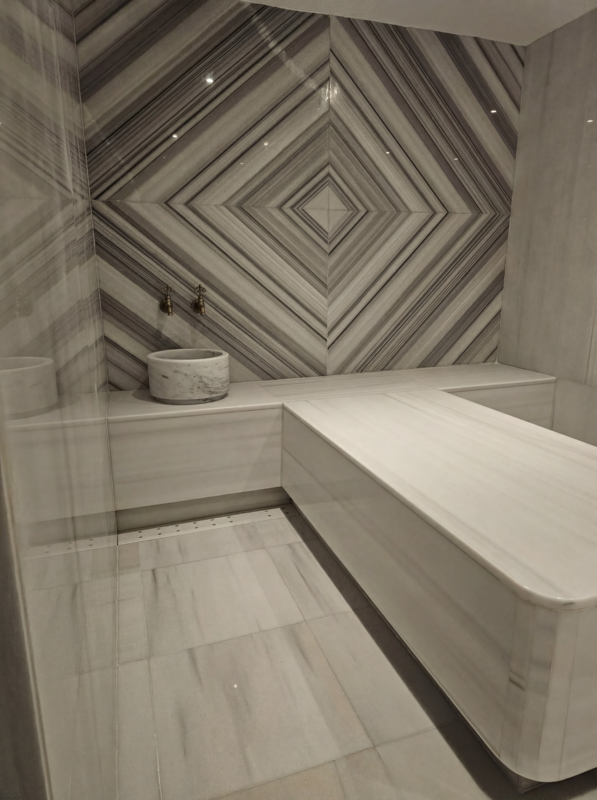
Marmara Sperenza Marble Bookmatch Wall and Marmara White Marble Turkish Hammam
Marmara Marble and CNC Design: From Natural Surface to Architectural Detail
Marmara Marble does not have to be limited to slabs and conventional tiles. CNC machining can give the material an entirely different architectural language.
Linear grooves, geometric reliefs, circles, diagonal cuts and other three-dimensional textures can be created across individual marble pieces and assembled into a larger decorative wall composition. Using multiple Marmara selections within the same surface further highlights differences in white, silver, grey and darker veining.
This approach is particularly relevant to hotels, spas, reception areas, luxury residences and commercial interiors where architects want natural stone to function as a bespoke design feature rather than simply a background material.
The contrast between precision machining and naturally changing veins is what makes such applications distinctive: the geometry is controlled, while every piece of marble remains naturally unique.
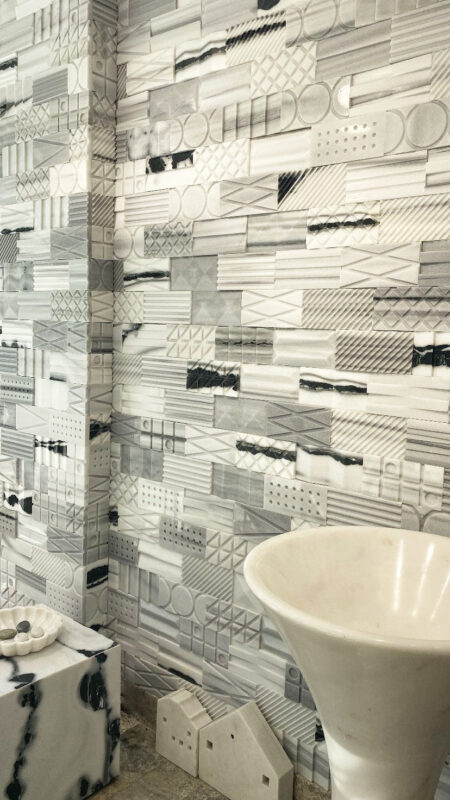
Marmara Marble CNC Carved Feature Wall with Mixed Marmara Stone Selections
Marmara Sperenza Marble in Contemporary Bathrooms
Bathrooms remain one of the strongest applications for the Marmara family, but contemporary designs no longer need to imitate traditional hammams.
With Marmara Sperenza, directional grey veins can become a graphic architectural tool. When slabs or cut-to-size pieces are positioned according to the vein direction, walls can form continuous horizontal or geometric compositions. The stone can therefore visually connect floors, walls, vanity surrounds and other bathroom surfaces.
Wood, brushed metal, glass and darker architectural elements can also provide contrast against Marmara’s predominantly white and grey palette. This makes the material relevant not only to classical interiors but also to modern residential bathrooms, hotels and wellness projects.
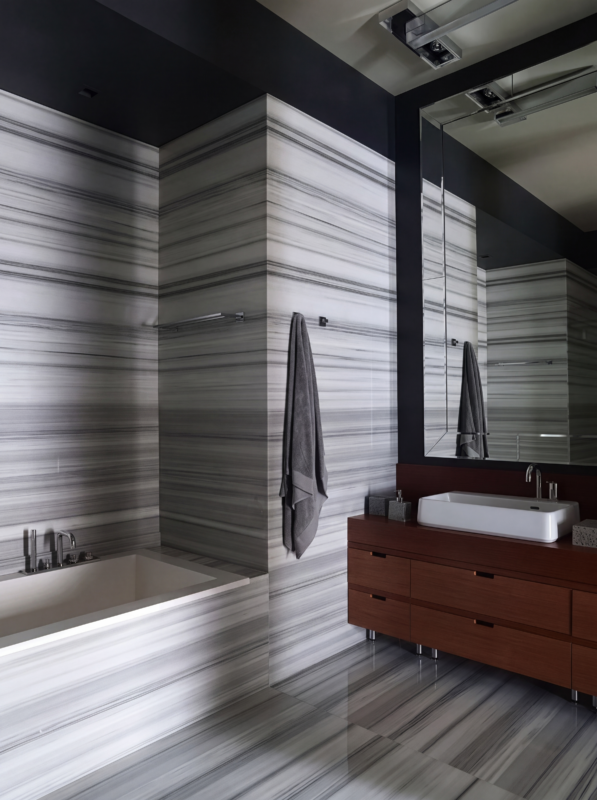
Marmara Sperenza Marble Bathroom with Linear Grey Veining
Marmara Epica Light Marble for Floors and Staircases
Marmara Epica Light Marble offers another interpretation of the Marmara aesthetic. Its lighter grey-white movement makes it particularly suitable for large architectural surfaces where continuity matters.
Flooring and staircases are a strong example. Using the same marble across horizontal flooring, stair treads and risers creates a coherent material transition between different levels of an interior. Rather than introducing another material at the staircase, the natural stone becomes a continuous architectural surface.
This is especially useful in entrances, hotel interiors, villas, corridors and other circulation areas where flooring forms an important part of the overall visual identity.
The Marmara quarry family is suitable for both interior and exterior architectural applications, including flooring, stairs and risers, wall cladding and other cut-to-size elements. (efesusstone.com)
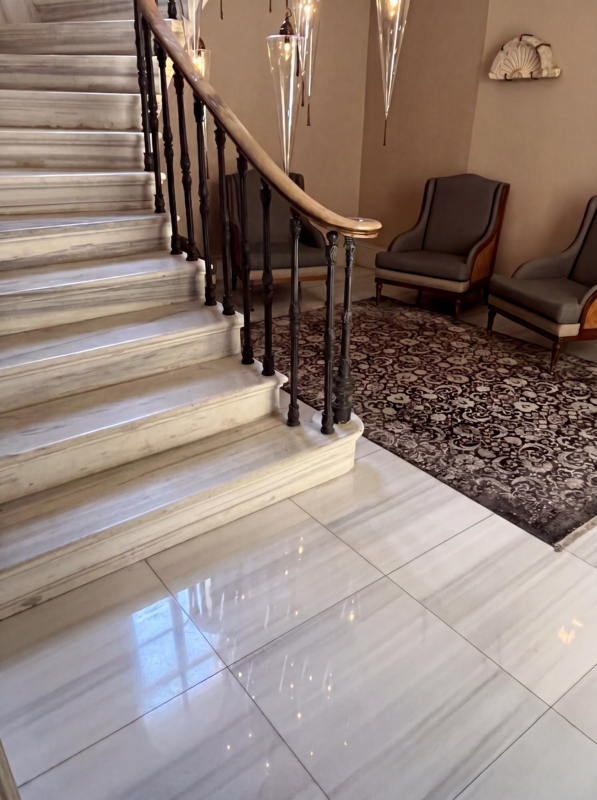
Marmara Epica Light Marble Flooring and Staircase
Panda White Marble: The Boldest Member of the Marmara Family
At the dramatic end of the Marmara spectrum is Panda White Marble.
Quarried from Marmara Island, Panda White is characterized by a white background intersected by bold black veins. While classic Marmara selections are often recognized for regular grey stripes, Panda White creates a much stronger visual contrast. (efesusstone.com)
This makes Panda White particularly effective when the stone needs to become the focal point of a room. Large dining tables, kitchen islands, feature walls, countertops and bookmatched surfaces allow its black veins to remain visible across a broad area.
A large Panda White dining table demonstrates this particularly well. Instead of treating marble as a secondary finish, the tabletop becomes an individual natural composition. Each variation in the black veining changes the appearance of the finished piece, meaning no two large-format applications are completely identical.
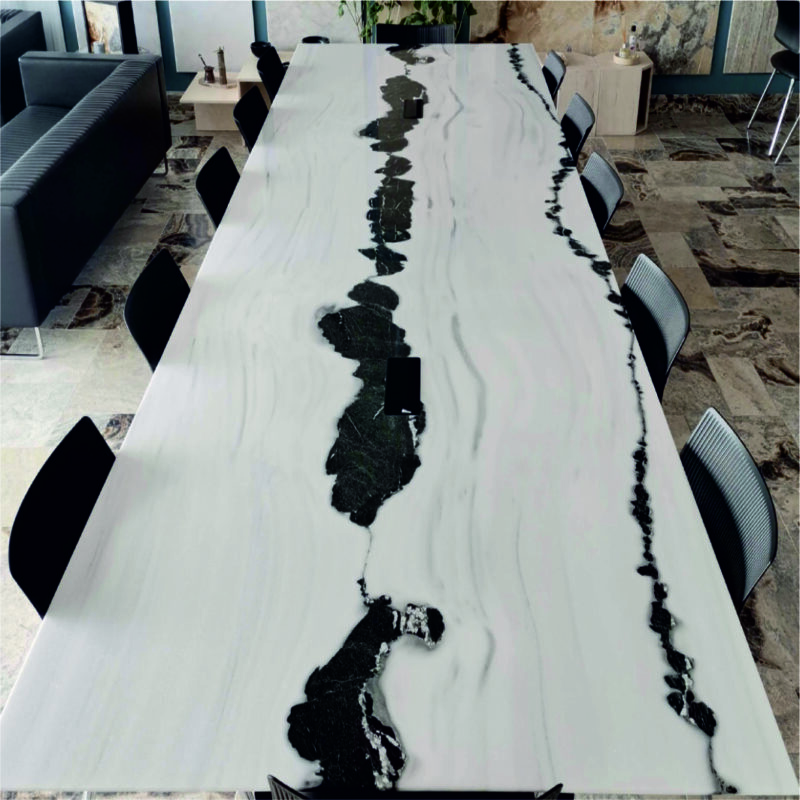
Panda White Marble Dining Table with Natural Black Veining
Why Marmara Marble Remains One of Turkey’s Most Important White Marbles
Marmara Marble occupies an unusual position in the natural-stone industry because it connects historic architectural use with contemporary design possibilities.
Its classic striped appearance is immediately recognizable, yet the broader Marmara family offers much more than a single pattern. Clean Marmara White can support restrained interiors; Sperenza can create directional and bookmatched compositions; Epica Light can provide continuity across floors and stairs; and Panda White can become a dramatic focal surface.
This versatility allows designers to specify Marmara stone for very different architectural languages while maintaining a connection to the same Turkish marble tradition.
For international architects, designers, contractors and natural-stone buyers, quarry origin also matters. Efesus Stone’s Marmara quarry provides access to several selections that can be processed according to project requirements for floors, walls, bathrooms, Turkish hammams, stairs, tables and custom architectural elements. (efesusstone.com)
Marmara Marble therefore should not be viewed simply as another white marble. Its identifiable veining, selection diversity, long architectural history and connection to Marmara Island give it a position of its own among premium Turkish white marbles.
Frequently Asked Questions About Turkish Marmara Marble
Where does Marmara Marble come from?
Authentic Marmara Marble originates from Marmara Island in Turkey’s Sea of Marmara. The island has a centuries-old marble quarrying tradition. (efesusstone.com)
What does Marmara Marble look like?
Classic Marmara Marble typically has a white background with parallel grey veins. However, different quarry selections can range from relatively homogeneous white surfaces to silver-grey linear patterns and strongly contrasting black-and-white varieties.
Is Marmara Marble the same as Marmara Equator Marble?
Marmara Equator is one of the best-known names associated with the strongly striped appearance of Marmara stone. It is recognized for straight, parallel veins that create a highly structured pattern. (efesusstone.com)
Is Panda White Marble from Marmara Island?
Yes. Efesus Stone identifies Panda White as a marble quarried from historic Marmara Island, characterized by a white background and prominent black veins. (efesusstone.com)
Where can Marmara Marble be used?
Depending on the selection, finish and project requirements, it can be used for flooring, wall cladding, bathrooms, Turkish hammams, staircases, countertops, tables, decorative surfaces and exterior architectural applications. (efesusstone.com)
What finishes are available for Marmara Marble?
Common options include polished, honed and sandblasted finishes. The appropriate finish should be selected according to the application and required surface performance. (efesusstone.com)