
Bedrooms are among the most personal and rest-focused spaces in the home. Every element selected for this environment should support both visual harmony and everyday comfort. While the bed, headboard, lighting, and textiles usually define the main atmosphere, the nightstand also plays an important role in shaping the room’s overall character. Positioned directly beside the bed, this relatively compact piece of furniture can significantly influence the balance of materials, colors, and proportions within the interior.
Alongside traditional wood, lacquered, and upholstered nightstands, natural stone furniture has become increasingly visible in contemporary bedroom design. Marble and travertine, in particular, bring distinctive mineral patterns, tactile surfaces, and architectural weight into the room. Because every slab has its own veining, pores, tonal transitions, and natural markings, each finished nightstand develops an individual appearance.
Marble and travertine nightstand designs are more than decorative additions. The physical presence of natural stone, combined with its layered texture and visual depth, transforms a functional bedside surface into a strong interior feature. Some designs use simple cube forms to emphasize the stone pattern, while others incorporate rounded edges, arched backs, crossed stone bases, or metal legs to create a lighter and more furniture-oriented expression.
One of the main reasons natural stone nightstands work well in modern bedrooms is their ability to adapt to different interior styles. The dramatic gray veining of Calacatta marble can create a bold contrast in bright and minimal rooms. Light Travertine, with its warm beige tones and softly layered texture, introduces a calmer and more organic atmosphere.
The effect of natural stone is not limited to color. Vein movement, surface texture, and the way light interacts with the material all influence how the furniture is perceived throughout the day. Morning light may emphasize the crisp gray patterns of Calacatta marble, while warm evening lighting can deepen the creamy beige tones of Light Travertine.
Functionality remains equally important. A nightstand must provide an accessible surface for a lamp, books, a glass of water, a phone, or small personal items. When designing a natural stone nightstand, the height in relation to the mattress, the width of the top, the edge profile, the overall weight, and the available clearance beside the bed should all be evaluated together.
This article examines four different natural stone nightstand designs in the order shown in the images. The first section focuses on a cube-shaped Calacatta marble nightstand. The second explores an arched Light Travertine nightstand with softened architectural details. The third reviews a round Calacatta marble nightstand with a crossed stone base. The final section presents a Light Travertine nightstand supported by dark metal legs.
Each design demonstrates a different way to interpret natural stone as bedroom furniture. The cube form strengthens the solid block-like character of marble. The arched travertine design creates a softer and more decorative expression. The round Calacatta nightstand displays dramatic veining across a lighter silhouette, while the metal-leg travertine design introduces a clear contrast between natural stone and a contemporary supporting structure.
Cube-Shaped Natural Stone Nightstand Crafted from Calacatta Marble
A Sculptural Bedroom Statement with a Calacatta Marble Cube Nightstand
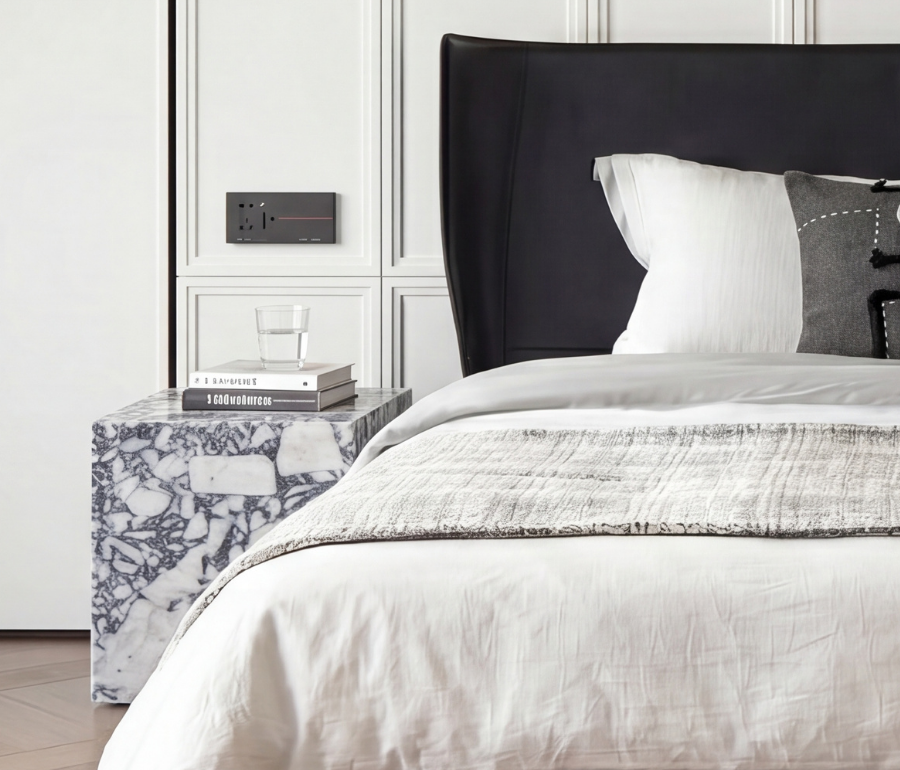
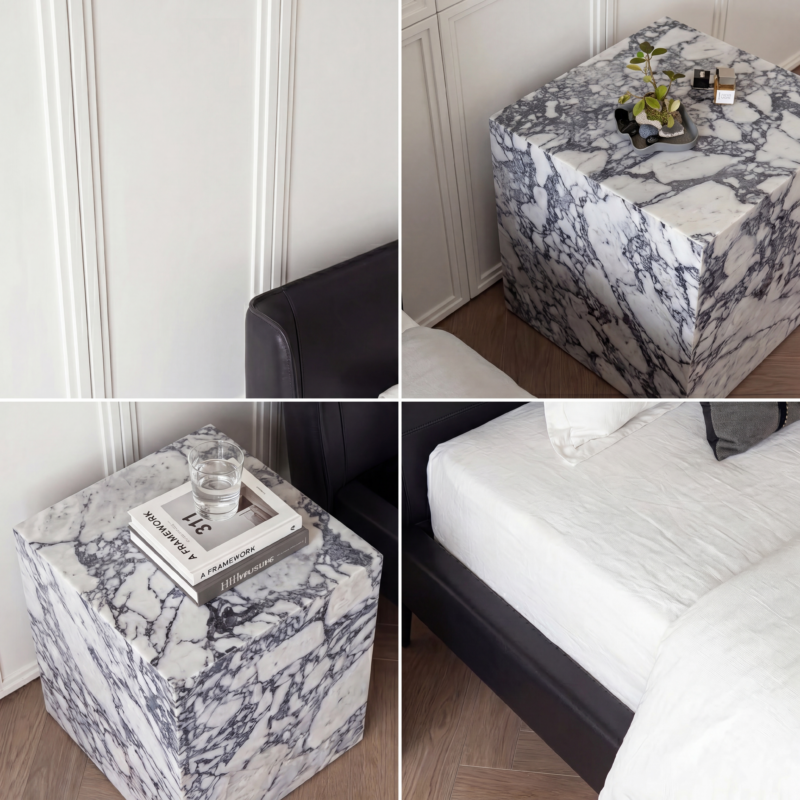
Calacatta marble is recognized for its bright white background and expressive gray veining. When used in natural stone furniture, this contrast creates a strong visual identity. The cube-shaped nightstand shown in the first image presents the stone through a simple geometric volume, allowing the marble pattern to become the primary decorative element.
The absence of visible legs, drawers, or contrasting materials gives the piece the appearance of a solid marble block. Rather than reading as a conventional bedside cabinet, it resembles a small architectural object or sculptural pedestal placed beside the bed.
The cube is one of the most fundamental geometric forms used in architecture and furniture design. Its balanced proportions and straight surfaces create a sense of order. When this controlled shape is combined with the irregular movement of Calacatta marble, the result feels both structured and dynamic. The simple form provides a calm framework for the complex natural pattern.
Because the marble veins move unpredictably across the material, every visible face of the cube presents a different composition. The top may contain broader white areas, while the side panels may display denser clusters of gray and charcoal veining. This variation allows the nightstand to reveal different details depending on the viewing angle.
Slab selection and vein orientation are especially important in a cube-shaped natural stone design. Since the top and multiple side faces remain visible, the relationship between adjoining surfaces should be planned carefully. When the pattern is aligned across edges, the marble appears to continue from the top onto the sides, reinforcing the impression of one continuous stone volume.
This type of vein continuity requires thoughtful cutting and skilled fabrication. The goal is not necessarily to create perfectly identical patterns on every face, which would be impossible with natural stone, but to establish a visual relationship between the panels. A well-planned layout helps the finished nightstand feel cohesive rather than assembled from unrelated pieces.
In the bedroom shown, the cube nightstand is surrounded by a neutral palette of white walls, white bedding, warm wood flooring, and a dark upholstered bed frame. The Calacatta marble connects naturally with both the light and dark elements in the room. Its white background relates to the walls and bedding, while the charcoal veining reflects the darker furniture details.
This material relationship prevents the nightstand from appearing isolated. Instead, it acts as a bridge between the bright and dark tones already present in the room. The marble introduces pattern without requiring additional printed fabrics, wallpapers, or decorative surfaces.
The generous top surface provides space for books, a glass of water, fragrance bottles, a small plant, or a bedside lamp. However, because Calacatta marble already has a highly expressive pattern, the styling should remain relatively restrained. Too many decorative items can hide the veining and reduce the visual impact of the stone.
A small arrangement of books, one glass object, or a compact plant is often enough to make the surface feel functional while preserving the natural pattern. Transparent glass and neutral accessories are particularly effective because they do not compete with the marble.
The Impact of Cube Forms in Modern Bedroom Design
Cube-shaped natural stone nightstands work especially well in interiors defined by clean lines, architectural wall panels, and minimal furniture. Their geometry reinforces the order of the room and can complement rectangular beds, paneled walls, linear flooring, and modern lighting.
In a minimal bedroom, a single cube nightstand can serve as the primary decorative feature. When surrounding patterns are reduced, the Calacatta veining becomes more visible and meaningful. The design does not need additional ornament because the natural stone already provides enough movement and detail.
The cube form also gives the nightstand visual weight. Unlike thin-legged furniture, a solid-base design sits firmly on the floor and creates a stable, grounded presence. This makes it particularly suitable beside large beds, where a lighter or narrower nightstand might appear undersized.
The relationship between the mattress height and the nightstand height is essential for comfortable use. Ideally, the top surface should align with or sit close to the upper level of the mattress. This makes it easier to reach a phone, book, lamp switch, or glass of water while lying in bed.
Since natural stone furniture can be customized, the dimensions of the cube can be adjusted according to the bed height and available space. A compact version may be appropriate for a smaller room, while a larger cube can create stronger balance beside a king-size bed.
In spacious bedrooms, matching cube nightstands can be placed on both sides of the bed to create symmetry. Their solid volumes frame the bed and contribute to a more architectural composition. In smaller bedrooms, one cube nightstand can be used as a statement piece while the opposite side remains visually lighter.
Because the piece sits directly on the floor, its scale should be considered carefully. An oversized cube can make a compact room feel crowded. Sufficient clearance should remain between the nightstand, bed, wall, and circulation path.
Styling and Lighting a Calacatta Marble Nightstand
The lamp selected for a Calacatta marble nightstand should complement the simple geometry of the cube. A slim metal lamp can visually lighten the solid stone base, while a rounded or sculptural fixture can introduce a softer contrast.
Black lighting fixtures emphasize the darker gray veining in the marble and connect naturally with dark bed frames or hardware. Brass or bronze fixtures add warmth and can balance the cooler white and gray tones. Chrome and brushed nickel create a cleaner, more contemporary relationship.
Glass or white ceramic lamps can support a brighter and more restrained bedroom palette. However, the lamp base should not cover too much of the marble surface. The proportions of the fixture should remain appropriate for the size of the nightstand.
Books introduce a personal and lived-in quality to the room. A small stack of two or three books can create height without overwhelming the surface. A compact decorative object placed on top can complete the arrangement while leaving enough of the marble visible.
Transparent glass accessories work particularly well because they preserve the visibility of the veining. Small metal objects can create stronger contrast, while muted ceramic pieces add texture without competing with the stone.
When color is introduced through flowers, art books, or decorative accessories, it should relate to the wider bedroom palette. Soft greens, muted burgundy, warm beige, dusty pink, and charcoal tones can all complement Calacatta marble when used in moderation.
Arched Natural Stone Nightstand Crafted from Light Travertine
The Softening Effect of the Arched Form
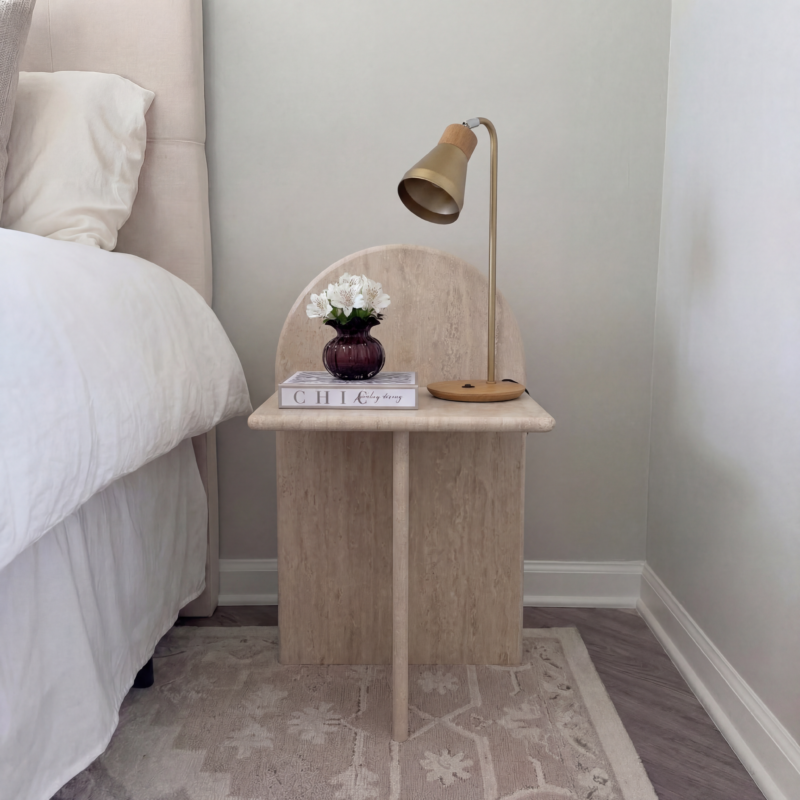
The arch is a strong architectural element that has been used for centuries in doorways, wall niches, windows, mirrors, and furniture. In contemporary interiors, curved forms help soften spaces dominated by straight walls, rectangular beds, linear flooring, and flat cabinetry. The arched back panel of the Light Travertine nightstand serves the same purpose.
Although the main body of the piece is defined by clean and simple planes, the curved upper section prevents it from looking like a basic stone block. The rounded outline relates naturally to upholstered headboards, softly draped bedding, and other tactile elements within the bedroom.
The arched panel should not be viewed only as decoration. It also creates a visual background for the objects placed on the top surface. A table lamp, ceramic vessel, book, or small sculpture becomes more clearly framed when positioned in front of the raised stone element.
This feature adds vertical presence without increasing the footprint of the nightstand. It creates a subtle transition between the horizontal furniture surface and the wall behind it, helping the bedside composition appear more complete.
Arched designs are especially effective in bedrooms with restrained color palettes. When the room includes only a limited number of patterns and materials, the silhouette of the furniture becomes easier to appreciate. The Light Travertine texture and curved form can provide enough visual interest without the need for additional decorative layers.
The arch also creates a connection between historical architecture and contemporary furniture design. Although curved openings are associated with classical buildings, their use in a minimal natural stone piece gives them a cleaner and more current interpretation.
Functional Use of a Light Travertine Nightstand
Although a nightstand is relatively small, it supports many parts of the daily routine. Books, phones, glasses, water, lighting, and personal items are usually placed within easy reach beside the bed. For this reason, the dimensions of the furniture must be evaluated as carefully as its appearance.
The top should provide enough room for the items that will actually be used. An excessively narrow surface may look elegant but become impractical. On the other hand, an oversized nightstand can restrict movement around the bed.
The height should remain close to the top level of the mattress. A surface positioned too low may be difficult to reach, while a piece that is too tall can feel visually unbalanced beside the bed.
The arched back panel creates a more defined area for arranging a lamp and accessories. It also prevents small objects from appearing visually disconnected from the wall.
When two matching nightstands are placed on either side of the bed, they create symmetry and strengthen the central position of the bed. A single stone nightstand can also be used on one side for a more relaxed and individual composition.
The design may be customized according to the room size, bed height, and intended use. Wider versions can accommodate larger lamps and reading materials, while compact versions are better suited to guest rooms or bedrooms with limited clearance.
The Natural Variation of Light Travertine
Light Travertine is a natural material, so every slab includes a different distribution of pores, bands, mineral markings, and tonal variations. Even two nightstands produced from the same quarry selection will not appear completely identical.
Some pieces display a relatively uniform beige tone, while others contain stronger cream, brown, or gray transitions. The appropriate slab should be selected according to the desired design direction.
For a quiet and minimal bedroom, a more consistent section of stone may be preferred. For a more expressive piece, slabs with visible layering and stronger mineral movement can create greater character.
The cutting direction also changes the appearance. Vein-cut travertine reveals more linear banding, while cross-cut material produces cloud-like, circular, and irregular patterns.
In a furniture design combining horizontal and vertical planes, the orientation of these patterns can be used intentionally. Horizontal movement across the top may contrast with vertical lines on the arched panel, creating depth without changing the color palette.
A Light Travertine nightstand offers a calm but distinctive presence through its warm tone, natural texture, softened edges, and architectural form. When paired with pale textiles, timber flooring, and warm metal details, it contributes to a balanced bedroom interior built around tactile natural materials.
Round Natural Stone Nightstand with a Crossed Calacatta Marble Base
A Fluid and Balanced Interior with a Round Calacatta Marble Nightstand
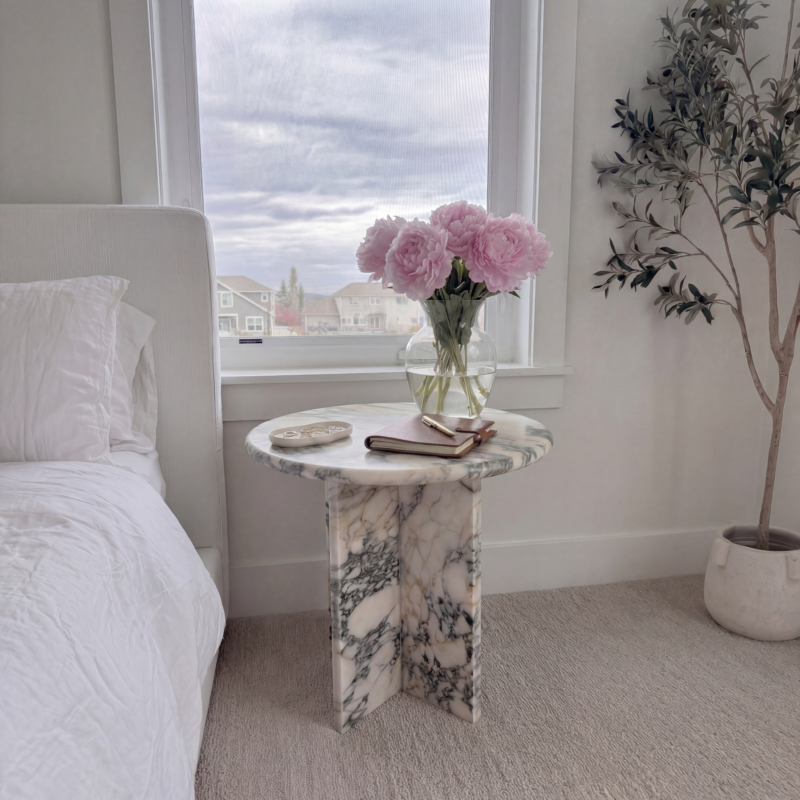
In the first design, Calacatta marble was presented through a solid cube form. In the third image, the same stone takes on a lighter and more furniture-oriented character. The round top and crossed stone base soften the visual weight of marble and create a more open composition beside the bed.
Circular forms are useful in rooms dominated by rectangular architecture. The bed, windows, walls, rugs, and floorboards are usually defined by straight lines. A round nightstand introduces a contrasting geometry that makes the room feel less rigid.
The absence of sharp corners also creates a more fluid appearance. In compact bedrooms, this can help the furniture feel easier to move around, particularly when it is positioned close to a circulation path or window.
Calacatta marble displays gray, charcoal, and occasionally warmer beige mineral movement across its white background. On a circular top, these veins are framed differently than they would be on a rectangular slab. The pattern can be viewed from multiple directions, giving the surface a more dynamic character.
The selected section of the slab is especially important because the circular cut creates a natural frame around the pattern. A quieter central area can produce a calmer result, while a strong diagonal vein crossing the top can turn the nightstand into a more dramatic focal piece.
In the image, the nightstand is placed in a bright bedroom with white textiles, pale walls, and natural light. The marble’s white background connects with the surrounding palette, while its gray and brown markings introduce depth.
The transparent vase preserves the visibility of the surface. Soft pink flowers add controlled color without competing with the natural pattern. This restrained styling allows the stone to remain the primary visual element.
Using a Round Marble Nightstand in Smaller Bedrooms
In a compact bedroom, the visual volume of a nightstand may be as important as its actual dimensions. A fully enclosed piece occupies more visual space, while an open base allows the floor to remain visible.
The round shape can also reduce the sense of obstruction near the edge of the bed. However, sufficient clearance must still be maintained between the furniture, wall, bed frame, and circulation path.
The diameter should be determined by the intended use. When a wall sconce replaces a table lamp, the top can remain smaller. When a lamp, books, and personal items are required, a wider surface is more practical.
Matching round nightstands on both sides of the bed create symmetry. In an asymmetrical layout, one marble nightstand may be paired with a slimmer piece on the opposite side to accommodate limited space.
The open base can make cleaning beneath the furniture easier compared with a floor-standing block design. However, the piece should always be lifted and supported properly rather than dragged, as this may damage both the stone and the flooring.
Design Flexibility of the Round Calacatta Marble Nightstand
A round Calacatta marble nightstand is not restricted to bright white bedrooms. Against deep green, navy, burgundy, charcoal, or black walls, the marble creates a stronger contrast and becomes more visually prominent.
Timber headboards and textured fabrics can soften the cooler character of the white and gray stone. Light oak produces a relaxed atmosphere, while walnut and dark wood add greater depth.
Brass, bronze, black, or brushed metal lighting can be used to adjust the final style. Black creates a graphic contemporary effect, while warm metals produce a softer and more decorative relationship.
The same piece can be used in boutique hotel rooms, guest rooms, dressing areas, reading corners, or beside a lounge chair. Its combination of decorative stone and open structure allows it to move easily between different functions.
Every version remains unique because the marble pattern changes from slab to slab. The round top, crossed base, and natural vein movement together create a furniture piece that feels individual rather than standardized.
Round Light Travertine Nightstand with Dark Metal Legs
Material Contrast in a Light Travertine Nightstand with Metal Legs
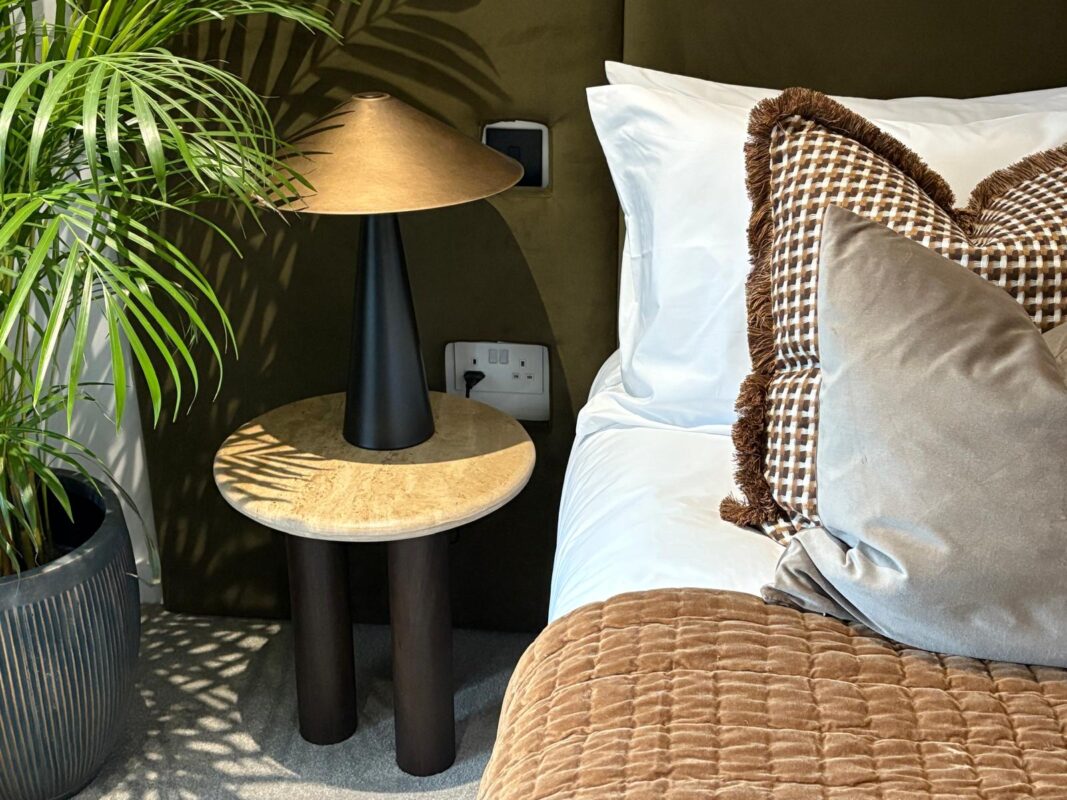
The fourth nightstand combines the warm, organic character of Light Travertine with a dark and slender supporting structure. Unlike the earlier pieces, where natural stone forms both the top and body, this design limits the stone to the tabletop.
This approach gives the furniture a lighter and more contemporary profile. The round travertine top displays the beige color, small pores, and natural mineral transitions, while the dark legs introduce a clear contrast in both color and texture.
Mixed-material furniture is especially useful in interiors where natural stone is desired without the visual mass of a fully stone-built piece. The open lower section occupies less visual space and allows more of the flooring to remain visible.
In the bedroom shown, the nightstand is placed against a deep green wall and surrounded by white bedding, brown textiles, and abundant planting. The Light Travertine top becomes a bright balancing element within this darker and warmer palette.
Its beige tone relates naturally to the brown cushions and organic materials, while the dark legs connect with the wall, lighting fixture, and other black details. The furniture therefore stands out without feeling disconnected from the wider composition.
The combination of green, beige, brown, and black creates an interior influenced by nature. Travertine and greenery support the organic atmosphere, while the metal structure introduces a cleaner contemporary line.
Light Travertine Against Dark Bedroom Walls
Light Travertine is often associated with cream, beige, and white interiors, but it can be equally effective against dark green, charcoal, brown, or black walls.
The contrast makes the stone’s warm tone more visible. In the image, the deep green wall intensifies the beige tabletop while the brown bedding creates a tonal bridge between the light and dark surfaces.
The combination of travertine and green is especially appropriate for biophilic interiors. Timber, plants, linen, wool, and natural stone can be layered to create a warm and tactile environment.
Using several levels of tone prevents the room from appearing flat. The travertine provides the lightest element, brown fabrics occupy the middle range, and the green wall and black legs establish depth.
This demonstrates that Light Travertine is not limited to pale or minimalist bedrooms. When placed against stronger colors, its mineral texture can become even more noticeable.
What to Consider When Choosing Marble and Travertine Nightstands
Selecting a natural stone nightstand involves more than deciding between marble and travertine. The height of the bed, room dimensions, circulation space, furniture weight, surface finish, and intended daily use should all be considered.
A Calacatta marble cube nightstand creates a strong and sculptural presence. Round designs feel visually lighter, while metal-leg travertine nightstands create a more open and contemporary profile.
The width or diameter should not restrict movement beside the bed. In a larger room, matching nightstands can create symmetry. In a compact room, one smaller natural stone piece may provide enough visual impact.
The slab should be reviewed before production. Calacatta marble varies in vein density and direction, while Light Travertine changes in pore structure, banding, and beige tone.
Surface finish also influences the final result. Honed finishes create a softer and more natural appearance, while polished finishes increase reflection and contrast.
Accessories and lighting should remain proportionate to the available surface. Over-styling can hide the stone pattern and reduce the visual value of the material.
Natural variation should be expected and appreciated. Each piece will contain unique mineral details, making every finished nightstand different.